Leaps in the Dark: Women in Chennai are learning to be fearless in the night
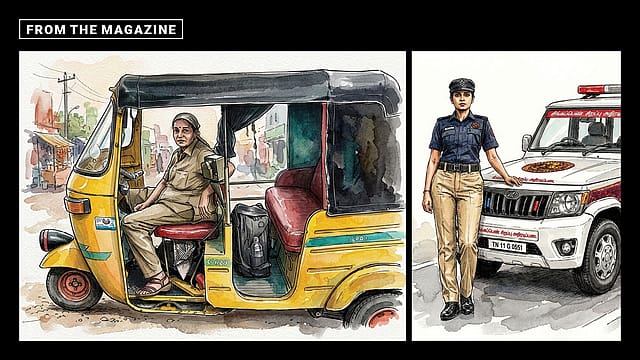
WHEN PV RAJI ASHOK FIRST MOVED TO Chennai from Palakkad, Kerala, in 1999, she was 27 years old and wanted to be an accountant, having studied finance all through her higher education. But jobs were scarce in the field and she didn’t want to idle at home, given that she was newly married and that the couple’s cost-of-living had grown exponentially in a big city. So, much to the amusement of some and ridicule from others, Raji chose to become an autorickshaw driver, or autokaari, in Tamil – a profession that was simply not sought after by women in Tamil Nadu, largely due to safety issues.
But she persisted. As the only woman driver behind the handle of a three-wheeler in Kolathur, if not all of Chennai, Raji had to endure all sorts of abuse in the early days. She was teased, eve-teased, not paid her fare, verbally harassed and even mugged once (the assailant being a woman, no less) by her customers, all these acts committed during broad daylight, because back then she wouldn’t drive at night. “Some real villains, like they show in Tamil movies, would get into my auto, almost like they were targeting me. And in the early days, there were no CCTVs either,” says Raji. “Life as a woman in a man’s profession is hard in any field, but more so when you are driving with your back to strangers. But I didn’t have a choice, I had to go on.”
She most certainly went on, to the point of “choosing” to drive at night – where the risk to her personal safety rose by several degrees. “Not only that, I would also drive at night into certain areas and localities that drivers, be it women or men, are scared to go into even today,” she says with a hint of pride in her voice. “Was there fear? Yes. But how long can one live in fear? I wasn’t ready to allow fear to dictate how I go about my life.”
WORD SPREAD OF her bravery on message boards and online forums. Then, about a decade later, her phone number began circulating on WhatsApp groups – largely around Perambur, where she had moved. “I started getting calls from other women, mainly. Like a girl who was working late in her office and needed to get home. Or a sister who had a medical emergency in the family and needed to get to the hospital. I started responding to those,” Raji says. “Then women started calling me to find out how they too can become autorickshaw drivers. That’s when I knew that I had a bigger purpose.”

First, she persisted, then she prevailed. Today Raji is 54, known fondly as Raji Akka – Elder Sister Raji – and heads a support group for women autorickshaw drivers in Chennai called Enayum Kaikal. There are more than 300 women drivers on this one group alone, a majority of whom she gave free three-wheeler driving lessons. “These days, there is a lot of talk about paathukaappu [safety] and equality. The only way to make these things happen is to go and get it,” she says. “No one will simply give you equality, you have to take it. That’s what I am most proud of, that’s what makes me free of constraints.”
This is what freedom, in its essence, means to not only Raji but women across a cross-section of society in Chennai: the reclaiming of space – such as a profession – and time, especially the night. Priya Vignesh, a 41-year-old housewife and mother of two, was always afraid of the night, specifically running – which she loves to do otherwise – after sunset or before sunrise. “I live in Besantnagar, one of the safer areas in Chennai, a locality that is very proud of its running/jogging culture. But, for a time, I simply wouldn’t dare to step out in the wee hours, worried, of course, for my safety as a woman,” Priya says.
Until her mid-thirties, Priya worked in a global consulting firm. Then she had kids, and raising them became her full-time occupation. “The children would keep me busy right through the day, so the only time to run was either before they woke up or after they went to sleep. Both were impossible,” she says. “I either would be scared to step out into the dark, or my husband would be, or both of us together would be. It was crazy. So, I joined a gym, right here in Besantnagar itself, and ran on the treadmill. It wasn’t the same.”
Right about the same time, as luck would have it, a jogging track was built along the main artery of Besantnagar, starting at the mouth of Adyar and carrying on all the way around the forested confines of Theosophical Society, the track itself dotted with pretty rest-stops with water coolers, and art installations of running figures with dogs on leashes. “Once the track was built, it really forced our hand,” she says. Women-only WhatsApp groups were immediately created, and Priya found solace in more than just safety in numbers: a growing community.
“Now I start my run, along with like-minded girls, at roughly 4AM, as my entire household sleeps, even returning home before the sun is up. I sometimes even head out without checking the group to see who is coming out for a run and who isn’t. That time is sacred for me, because it is time for myself and my health. It feels like freedom to not worry anymore,” says Priya, before adding, “Also, plenty of safety measures have been put in place for women by the new government. If anything untoward were to happen, I know I can always call 1091.”
1091 is a new toll-free helpline number in Tamil Nadu that activates access to the Singappen Special Force (SSF), a specialised, all-women police rapid-response unit, launched as recently as June 2026 by Chief Minister C Joseph Vijay. Backed by an initial allocation of `354 crore, the initiative focuses on preventing crimes against women (and children) in public hotspots. So popular has Singappen become that Instagram is already flooded with their Reels, mainly of women walking alone on a Chennai pavement at night, smiling as a taskforce car follows them at heel, towards either home or safety.
When I dial 1091 to speak to an officer from the unit, the operator promises me a response within the hour. I receive a call-back within 10 minutes, from a 25-year-old officer who withholds her name but speaks with enormous pride about her purpose. “Life in India, not only the big cities, is difficult for women. I faced my share of problems growing up, so I always knew that when I got a job, it would be in the police to help protect other women. Then Singappen was formed and I immediately enrolled to be a part of it,” the officer says. I ask her if she has had a chance to be on active duty and she says: “Almost every night since Singappen was formed. The roads are safer because of this unit.”
BHAGWANI S WILL AGREE. Bhagwani, 35, works as a delivery rider for a major Indian quick-commerce app. But here’s what makes her special: she is the only female rider in the company’s Perungudi office. The remaining 249 delivery riders are all men. So, when it is her turn to pick up goods from a dark store and drop it off in the dingy bylanes of Old Mahabalipuram Road or East Coast Road (the area serviced by the Perungudi office), she keeps the Singappen helpline number on speed-dial.
“I work well into the night, oftentimes as late as 1 and 2 in the morning. It gets very scary, especially when I have found the house, it is on an isolated street, and no one responds to my delivery call. How long can I keep waiting on the scooter, looking this way and that?” Bhagwani asks. “That’s when I keep the phone ready. Before Singappen was formed, I would keep 100 [the pan-Indian police helpline number] ready. But I trust women to understand the plight of another woman much more.”
Bhagwani says that she has worked this job for only eight months, largely out of necessity. “My husband has a lot of medical issues, and can’t hold down a job, so I alone have to put my children through school. They are still very small,” she says. “But even though I didn’t choose to become a delivery girl, I have taken to it. And I want to continue doing it for as long as I can. My only worry about getting into it was that of safety, but if paathukaappu is taken care of then why shouldn’t I be able to do what men can so easily do, which is work at night without any difficulties?”
There are strong echoes here to Raji’s reasons for continuing to be an autokaari well into her 50s; now that her grown-up son has begun earning a salary as an IT professional. “My son keeps asking me to retire. He says, ‘Amma, why do you still drive around in an autorickshaw when I am capable of looking after all of us now?’” she says. “I tell him to never forget that with the money I earned from autorickshaw fares, I have built us a big house for `50 lakh in Palakkad. But more than money and fame, it is by being an autokaari that I have inspired some women, and made others feel safe at night. Why will I want to retire?”