Kitchen to Kalashnikov: Islamist Terrorist Organisations in Pakistan are Now Recruiting Women
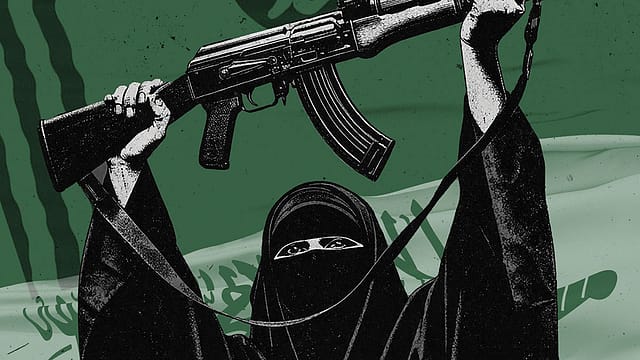
THE VIDEO, AT first glance, appears entirely unremarkable. It is the sort of material intelligence operatives and journalists covering militancy, especially those tracking Telegram channels run by Islamist terrorist organisations, encounter routinely. It shows a group of women draped head to toe at what appears to be an event in Pakistan, while devotional Islamic music—a familiar staple of such propaganda videos—plays in the background. Yet, as the footage progresses, the camera lingers on a woman wearing two rings on her fingers, and the seemingly ordinary clip begins to reveal a more unsettling significance. Intelligence agencies in India have identified the woman as the wife of Haris Dar, a commander of the Pakistan-based terrorist organisation Lashkar-e-Taiba. There is strong evidence to suggest that wives of senior commanders of terrorist organisations like Lashkar and Jaish (Jaish-e-Mohammed) are now being drawn into operational roles. The idea, reveals a senior police officer in Kashmir, is to create a women force that can be used for fidayeen attacks (a type of operation where heavily armed attackers intentionally raid a heavily fortified target such as a police station with the primary objective of fighting to the death while inflicting maximum casualties) and also to facilitate logistics, safe houses, communication and recruitment support not only in Kashmir but in the rest of India as well.
In the last few months, both Jaish and Lashkar have organised several events across Pakistan to recruit women for such tasks. These events, according to an intelligence source, are mostly led by family members, particularly wives, of senior terrorist commanders. The new strategy, it is believed, has come in response to the hollowing out of the terrorist ecosystem in Kashmir, a result of increased intrusive surveillance. Women, says the senior police officer in Kashmir, remain comparatively invisible to the security gaze, especially when moving under social roles like that of a teacher or a doctor.
The invisibility has long been recognised by militant organisations—from Sri Lanka’s LTTE to carefully cultivated female units of Boko Haram. But Kashmir, shaped by its social conservatism, has resisted that shift. Insurgency in Kashmir has mostly remained male, shaped by a visual grammar of young men beginning as stone-pelters, graduating to overground networks linked to militant organisations, and then, one day, disappearing, only for photographs of them holding assault rifles to surface later on social media, announcing their arrival as militants. Women, by contrast, remained close to the architecture of violence, but at its edges, as sympathisers or sometimes couriers. In whispered stories traded often in Kashmir, the figure of the jilted lover recurs with striking frequency—a woman whose grievance or heartbreak is said to have occasionally helped security agencies track, arrest, or even eliminate militants. Top militant commanders like Lashkar’s Abu Dujana and Jaish’s Shahid Showkat were killed after tip-offs from women they were allegedly involved with. In 2019, militants killed a young woman, Ishrat Munir Shah, holding her responsible for the killing of a top militant commander, Zeenatul Islam. Such stories reinforced the broader perception that women were less combatants and more figures orbiting the insurgency’s masculine core. When the National Investigation Agency (NIA) officials investigating the 2019 Pulwama suicide attack were able to get into the mobile phone of mastermind Umar Farooq (Jaish founder Masood Azhar’s nephew), they found, among several others, a picture of him with a local girl, Insha Jan. Upon interrogation, the 22-year-old Jan confessed that she and her father had been overground workers of Jaish. She shared all details with NIA once she was shown proof that, apart from her, Farooq had been intimate with other women, including Jan’s cousin.

But she also revealed something chilling: at some point in their relationship, Farooq had introduced Jan to his mother, and wife, Afira Bibi, on a WhatsApp video call. Instead of feeling jealous, Afira Bibi told Jan that it was her duty to take care of Farooq and to see that all his needs were met.
Cut to October 2025: Jaish announces its first-ever women’s wing, Jamaat-ul-Mominaat. Its first recruitment drive commences on October 8 at Markaz Usman-o-Ali in Bahawalpur, Pakistan. It is led by Sadiya Azhar, one of Masood Azhar’s sisters, whose husband Yusuf was killed on May 7 during Operation Sindoor. Jaish, according to NIA’s investigation, uses Afira Bibi to radicalise educated professionals, including doctors like the Lucknow-based Shaheen Shahid—she was arrested in November and has been accused of carrying out multiple car blasts across Indian cities. Investigators also say that she was allegedly directed by Afira Bibi and others in Jaish to recruit women as fidayeen.
It is not clear how many women like Shaheen Shahid have become part of Jaish’s plan. But inside Pakistan, according to intelligence sources, the recruitment has crossed 5,000 members to be used both as fidayeen and for overground networks, with relatively low suspicion. Some of these centres, according to intelligence sources, are now running in Bahawalpur, Karachi, Muzaffarabad, Kotli, and Mansehra.
Much like Jaish, Lashkar has also started recruitment in the same fashion. One such event, held on February 25 this year at the Aiwan-e-Iqbal complex in Lahore, under the banner of ‘Tayyibat’, has been described in an intelligence report as aiming at “integration of family units into the organisational ecosystem.” The event was led by Iffat Saeed, who functions as the ‘Ustazah (female instructor)’, focussing on online indoctrination and digital training modules. Many of such events are held under the banner of the Muslim Women league and Muslim Girls league, both Lashkar front organisations. One other woman whom intelligence agencies have identified is Maryam Rehman who, according to the report, focuses on targeting adolescents and young females. These gatherings are being falsely projected as educational workshops. In reality, they are meant to indoctrinate, brainwash and radicalise women, grooming them to indirectly support and participate in terrorist activities, says the report.
In some videos that intelligence agencies could access, “terror classes” were held for women recruits in Sialkot and Muridke, in which videos of operations by the Indian Army were shown. These classes are led by family members of Hafiz Saeed, co-founder of Lashkar. “By leveraging familial networks and ideological indoctrination within households, Lashkar appears to be creating a more deeply embedded support structure. This model not only sustains the organisation internally but also helps in grooming the next generation of recruits,” says the report.
What particularly worries intelligence agencies is that the new model of recruitment no longer depends on physical proximity, clandestine meetings or training camps in the way insurgencies once did. According to intelligence assessments, radicalisation is increasingly being routed through the infrastructure of everyday digital life and encrypted messaging applications that young people already inhabit for reasons unrelated to politics or ideology. The transition, officers say, is usually gradual. It typically entails a religious video shared through a social media feed, a private message offering entry into a study group, a sermon framed as spiritual guidance, followed by increasingly structured ideological material delivered through closed circles. Investigators describe the process less as recruitment in the conventional sense and more as digitally enabled socialisation. Online lessons, sometimes modular and sustained over weeks, reportedly combine theological instruction with narratives of grievance, sacrifice and obligation, creating a favourable ground for brainwashing. Once this movement migrates to encrypted spaces, it creates tightly controlled networks of trust that are difficult to infiltrate and harder still to map. Extremist ideology, when folded into kinship, routine communication and domestic instruction, becomes harder to isolate as external intrusion.
AT THE CENTRE of this concern stand two names repeatedly invoked by investigators: Abdullah, better known as Abu Huraira, and another Pakistani national, Umer Harris, known by the oddly gentle alias ‘Khargosh’. What unsettled investigators about Harris is not that he was a Lashkar operative but his ability to disappear into civilian life. He is from Pakistan’s Khyber Pakhtunkhwa province. Security agencies say he drifted into Lashkar less through ideological conviction than opportunism. Facing multiple arson-related cases and allegedly seeking to evade police scrutiny, he found in the organisation both sanctuary and reinvention. Organisations like Lashkar have often absorbed fugitives, smugglers and men escaping private failures, folding criminality into ideology through the promise of anonymity and redemption. Lashkar, investigators believe, eventually pushed Harris into Kashmir around 2012, where he entered the Valley not as a fidayeen announcing himself through violence but as another invisible node in a clandestine network. Inside Kashmir, according to interrogation records and police investigations, Harris acquired a reputation for restless mobility. He moved frequently between the Line of Control (LoC) with Pakistan-occupied Kashmir (PoK) in the north and Srinagar, slipping through safe houses and shifting locations before surveillance could trap him. It was this ability to vanish and reappear with startling speed that reportedly earned him the alias Khargosh—rabbit—among associates, a man who could “hop” from place to place before security forces closed in. Investigations revealed that after entering the Valley Harris married the daughter of a Lashkar overground worker, embedding himself more deeply into a familial ecosystem of support that counterinsurgency officials increasingly view as central to militant survival. The marriage itself reportedly unfolded under conditions of deception and concealment. The nikah, according to investigators, took place in Jaipur, far from Kashmir, where Harris appeared under the assumed name ‘Sajjad’. This is a reminder of how militancy often survives not only through guns and ideology but also through carefully managed performances of normalcy. According to officials, the Lashkar operative managed to flee to Indonesia, where he is believed to have procured or travelled onwards using another forged document before resurfacing somewhere in Saudi Arabia in 2024-25. The journey, pieced together through intelligence inputs and interrogation records, reflects the transnational agility long cultivated by terrorists like Harris. Once they merge with the civilian population, their ability to move through overlapping circuits of forged identities, sympathetic intermediaries and jurisdictions becomes easier.
The case of Abu Huraira, which police describe as exposing an interstate support ecosystem extending through Jammu & Kashmir, Punjab, Rajasthan, and beyond, deepened this unease, because investigators discovered clandestine networks that survived through facilitators, safe houses and routines of trust that make underground lives sustainable. Investigators say Huraira was apprehended in Malerkotla, Punjab, after evading security scrutiny for years by concealing his identity and moving across states. One associate was also detained, a development that officials say helped unravel the contours of a wider logistical apparatus that could date back to an infiltration around 2010, when Huraira is believed to have entered India and operated in Kashmir before disappearing from the radar. According to investigating agencies, the module functioned less as a conventional militant cell than as a covert support system, allegedly receiving terrorists crossing in from Pakistan, arranging safe houses and facilitating their onward movement towards Jammu & Kashmir. It is precisely within this quieter infrastructure, security officials and researchers say, that women are increasingly being drawn, not always as visible operatives but as recruiters, ideological instructors, caretakers of safe spaces, logistical facilitators and trusted intermediaries whose domestic invisibility can make terrorist networks harder to detect and sustain over longer periods.
The fear, then, is not of women suddenly replacing men in the forests of Kashmir or emerging overnight as the new face of militancy. It is subtler, quieter, and perhaps harder to confront that terrorist organisations may now be moving conflict deeper into the ordinary structures of life, drawing women into the system. The domestic sphere then begins to acquire new strategic value.
For decades, terrorists in Kashmir disappeared into orchards, forests and mountain hideouts, into the visible geography of insurgency. The pattern now emerging from the videos from Pakistan and the on-ground investigations into figures such as Abu Huraira and Shaheen Shahid is that the next adaptation is bound to seek invisibility, which raises the unsettling possibility that the ordinary life around us may not always be ordinary.
According to intelligence assessments, the process of deployment and role allocation is now believed to be entering its final stages, with a more formal rollout anticipated in the coming months. Investigators say the effort reflects a broader strategic recalibration within organisations like Lashkar and Jaish. It is an attempt to diversify operational methods at a moment the traditional militant infrastructure has come under sustained pressure from surveillance and targeted operations. The organisation, officers argue, appears increasingly aware that male terrorist networks, once the unquestioned backbone of insurgency, have become easier to identify, track and disrupt. Add to that the social legitimacy of a doctor, as was the case with Shaheen Shahid, and the calculus becomes extremely dangerous.