Kirtan is the New Cool
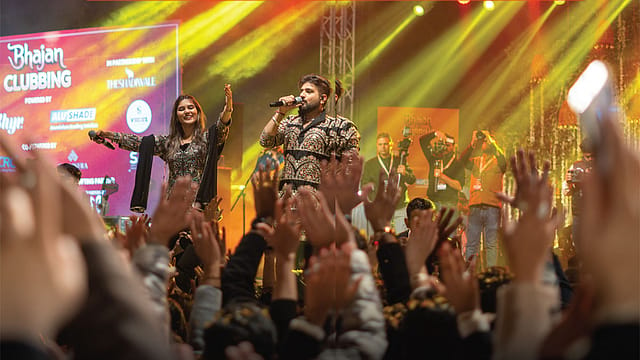
IMAGINE THIS: THOUSANDS of people in packed arenas with strobe lighting, akin to a club or a techno concert. The air is buzzing with the low hum of amplifiers, lights cut across the room and a sense of exhilaration is pervasive. The crowd, comprising primarily Gen Z, dance and sway, caught in the music and the moment. What sets this scene apart is the music itself—not rock, pop or techno, but devotional Hindu music set to modern beats. Enter Bhajan Clubbing, a new form of live music performance on the rise; essentially, concerts of kirtan—antiphonal style song or chant with roots in the Vedic anukirtana tradition, set to music, that proclaim loving devotion to a deity, or discuss spiritual ideas.
Bhajan clubbing is everywhere, propelled by a loyal audience whose numbers keep growing. It is selling out gigs at well-known music venues in both metros and tier-2 cities—one finds concerts and events not only in Mumbai, Delhi, Hyderabad and Bengaluru but also in Faridabad, Pune, Ahmedabad, Visakhapatnam and Lucknow. It’s also replacing sangeet and musical functions at the Big Indian Wedding as a spiritual yet trendy answer to pre-wedding revelry. A stage or a club is not mandatory—even coffee shops and bars are serving double duty as venues. Instagram is filled with hundreds of reels and posts of young Indians jamming to bhajans. Such is the phenomenon that even Prime Minister Narendra Modi has taken notice—speaking during his monthly radio series Mann Ki Baat, he called it as a coming together of spirituality and modernity reflecting the role of devotion in contemporary youth culture. This month, backed by the Delhi Government, colleges across the city are hosting a series of bhajan clubbing concerts as part of Vasantotsav 2026.
This popularity has been linked to multiple factors. The first, of course, is the enmeshing of traditional music and spiritual hymns that many Indians grew up with, with contemporary inflections. The kirtan, as a genre of music, hasn’t often permeated mainstream pop culture in the past. There have been a few exceptions; such as Shah Rukh Khan’s iconic sprint across the boardwalk in Karan Johar’s Kuch Kuch Hota Hai (1998) to a modern, up-tempo edit of the Hindu devotional song ‘Raghupati Raghav Raja Ram’. But for the most part, bhajans have conventionally been in a silo, their presence felt in spiritually charged events, gatherings or occasions more than on modern music stages.
Bhajan clubbing is distinctly Gen Z in its appeal; both for a desire to connect to their roots in the increasingly global world they inhabit, and also for its divergence from ‘party culture’. “In today’ s world, everyone is so busy–and everyone is looking for an escape,” says Prachi Agarwal, one half of musical duo Backstage Siblings, best known for their kirtan-style set-lists and performances. ‘We wanted to give people a different kind of high; a high without alcohol. A high that comes from music, from bhajans, from sitting together for an hour and feeling those vibrations in your body. That feeling is stronger than any substance, and in these tough times, this is the escape we want people to experience.”
For a generation that drinks minimally and is furiously keen to connect to the traditions it grew up with, this desire to rave on bhajans (sans intoxicants) adds up. It isn’t an out of pocket idea. The same bhajans that were once considered forced morsels of a daily religious diet for generations past have now become the antidote to a growing globalisation. What’s more, bhajan clubbing as a concept has managed to marry those cosmopolitan music tastes with the spirit of Indian tradition.
LOVISH SHEETAL FROM devotional rock band Keshavam defines their music as devotional rock—their vocabulary rooted deeply in Bhakti, but expressed through a soundscape that belongs in the contemporary. “At its core, it’s still bhajan and kirtan,” he says. “The lyrics, intent, and devotion remain untouched. What changes is the delivery.”
Raghav Agarwal, the other half of Backstage Siblings, finds it harder to categorise their genre. “There’s no specific genre we fall into. The songs come from the audience, the vibe comes from the audience, and we sing anything that brings a smile to their faces.” But the core of their music harkens back to the satsangs of their childhood–and the charge they felt at them. “Growing up, we’d go for satsangs with our dad and sit beside him, not understanding a word–not even knowing how to sing. But the energy, the vibrations in that one hour felt magical. That same feeling has stayed with us, and singing devotional songs still brings us back to that moment.”
It isn’t exactly new or revolutionary for people to be brought together in kirtan–many older generations of Indians have often assembled in homes, parks and temples for the musical ritual. This is often centred on festivals such as Deepavali and Navratri, or to mark ceremonial occasions, prayer gatherings and auspicious days. Why this new movement sparks interest, however, is both because of the contemporary setting–cafes, yoga studios, clubs–and the fact that the average age of the demographic is roughly in their 20s and 30s. If you look closer, the setting, age-range, and kind of music with its soothing repetitiveness and hypnotic rhythm are akin to another popular young music movement–psytrance.
There is a chicken-and-egg energy to this theory. The idea that psytrance has the original claim is controversial–and not one being espoused here. It is more the idea of that form of spiritual trance music making it to the mainstream that really leads to this comparison. Bhajans date much further back in the timeline of musical history. Psytrance can, perhaps, lay claim to being the first of the two, in terms of a music movement that has youth yearning for connection at its heart. Kirtan, albeit older, has only just made it to the contemporary cultural zeitgeist.
Whether it’s the collective consciousness of psytrance that comes from hundreds of bodies moving in unison, the dream-like rhythmic beats that meld into repetitive chants, or the tracks that tend to blend into one another, the similarities between the genres abound. But Prachi argues that it was bhajans that formed the wellspring for most electronic dance music in the first place. “Powerful bhajans like ‘Ay Giri Nandini’ and the ‘Shiv Tandav Stotram’ are the roots that many modern sounds draw from. Genres like EDM or psytrance have been influenced by that energy and rhythm.”
Music critic Bhanuj Kappal observes that there are certainly tropes in Eastern spiritual and music traditions that Western music has always borrowed from; the repetition, the use of different scales. “I think, in particular, the concept of vibrations from Hinduism, ‘Om’, as the universal vibration is something that really appeals to psychedelic spirituality,” he says. “Hippie and psytrance culture in Goa definitely did a lot of sampling from Indian religious and devotional music, and ideas from that.”

Prakriti Sharma from Keshavam finds it a fitting parallel; with one important differentiator factored in. “The comparison makes sense on an experiential level. Both psytrance and devotional music can be repetitive, trance-inducing, and meditative. The difference lies in intention. Psytrance often seeks transcendence through abstraction, while devotional music seeks transcendence through surrender and meaning. But the human nervous system responds similarly to rhythm, tempo, and repetition and that’s where the overlap is.”
Kappal adds that it is important to note that this ‘borrowing’ is more Western appropriation than homage of some sort–a surface level influence that doesn’t quite understand the roots of what it’s taking from. “But it’s interesting to see it come full circle; that these musicians are borrowing from contemporary forms and styles to make these bhajans more accessible to younger people.”
Sheetal agrees with this train of thought. “Younger audiences often feel disconnected from traditional formats, not because they lack faith, but because the expression feels inaccessible or outdated to them,” he believes. “By presenting bhajans in a contemporary, immersive format, we remove the barrier of ‘this isn’t for me.’ Once that barrier is gone, the lyrics, stories, and devotion naturally find their way in. We’ve seen people attend for the music and leave with curiosity, connection, and sometimes even a deeper spiritual practice.”
Raghav revels in the idea that this generation is rediscovering a ‘spiritual connection’ in its own way. “For many of us, music is the space where we feel grounded, calm, and understood. We believe that any song, even a Bollywood song, when sung with the right emotion and energy, can be dedicated to the Almighty. For us, it’s never about the song itself but the feeling behind it.”
There is a sense of hedonism to the subculture of psytrance, Kappal points out; one that certainly borrows from eastern spirituality, but is often fuelled by substances and chemicals. He argues that, while the two music genres have the unification of their audience in common, they create that oneness in different ways. “There is that sense of connection in bhajan clubbing, and the music enables that connection, but the context is very different. I don’t think most people that go bhajan clubbing, or champion it, are likely to have the same POV on the world as someone going to a psytrance rave. I would liken bhajan clubbing more to that sense of community created in a church, or any other religious or devotional gathering.”
There is a comparison he brings up as well to the ‘sober raves’ or the ‘coffee raves’ that a lot of urban Indian Gen Z have taken to. “I think it has an interesting overlap with psytrance because this is an appropriation of rave culture. It’s a sanitisation of that rave culture for people that perhaps either don’t fit into it, or aren’t willing to take the risks associated with it.” He posits that bhajan clubbing is a crossover of that connection and community of rave culture with the safety of the sober rave. “An approximation of the real thing that is like it, but isn’t it.”
Sheetal, however, doesn’t quite see it the same way. He sees it as a new form in itself; one that isn’t in contest with traditional nightlife or raves, but simply seeks to peacefully coexist with them. “Bhajan clubbing isn’t about replacing nightlife, it’s about redefining it. Yes, of course, genres like rock, ambient, electronic, and even elements of techno have influenced how we build energy, structure crescendos, and design live experiences–and we’re planning a dedicated techno set in our future concerts as well.” But he believes what makes bhajan clubbing unique is that “the high doesn’t come from alcohol or escape, but from participation and presence.” As he says, “Everyone is singing, clapping, chanting, not watching from the sidelines. Unlike conventional club spaces, this form of gathering is inclusive and intention-driven. That combination is rare.”