Jharkhand Student Protest: The write answer
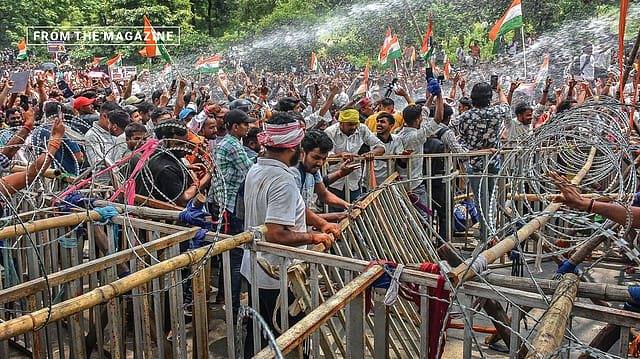
WHEN JHARKHAND CHIEF MINISTER Hemant Soren addressed reporters on August 17 in Ranchi, it was clear that his government had relented to the demands raised by students who had begun their protest on July 25. “Today, the Cabinet also decided to cancel the JSSC-CGL examination. All “mistakes”, big or small and regardless of who committed them, will be inquired into,” Soren said. A day after he made the announcement, 44 examinations were cancelled.
Soon after that, Devendra Singh Mahato, one of the faces closely associated with the agitation, broke his fast in the presence of Jharkhand ministers Dipika Pandey Singh and Irfan Ansari. Just days earlier, on August 15, Mahato was prevented from leaving his hospital room to participate in a tiranga yatra or a tricolour rally at the Jaipal Singh Munda Stadium, the location where students were camping in protest. At that time, it seemed the students were in for a long haul.
Two days later, the Soren government gave in. The dynamics of decision-making in dealing with the students and their demands were marked by denial, prevarication and acceptance of some demands, haltingly. For example, on August 6, Ansari denied any leak had taken place during the examinations in Jharkhand. He flatly refused to cancel the Jharkhand Public Services Commission (JPSC) civil services examination. “I want to say again that there has been no paper leak in Jharkhand. This is not Uttar Pradesh, not Bihar, and not Gujarat. This is Jharkhand, and we are concerned about it,” he told reporters. The minister said that cancelling the examination would create unrest among successful candidates.
Yet days after Ansari’s statement, a negotiating committee of the government, agreed to “98% of students’ demands”, which included cancellation of the JPSC examination. But the negotiators did not agree to cancelling the Jharkhand Staff Selection Commission Combined Graduate Level (JSSC-CGL) examination in which a large number of candidates had appeared. The government was amenable to a probe by the Enforcement Directorate (ED) into the financial aspects of the examination issue as well as creating a fast-track court where a chargesheet would be filed within 90 days.
Ultimately, what forced the government’s hand was the prolonged nature of the agitation, which refused to die down. The number of students who had gathered at the stadium did not dwindle through the rainy season. Then came the attempt to march to the state Assembly on August 10. This was not allowed and the police used lathis and water cannons to stop the students. The bandobast to prevent the encircling of the Assembly was quite elaborate with barricades and heavy deployment of security forces. The march was foiled. Mahato, who is also an activist of the Jharkhand Loktantrik Krantikari Morcha (JKLM), was taken to a hospital after his health deteriorated on the same day after participating in the march. He had been on a hunger strike since August 2.On August 14—some 20 days after the protests began—Rahul Gandhi, the Leader of Opposition in the Lok Sabha, wrote a letter to the Jharkhand government, urging dialogue with the protesting students. Some claim that this letter forced the Soren government’s hand.
The cancelled examinations include those involving recruitments for civil judges (junior division), assistant public prosecutors, deputy collectors, dentists, assistant engineers, drug inspectors, assistant professors in government medical and engineering colleges, appointments in government polytechnics, forest range officers, assistant conservators of forests and other positions in the government.
Many of the examinations were conducted by a private organisation, TDPL, that had come under a cloud. In recent days, three members of JPSC—Jamal Ahmad, Ajeeta Bhattacharya and Anima Hansda—have resigned while the chairman of the commission, L Khiangte, had quit in July. Khiangte was arrested on August 10. The allegations against him include irregularities in the 14th civil services examination conducted by JPSC. This examination involved TDPL, a company that had been “blacklisted” but was still empanelled to conduct the examination.
The rot in Jharkhand’s examination system for government jobs is well-known. In recent years, especially since 2023, the problem has turned acute. The JSSC-CGL examination, the gateway to different jobs in the government system, has seen repeated leaks. Virtually all examinations involving recruitment to the civil services in Jharkhand from 2023 onward—including the preliminary examinations for new batches as well as “backlog” examinations—have been marred by allegations of leaks or apprehensions of corrupt practices in recruitments. Yet, at no point did the Soren government pay heed to these allegations. Most of these examinations, at least the ones involving JPSC, were conducted during the tenure of the Soren government.

The other problem, one that is acute in all non-metropolitan regions, is the extraordinary attraction that government jobs hold. In these areas, private sector jobs are not considered attractive. Once one manages to enter the government sector, the thinking goes, “one is set for life”. It is a vicious circle. The lack of attractive work in the private sector—for example, in technology startups and other innovative companies—often drains states like Jharkhand of their best talents. Whatever is left behind then makes a rush for government jobs. Jharkhand, a state well-endowed with natural and mineral resources, has hardly any technology firms worth the name. The exploitation of mineral resources continues—itself subject to recurring controversies over mining—but that is not enough to take the state up in the league table of Indian states when it comes to growth and economic performance. The results are for everyone to see: the scramble for a small and very limited number of government jobs. This sector of “economic activity” then becomes too tempting for persons involved in recruitments not to indulge in corruption at their level. At some point, frustration among students who lose out then boils over.
AT THIS POINT, it is inevitable that comparisons will be drawn between the so-called “Gen Z” protests in New Delhi and the students’ protest in Jharkhand. The comparisons are wholly inappropriate. The Delhi event was starkly political while the Jharkhand one was all about protecting the life chances of candidates who had appeared in examinations for government jobs.
The first thing worth noting is the timeline of the two protests. The one in New Delhi lasted between June 6 and July 25. But this is misleading. The event on June 6, when Abhijit Dipke, the founder of the Cockroach Janta Party (CJP), arrived to take charge of the agitation, it petered out. The agitation proper began after the Ladakhi activist Sonam Wangchuk joined the agitators at Jantar Mantar in New Delhi on June 28 and lasted till July 25—a total of 28 days. In contrast, the students in Ranchi camped at the Jaipal Singh Munda Stadium between July 25 and August 17—a total of 24 days. To that extent, the two events remained active for almost the same time, with the one in Jharkhand following the one in New Delhi.
This proximity in time and their sequential nature has led to the two events being viewed in the same frame. Hence the description, “Gen Z” protests. This is a misleading characterisation. The event in New Delhi was a political mobilisation aimed at a specific political objective. At its narrowest, this was the removal of then Union Minister of Education Dharmendra Pradhan and on a wider level, paralysing the Narendra Modi government. It met the first objective when Pradhan resigned on July 25. Because the agitation continues beyond its original goal—the students’ concerns with leaks due to mishandling of examinations by the National Testing Agency (NTA)—it cannot be described as a students’ protest.
The events in Jharkhand, on the other hand, were tightly focused on a single issue: ensuring justice for candidates who had appeared in various examinations in the state. At no point did the protest acquire a political colour. In fact, when Neha Bora, an activist of the All India Students’ Association, the student wing of the CPI (Marxist-Leninist) Liberation, an ultra-Left organisation, tried to interject herself among students in Ranchi, she was marched off the stage. The students there did not like her “political approach” to the event. Bora allegedly tried to raise the issue of Umar Khalid’s detention and courts refusing him bail. Khalid is accused under the Unlawful Activities (Prevention) Act, 1967, for his role in engineering the Delhi riots of 2020.
Differences between the two are quite glaring now. While the Jharkhand students, including Mahato—perhaps the most “political” of all the protesters there—have called off their activities after 44 examinations were cancelled, the CJP continues to try and mobilise in the hope of cornering the Modi government. Hence, their desultory visits to government schools in states ruled by the Bharatiya Janata Party (BJP)—but none to those states where the opposition parties’ rule—and other aimless statements.
Finally, the CJP’s leadership, or at least its key sections, has been associated in one way or another with the Aam Aadmi Party (AAP), a political party known for its opposition to BJP. As such, the CJP’s claim that it represents the students of India is suspect. That it managed to mobilise a crowd in Delhi—one that had other sections and not just students—has been labelled as some kind of ferment in India’s “Gen Z.” This is a formulaic—and lazy—description of a one-off event. Even on June 6, the very first CJP event, it was clear that it would not go far. To generalise these two events into some kind of claim that India is in the “throes of a revolution” is to misread what is going on.