Jammu & Kashmir: Rethinking the Grid
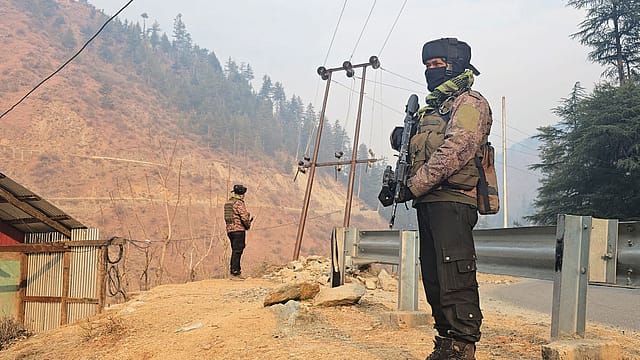
ON JANUARY 23, A joint operation led by the Jammu & Kashmir Police in the state’s Kathua region culminated in the killing of a Pakistan-based Jaish-e- Mohammed terrorist, codenamed Usman. He was a most-wanted Jaish terrorist in the Udhampur- Kathua belt of the Jammu division, linked to multiple attacks for nearly two years.
This encounter stands out as one where the operation concluded without the kind of losses that have become common in Jammu’s recent counter-terror campaigns. In a region where small groups of highly trained terrorists have repeatedly drawn security forces into costly pursuits, Kathua offered an example of control—something which many feel has been missing elsewhere. In the upper reaches of the Jammu region, including in an encounter in Kishtwar just days before Kathua, which led to the death of a soldier of the Army’s Special Forces, encounters have stretched across days. Terrorists have remained mobile, slipping through forests and ravines, mostly initiating contact on their terms. In some such encounters, casualties among the forces have followed, even when terrorists were eventually neutralised.
In Kathua’s case, the intelligence was specific. “A small team neutralised Usman,” said Mohita Sharma, SSP, Kathua. “We received specific intelligence about his presence at a location which was four-hours’ walk from the roadhead.”
It is because of this that the operation was over in a few minutes. There was no casualty among the forces. The encounter ended before fatigue of extended cordons and repeated exposure could take its toll.
By contrast, in some operations, say sources in the police, intelligence was fragmentary, which led to the necessity of large cordons. Small teams then became involved in locating rather than striking. In such cases, even the advantages of deploying elite forces narrows sharply.

Global By Design
29 May 2026 - Vol 04 | Issue 73
Is the future of fashion Indian?
The texture of militancy in Jammu & Kashmir has changed. In the Valley, terrorism is contained, and attacks are rarer. The old ways of engagement like stone-pelting, which kept a big chunk of forces occupied, have thinned out. The grid is tight. Yet in places like Kishtwar, the ground tells a different story. Small groups of terrorists continue to surface in forest areas. Sometimes they come down and carry out attacks against the forces and civilians.
In the last decades, the forces have mostly fought counter-insurgency battles in urban settings. Acting on specific intelligence, or sometimes even by accident during search operations, the forces, over the years, had achieved a certain sophistication in neutralising terrorists who get trapped in a house. But in the last few years, with the infiltration of foreign terrorists, Jammu can no longer be treated as an appendage of the conflict in Kashmir Valley. Kishtwar or Poonch are not downtown Srinagar, nor even Shopian, nor Pulwama. The belt running through Rajouri, Doda and Kishtwar has become a low-visibility war zone. It’s an area where dense forests and inclement weather conditions restrict surveillance. Villages are scattered, and intelligence is episodic. On top of it, terrorists have learnt to minimise their contact with the civilian population.

As counter-insurgency operations intensified in Kashmir, intelligence gathering in Jammu no longer remained a priority. The Army’s ability to saturate space and dominate an area through checkpoints and patrols does not work for a terrain like Kishtwar. Terrorists stay put for weeks and have no need to cross roads or enter villages. The counter-insurgency muscle memory of the forces was built in towns and semi-rural belts, not in alpine forests. These structural weaknesses in the counter-terror grid are then compensated with pushing elite forces. By widening the theatre south of the Pir Panjal, Jaish terrorists have diluted the security grid, compelling the forces to fight on terrain where its advantages are less settled.
In Kishtwar, the intelligence seems to have been specific. Yet, one Special Forces soldier was killed. After the encounter, a bunker was found with a running kitchen containing essential food supplies. Hours later, the forces were caught in another encounter not far from the site of the bunker. It raises questions about mission design and why in such operations the competitive edge of elite forces narrows. Is it because the para teams are repeatedly tasked with search-and-track missions rather than for raids where surprise is decisive? These questions have not been addressed, neither is there any evidence that this imbalance seems to be taken into account. Is there need for an investment in building jungle-domination capabilities and in local intelligence? Because otherwise, as is evident from the last few years, there has been a slow erosion of capability, where it is not understood that terrorists are more interested in outlasting than fighting battles.
VETERANS OF COUNTER-insurgency operations in Jammu & Kashmir maintain that while technical intelligence plays an important role, it cannot compensate for the lack of human intelligence. They say that the forces, especially the local police, must develop it by discovering an older skill: local familiarity. But such knowledge accumulates slowly. Officers need time to acquaint themselves with a terrain and that active areas like Kishtwar cannot now be treated as temporary.
“What the police must do now is to find the overground networks in Kishtwar and elsewhere through which terrorists are able to sustain themselves. That requires work on local intelligence,” said Shesh Paul Vaid, former director-general of Jammu & Kashmir Police.
Sources in Kashmir also point out how the Gujjar community has been feeling aggrieved in the last few years. The community has played an important role in fighting insurgency, but now many of them feel a deep sense of injustice. This is a result of several cases in which people from the community were targeted. In 2018 in Kathua, a young Gujjar girl Asifa was raped. Last year, a young Gujjar man, Makhan Din, in Kathua’s Billawar area recorded a video from police custody alleging torture by the police who he said were pressing him to confess links with militants. The video went viral, and shortly afterwards, the man committed suicide saying he could no longer endure the alleged harassment. The matter is now in court. In 2023, following a terrorist attack in Jammu’s Poonch division, security forces detained many locals for interrogation. Three Gujjar men allegedly died in custody. Videos surfaced later showing officers beating civilians. In 2020, three Gujjar men were allegedly killed in a fake encounter in South Kashmir’s Shopian district. A court martial held an Army officer guilty and recommended that he be sentenced for life, but in 2023, an armed forces tribunal suspended the sentence and granted bail to the officer.
These incidents have led to a serious trust deficit. A senior Gujjar leader, Shahnawaz Choudhary, has warned of the widening void between the community and the government. Community leaders point out how because of the government apathy the trans-Pir Panjal animal trade, which is the lifeline of the community, has been hit. Sources point out that the radical Islamist organisations have taken advantage of this situation, and together with the rise of the activities of rightwing Hindutva organisations, many among the Gujjar community are falling prey to radicalisation. Speaking to the Press Trust of India in September last year, the former chief of the Army’s Northern Command Lt Gen DS Hooda (retd) acknowledged that the government had not done justice to their (Gujjars’) role. He was quick to point out that the first women Village Defence Committee (VDC) members, who have often been the first line of defence against terrorists in difficult terrains, were from the Gujjar and Bakarwal tribes. He cautioned that it was essential to avoid actions that alienate them.
On January 27, despite snowfall, security forces in Kishtwar extended the combing operation following fresh gunfights with terrorists. But so far the terrorists, believed to be two or three in number, have managed to escape. Helicopters were pressed into service in the area as search parties were spread in larger areas to track down terrorists.
As operations continue, it is imperative now that intelligence be rooted in villages and among communities that feel secure. The erosion of that trust, particularly among Gujjars who have historically stood against militancy, weakens the grid more effectively than any ambush. The lesson from Kishtwar is not simply tactical but structural: Jammu can no longer be treated as a subsidiary theatre that borrows methods from the Valley. It requires patient investment, in local familiarity, in jungle-capable forces, and in relationships that take time to mend. Without that recalibration, operations will continue, encounters will recur, and successes will remain far and few, while the larger contest slips into attrition.
What is unfolding south of the Pir Panjal is not an escalation but something that is fast turning permanent. Terrorists have adjusted to pressure by becoming patient, by embedding themselves in terrain and time. The response so far has been largely reactive, shaped by intelligence as it arrives rather than by a settled design for the region. Each encounter is treated as discrete, even as the pattern becomes harder to ignore.
The danger lies in mistaking motion for control.