Jallikattu: Raging Bulls
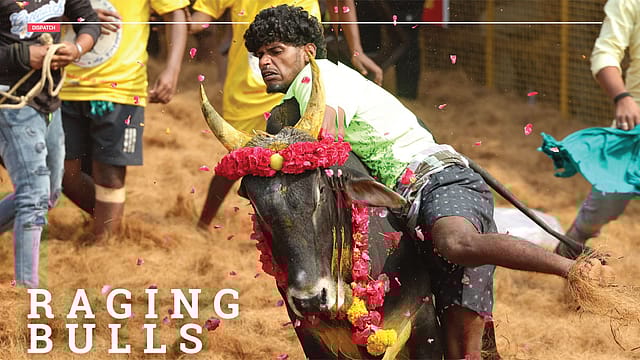
THE SNORTING BULL IS LARGE AND gorgeous, its strong blue hump, muscular grey torso and a sagging neck wholly plastered with copious amounts of yellow turmeric powder together glisten under the slanting rays of the morning Madurai sun. The bull belongs to the Kaaliamman Kovil, but despite its sacred origins, the temple animal has left a trail of gore in its wake. As it stomps a deadly hoof on the carpet made of loose coconut coir and majestically scans its immediate surroundings of the vaadivaasal, or bullfighting arena, seven young men in pink jerseys writhe on the padded floor.
Beyond the fallen, and well within the narrow confines of the crowded vaadivaasal, are 40 or so other men, these maatu veerans—the term for contestants roughly translating to “brave bull-tamers”—all in different stages of scramble and mortal fear. Some of them have climbed the yellow metal fences hemming in the vaadivaasal from the rest of the urban village of Avaniyapuram, while the others squat hard against decorated walls and billboarded pillars, especially those barricading the now-empty entry gate, the trapdoor from where this beast had emerged with an enormous leap just moments ago, promptly bulldozing through and flipping over the veerans that had dared to grab its prominent hump.
Having gathered itself after its initial daze, the bull charges the most densely packed corner of the fencing, forcing the huddled veerans on the ground to duck and shield their faces with their sweaty arms, even as the climbers surge further up the metal barriers. A wash of happy whistles and morbid laughter emanates from the spectators—the cheering thousands that includes dignitaries and ministers even, all equally relishing the promise of further violence and this ongoing contest between man and beast. “Super maatu pa, super maatu! Let’s applaud the maatu from Kaaliamman Kovil!” says the announcer, spitting into his mic, him straddled high over a pillar of the entry gate.
Just then, a veeran with curly hair and the number 182 printed on his pink tee, who had thus far retreated to a safe corner of the bull pit, rises. He tightens a green scarf across his forehead and rushes the maatu from behind. In one swift motion, No 182 leaps onto the bovine’s side and clutches the hump, swiftly wrapping his forearms around the protrusion and locks his elbows. The bull pivots with the fresh weight and tries to throw the man this way and that, in turn shaking off a cloud of turmeric. But No 182 coughs and hangs on, possibly for dear life, his knees dangling and bouncing mid-air.

From the far end of the vaadivaasal, a runway-like space designed to allow the animal to exit safely, this bull’s owners and handlers, about three of them, frantically wave their dirty beige towels in the air to catch its attention. The bull notices and careens towards them, but with No 182 very much in tow, who manages to somehow cling on for the final charge. The crowd roars, the bull owners scream “vaa da, vaa vaa! (come on, come, come!)” at the bull, even as the excitable announcer yelps: “The prize of one aanda for veeran No 182. The brave veeran has won an aanda!” Until, everyone, all at once, realises that the bull is nearing the end of the carpeted portion of the runway, still mounted by the man.
“Veedinga da, veedinga! (Leave the bull!)” is the anguished cry of the announcer, and on cue, the man lets go of the hump and lets the coir break his speedy fall, with the tumble stopping inches away from the bare concrete of the road. He bounces on to his feet and dusts his muddy shirt, running back towards the action where he is met by fellow veerans, who slap his back with glee, and then on the sidelines with the promised aanda, or steel bucket. Even before he can fling the aanda over the fence to his waiting family, already a new beast waits at the trapdoor entry, drawing all veerans into their “V” formation at the mouth of the cage.
“The next bull belongs to Suriya, the superstar actor,” says the announcer. “If Suriya maatu is tamed, the veeran will receive not an aanda, but a mixie! Yes, you heard that right, a mixie. If the bull escapes without taming, the handlers will receive a plastic dressing table.” Here, the announcer pauses, with an eye on the exiting kovil bull, who has lost all steam and has been expertly lassoed in by its disappointed handlers, them dragging the animal towards a fleet of tempo trucks. The announcer directs his following warning at them. “If you put powder on your bull again, be it turmeric or talcum, to make life difficult for our veerans, I will personally ensure that you are blacklisted from this sacred Pongal festival for the rest of your life. Respect our great and brave Tamil tradition that is Jallikattu.”
THIS, THEN, IS Jallikattu, the most controversial and simultaneously ferocious expression of Tamil pride. Most famously practiced across three suburbs of the city of Madurai (Avaniyapuram, Palamedu and Alanganallur) on successive days during the harvest festival of Pongal, Jallikattu—derived from the word “salli”, meaning coins, and “kattu”, which is to tie a package to the bull’s horns—is a most ancient tradition that is said to date back to the Sangam period of 400-100BCE. In this century, however, the practice is understandably fraught with legal disputes, even having been banned by the Supreme Court in the previous decade after successful petitions from the Animal Welfare Board of India and organisations, such as the People for the Ethical Treatment of Animals (PETA), due to the rising count of fatalities at these events, for both man and beast.
The ban provoked widespread protests across the southern state, so much so that the Tamil Nadu legislature passed a bipartisan Bill—agreed upon by the then-ruling party All India Anna Dravida Munnetra Kazhagam (AIADMK) and the opposition Dravida Munnetra Kazhagam (DMK), who simply didn’t see eye-to-eye on most other matters—exempting Jallikattu from the Prevention of Cruelty to Animals Act. Now, the sport, if one could call it that, had become a strong political tool, perhaps even as powerful as the Dravidian politics surrounding the language of Tamil, easily weaponised by every subsequent ruling party in the state in its “us versus them” rhetoric against the Centre. The incumbent government, formed by DMK in 2021, is no different. In fact, given that 2026 is election year in Tamil Nadu, the party pulled out all the stops to ensure that their leaders were front and centre of all three Jallikattu events that took place in Madurai over January 15, 16 and 17.
Each of the 1,700 individual veerans, who participated in hour-long batches of approximately 50 over the three Jallikattus, wore a jersey with a large picture of the father-son duo of MK Stalin and Udhayanidhi Stalin—chief minister and deputy chief minister of Tamil Nadu, respectively—printed prominently on the front. And back. A smaller logo bearing the smiling face of M Karunanidhi, father of the senior Stalin and the longest-serving (intermittently) chief minister of Tamil Nadu, graced the right breastplate of every shirt. Chief Minister Stalin had also personally sponsored the grand prizes for all three Jallikattus. In the first one at Avaniyapuram, the veeran with the highest number of successful embraces of the bull, or tames, received a brand-new Nissan Magnite car. The second prize was a mid-range Honda motorbike. And the best bull-owner took home a tractor.
All three prizes, the car, the bike and the tractor, were placed on a high stage flanking the Avaniyapuram vaadivaasal, each vehicle further draped with a tarp bearing the images of the two Stalins. If that wasn’t enough, the chief minister himself showed up in flesh and blood, as the guest-of-honour at the third and final Jallikattu event in Alanganallur.
It was here in Alanganallur that the first Jallikattu event to defy the ban was held back in 2017. Those who were there on that fateful day, February 1, almost nine years ago to the day, claim that the crush of spectators felt like all of Tamil Nadu had seemingly landed up in this little town, 15 kilometres to the north of Madurai. The attendance on the closing Jallikattu of 2026, held on January 17, was justifiably large as well, especially once word spread that the chief minister was going to be in attendance. For about four hours into the event, the VIP section of the main stage stood largely empty, those princely chairs sporadically occupied by the odd policeman or dignitary. Until, at about 10:30AM, it filled up all at once, causing a remarkable applause from the audience as Chief Minister Stalin appeared wearing gold-rimmed sunglasses, a crisp white shirt and beige trousers.
As soon as he took his seat, there was carnage in the vaadivaasal below. The emerging bull grazed a veeran with a flailing horn, drawing blood, before losing its footing on the coconut coir and promptly collapsing on its hooves, submerged in a cloud of dust. With both man and animal severely injured, the paramedics were summoned and for a few long minutes, as the man was stretchered out, Stalin sat there with a grimace on his face and his palm in a perma-twist. When the show resumed, the following bull evaded capture of any kind, so the man on the mic happily announced a special prize: “Thanga modaram (gold ring) for the bull owner from the honourable chief minister.”
The bull owner was hoisted to the front of the stage, where he sheepishly stuck out his hand and Stalin slipped the gold ring on a finger, a pose they held for the melee of photographers. “Don’t allow any more bulls into the vaadivaasal, please, the chief minister has a few words to say,” said the announcer, uncaring for the bull that was already within the claustrophobic confines of the trapdoor. Amid shrill cheer, Stalin was handed a microphone and a script on a sheet. He tested the mic with a tapping digit, cleared his throat and burst into his speech, in Tamil. The following is an excerpt from his address to the large crowd.
“Vanakkam. My heartiest Pongal greetings to all present here on this soil of Madurai, which is the soil of the brave. When I see the bulls and the brave veerans, it makes me feel proud to be a Tamilian… As the chief guest, I want to make two announcements. First, the winners that tame the most bulls in this historic event will get a job in the Animal Husbandry Department. Second, I have already commissioned a veterinary and training institute in Alanganallur at the cost of `2 crore. Do these announcements make you happy?”
The crowd gave a lukewarm response, so the announcer hyped up the promises on loop, enough for the audience to chant “Long Live the Chief Minister” in unison. Even before the applause could subside, Stalin and his entourage made a beeline for the exit, exactly 25 minutes after they had arrived. And just like that, the VIP stage was altogether empty again, even as the long-stranded bull was finally allowed through the trapdoor.
SHORN OF ITS woolly politics, Jallikattu is essentially a contest between the owner of the bull and the ones who want to tame it. The animal is simply a vehicle to derive who was more cunning among them, the handler or the veeran. To truly understand what makes them tick, I arrive at the first Jallikattu of the season at Avaniyapuram an hour before the scheduled start of 7AM. But a majority of the bulls, and their owners, had already arrived at the venue a whole lot earlier, at about 3AM, pushed this way and that by the 2,500 policemen deployed by the city of Madurai for crowd control, until they found the mouth of the queue.
The queue is a mile-long narrow corridor, barricaded by bamboo fences, that stretches all the way from the lake of Avaniyapuram to the trapdoor of the vaadivaasal. Among the earliest in this queue is Mugil Kamesh, a 24-year-old farmer from the village of Uthangudi, and his four-year-old bull, Chinna Raja. Chinna Raja is the 71st bull in the queue, according to Kamesh’s queue card, which but ensures he will participate in the first batch (each batch of veerans roughly receives 100 bulls to tame within the hour). And like all the other bulls on either side of him, he is of the Bos Indicus variety: the humped Indian cattle. But Chinna Raja, whose horns are decorated with a wreath of marigold flowers, is spotlessly black. He is also immaculate, devoid of powder.
“I have been training him daily, for about three months, just for this day. One hour of swimming and running, followed by dodging practice,” Kamesh says. “Chinna Raja is now fully averse to being held at the hump, I have prepared him for that.” Why does he enter his bulls in such a dangerous competition, I ask. “Because I am Tamil. It is a matter of pride.”
I follow Kamesh and Chinna Raja all the way to the mouth of the trapdoor, where, on handing over his queue card, he receives a plastic bag with a folded veshti in it. Just as Chinna Raja begins to grunt and stomp out of sheer nervousness, I sprint around to the stage to see how they perform. Kamesh pushes through the crowd of veerans first, placing himself by the exit, before Chinna Raja appears at the entry and instantly panics at the sight of the horde, the men stationed a little too close for comfort. The bull tries to turn around, gets stuck and enters the arena in reverse, where he is easily caught and tamed by a fit young man, who has quite the reputation on these baking plains.
His name is A Karthik, a 22-year-old veeran in the very first batch of the day, and Chinna Raja is the 14th bull he has tamed thus far. By the end of the hour, he will tame 16, head and shoulders above the next best in the group, guaranteeing him a place in the final round of the day, which will take place 12 batches and hours later, where he will have the chance to win yet another vehicle. “Already he has won our family a Nissan Datsun in 2022, a TVS bike in 2023 and a Nissan Magnite in 2024,” says A Santosh, Karthik’s older brother, his chest swelling with pride and his hands full with the 16 aandas stacked together, recently earned by his thambi in the first round.
Santosh was once a veeran too, but when he was stabbed in his right thigh by a horn during practice two years ago, he had to retire from the sport. “Kombu (horn) injuries are part of the tradition,” he says casually. “No, it did not want to make me stop my brother from becoming who he is today.”
At sunset, with the vaadivaasal glowing under powerful strobe lights, Santosh watches Karthik participate in the grand finale and finish second, adding a Honda bike to their growing stable of vehicles. The vaadivaasal is now fully invaded by ecstatic spectators, some of them carrying the winning veerans on their shoulders. The noise of this cheer is very loud, enough to completely drown out the bellow of the bulls, about a hundred of them simultaneously being prodded into the back of the waiting tempo trucks.