Internal Security: The Management of Calm
THERE IS CLARITY in one of India’s three persistent theatres of insurgency for 2026. This year will see the sustained operations against the Maoist insurgency in central and eastern India reach a finale. For Manipur, things may look calmer on the surface but complications beneath it will remain. Coercive capacity may seem to decisively favour the state, but social and political drivers of insurgency, like alienation and grievance, remain largely unresolved. Overall, the result is not peace as much as management for Manipur.
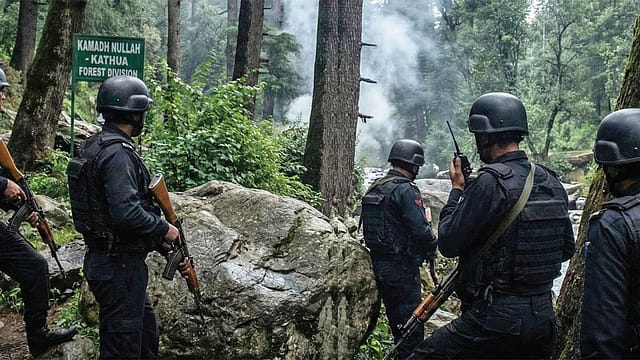
The third one—Kashmir—is trickier. Since 2019, it has been managed in a certain way. With surveillance and informant networks, the security grid continues to dominate and try and keep it localised. But it doesn’t always work, as is evident from the unravelling of terror modules involving Kashmiri doctors in Faridabad and Uttar Pradesh. It shows that as violence is compressed by an overwhelming security presence, the geography may stretch outwards. What does the shift reflect? It reflects pressure, and adaptation, and it stems from the conviction that the jihad against India does not have to be restricted to Kashmir.
The most striking aspect of this module has been the absence of spectacle, which did not involve any fiery speeches or grand claims but quiet logistics and a clinical intent—in other words, the idea of terrorism stripped of any romance. In this case there is no reliability on mass sentiment in Kashmir or visible street energy. The module in its sinister nature is designed to evade detection rather than be performative for a crowd.
According to a recent document prepared by the Union home ministry on India’s terrorism policy and strategy, the terrorist training and infrastructure remains intact in Pakistan and Pakistan-occupied Kashmir (PoK). The report acknowledges that in the recent past terrorist organisations like Jaish-e-Mohammed have intensified infiltration of its cadres. It is this cadre that has made its way to the upper reaches of Kashmir, and in Jammu region where contact with them has occurred several times in the recent past. It is a group of such terrorists that carried out last year’s Pahalgam attack. But since they operate in isolation and keep minimum contact with the civilian population, and are also much better trained than local Kashmiris, they continue to evade detection.

Travel Issue 2026
15 May 2026 - Vol 04 | Issue 71
The Cultural Traveller
The state’s narrative will continue to emphasise development: new roads, tourism numbers, and investment summits. While these are promising, there is also evidence that radicalisation among the youth has not only not come down but some radical groups like the Jamaat-e-Islami (Jammu & Kashmir) have again started their activities. The danger lies precisely there. Kashmir’s insurgency has long thrived not on arms alone but on symbolism: funerals, slogans, the theatre of defiance. As overt militancy may appear to have receded, the struggle risks migrating to quieter forms: radicalisation in private spaces and the slow corrosion of institutions. A heavily securitised calm may endure through 2026, but it will be brittle. The calculus for security agencies will be to prevent a ‘spark moment’—a custodial death, an election perceived as farcical, a viral humiliation—from igniting the street. That calculus will probably hold. But a deeper wager that any sort of de-radicalisation and some kind of political dialogue will be restored will remain untested.

On top of it is tension with Pakistan (and China) that is expected to remain high. Experts have warned of renewed escalations this year with Pakistan, especially in the event of a Pahalgam-like attack. The threat of more Kashmiris joining the militant fold also remains viable, especially with renewed activities of radical groups like the Jamaat and the Dukhtaran-e-Millat.
Politically, the implications are awkward. Delhi can point to the absence of largescale violence in Kashmir as proof of success, and lay the blame at Pakistan’s door for fostering terrorism on its soil. But, as happened during the unfolding of Operation Sindoor, the international community will keep asking about the local-grown terrorists in Kashmir and elsewhere.
The home ministry report also states that a global terror group like ISIS “continues its efforts to incite violence” in India through its sleeper cells. The report cautions that the propaganda of such groups has become richer in content as they exploit cyberspace through which their handlers, many of them Indian fugitives, continue to target educated youth. The report also emphasises the need to “identify and eliminate” local support to terrorist groups by regular monitoring of eateries and religious places and other hotspots.
In Bastar and other areas around it, the Maoist insurgency will continue its long retreat. The Communist Party of India (Maoist) is a shadow of its former self, hemmed in by surrenders, intelligence penetration, and the steady building of roads, mobile towers, and other markers of development. In 2026 the map of “affected districts” will shrink further, with small pockets remaining in southern Chhattisgarh, parts of Odisha and Jharkhand, and the Maharashtra-Telangana border. Sustained counterinsurgency operations have seen senior commanders lay down arms and hand over significant weapons caches, underscoring both organisational fatigue and the government’s intensified pressure. In 2025 alone, thousands of cadres surrendered across bastions such as Chhattisgarh, Maharashtra, and Telangana, dwarfing previous years’ figures and reflecting the limited appeal of protracted armed struggle amid enhanced security and rehabilitation incentives. The Union government has publicly targeted March 31 this year to declare the Maoist threat effectively over. Yet analysts caution that a complete eradication by that deadline is unlikely; battle-hardened cadres and the underlying socioeconomic grievances that fuelled the movement remain, and the core leadership, though weakened, could adapt by retreating to remote terrain or shifting tactics rather than dissolving entirely.
There is also a likelihood of Maoists adapting by becoming smaller, more criminal, and more local. Extortion will persist where mining and infrastructure projects advance without consent. The boundary between insurgent and gangster will blur. Some cadres will melt into village life, others into the informal economy of coercion. Violence will be less ideological, more opportunistic.
THE STATE’S CHALLENGE in 2026 will be not to win battles but to consolidate peace. Development will arrive faster than justice. Land rights, forest governance, and the dignity of Adivasi communities will lose the race to the asphalt. If governance follows security rather than merely accompanying it, the Maoist movement’s social base may finally erode. If not, the Maoist insurgency will linger as a chronic condition: controlled, not cured.
In 2026, Manipur is likely to remain divided, with hills and valley operating as parallel worlds divided by checkpoints and suspicion between the Meitis and the Kukis. New Delhi’s usual mechanisms of announcing talks and committees will remain just crisis management rather than resolution. The issue of drug trafficking will continue to poison dialogue, with political actors on both sides accusing each other of abetting the cross-border drugs trade that flows through the Golden Triangle. While the precise economics of the trade remain opaque, its sheer scale will continue to remain a currency of conflict, financing armed groups and entrenching local power brokers. Each enforcement success will be met with counter-allegations of bias, feeding the grievance cycle.
The conflict’s persistence has even spilled into the public discourse, with a Meitei civil society group recently urging the prime minister to view international outreach by Kuki organisations as a threat to India’s sovereignty. The Meitis, meanwhile, have spilled onto the streets demanding that the state facilitate resettlement of displaced persons in their original homes in Kuki-dominated districts.
Since July 2024, a standing focus group on counterterrorism operations in the Northeast has been active to monitor hotspots in the region to avoid potential escalation. Overseen by a senior official of the Intelligence Bureau (IB), the group—which has officers from agencies like IB, the National Investigation Agency (NIA), CRPF, SSB, and state police officers—deals with interlinkages between illegal immigration from Myanmar and Bangladesh with narco and arms smuggling funding insurgency in the Northeast. But, in the combustible mix that Manipur remains in, without breaking the hold of the drug economy and restoring mutual trust, the state’s uneasy peace in 2026 may prove brittle.
The most likely outcome is a tense equilibrium: violence contained, grievances entrenched. Not only Manipur, the Northeast will be shaped as much by events across the border as by choices made in New Delhi. Developments in Bangladesh like Islamic mobilisation will ripple through India’s eastern periphery. This may not resemble the insurgent spillovers of the 1990s, when camps and sanctuaries were visible and deniable. Instead, the influence will be subtler: money trails, ideological seepage, online radicalisation, and the movement of individuals rather than formations.
Domestic instability in Dhaka tends to loosen local controls. That slack is often exploited, not only by established insurgent groups but also by smaller Islamist networks and criminal syndicates operating in the seams between borders. The home ministry report reveals that Bangladesh-based Al-Qaeda cadres have been trying to hide and regroup in India. The report also points out the nexus between illegal arms syndicates and terrorist groups which, it says, use both legal and informal channels of money transfer for funding their operations.
The report says that an advisory has been issued to all states for ensuring effective segregation, surveillance and counselling of radical prisoners. States have also been advised to train prison staff to recognise signs of radicalisation and also engage with NGOs and religious scholars to counter the message spread by radical prisoners inside jail. For the segregation of hardcore criminals, high-security prisons are being built in Assam, Jharkhand, Karnataka, Punjab, Tamil Nadu, and Delhi.
The report also states that the domestic counterterrorism legal regime needs regular amendments to respond to emerging challenges. It advocates the continual need for capacity building of counterterrorism units to respond to and investigate terror-related incidents. The report also emphasises engaging legal and technological experts to make watertight cases against the perpetrators of terrorism.
Across all three fronts, the Indian state will deploy a familiar toolkit: intelligence dominance, targeted operations, and administrative control. What will not improve as quickly is legitimacy. Security successes rarely translate into political capital where trust has eroded. In Kashmir and Manipur, especially, the distance between compliance and consent will remain wide. The state’s confidence in its coercive advantage may dull the urgency of dialogue. That is a mistake history keeps offering.
The government has its own metrics and from that point of view it is likely to declare success on all three fronts. Declaring victory may suit the arithmetic of governance but history suggests that conflicts pronounced ‘over’ too soon have a habit of returning. India has learned how to suppress insurgency but it has not always learned how to end it. The difference lies in patient, risky, unglamorous politics. In 2026 the state will continue to prefer certainty to courage. Peace will hold. Whether it will last is another matter.