Infrastructure Projects: No to Stagnation
WHEN MAJOR-GENERAL Le Marquis de Bourbel, an engineer in the British army, compiled Routes in Jammu and Kashmir in the late 19th century, he was exploring a railway link connecting Punjab to Kashmir. Much water had flown in the Chenab, before almost a century later, a broad-gauge between Udhampur and Srinagar, found its way into the Union Budget, in 1994, under the PV Narasimha Rao regime. It was later extended to Baramulla, the gateway to the Kashmir Valley. In 2002, then Prime Minister Atal Bihari Vajpayee declared the Kashmir rail link, connecting the valley with the rest of the country, a national project.
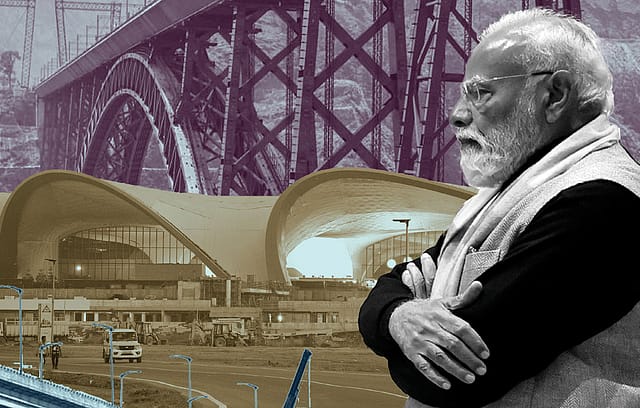
For decades, the ambitious all-weather Jammu-Udhampur- Srinagar-Baramulla Rail Link (USBRL) project, trudging through some of the most sensitive and difficult mountainous terrain of the Himalayas, dragged on, leading to cost overruns. In 2014, when the Narendra Modi government came to power, it still looked like a distant dream, its progress curbed due to land acquisition bottlenecks. The challenge in its execution lay not just in the state-of-the-art technology, but in the stumbling blocks that engineers could not manoeuvre around. Among the ten issues flagged on the Project Monitoring Group (PMG) portal, three pertained to land acquisition and forest clearances. Of the 1,291 hectares of private land required for it, only 1,198 hectares had initially been acquired, while forest clearance for 139 hectares of land in the Katra-Banihal section was still pending. A year later, the project was brought under PRAGATI (Pro-Active Governance and Timely Implementation), an information and communication-enabled platform, through which the Prime Minister directly reviews and monitors high-impact infrastructure projects. When it was first taken up under PRAGATI in June 2015, Modi directed the Jammu and Kashmir government, then led by a coalition of Mufti Mohammad Syed’s People’s Democratic Party (PDP) and the Bharatiya Janata Party (BJP), that since this was a crucial national project, it should complete the acquisition process of the remaining land, highly placed sources said. With the direction coming from the Prime Minister himself, the project, involving 38 tunnels and 943 bridges, including the highest railway bridge in the world over the Chenab River, picked up momentum.
It was reviewed again in November 2019, during which progress of land acquisition was reassessed and directions were issued to the railways ministry to coordinate closely with the state government and expedite its execution. The third PRAGATI review, held in December 2020, proved decisive. Issues related to land acquisition and forest clearances, involving district administrations, the state government, and multiple central agencies, were fast-tracked through coordinated decision-making, effectively breaking procedural inertia, the sources said. With the Prime Minister at the helm, the platform ensured heightened accountability at the highest administrative levels, compelling all stakeholders to adhere to time-bound commitments. The project, conceived as a 272 km-long railway line, sanctioned on March 31, 1994, at an initial estimated cost of roughly ₹2,500 crore, was finally completed at a cost of ₹42,760 crore on June 6, 2025.
In December 2025, Modi, while chairing the 50th meeting of PRAGATI since it was launched in 2015, said that over the years the platform has helped accelerate projects worth more than ₹85 lakh crore. Around 500 secretaries of the central government and chief secretaries of states have participated in meetings of PRAGATI, a platform bringing together Union ministries, state governments and senior bureaucrats to identify bottlenecks and enforce accountability, cutting time, cost overruns and coordination lapses in major projects.
By the 50th meeting, which reviewed five infrastructure projects on road, railways, power, water resources and coal, spanning five states, with a cumulative cost of over ₹40,000 crore, 377 projects had been reviewed under the platform, across which 2,958 out of the 3,162 issues had been identified and resolved. Of these, 35 per cent related to land acquisition, 20 per cent to environmental/wildlife clearances, and 18 per cent to right-of-way issues.
While speaking in the Rajya Sabha on the Motion of Thanks to the President’s address recently, amidst a bitter face-off with Congress, Modi flaunted the PRAGATI platform as a symbol of change in “work culture” from the days of governments led by the opposition. Facing an opposition onslaught over the trade deal with the US, with Congress alleging that the government had compromised India’s agricultural sovereignty, and former army chief MM Naravane’s book, Modi stated that his government had spent much of a decade correcting “mistakes of the past”. During his 97-minute speech, he listed projects left incomplete by previous regimes, accusing opposition governments of laying foundation stones and later abandoning them. He cited the case of the Sardar Sarovar dam, for which the foundation was laid in 1961 under Jawaharlal Nehru, India’s first Prime Minister. As Gujarat chief minister, Modi had undertaken a 51-hour fast in 2006 protesting against the Manmohan Singh government’s refusal to raise the dam’s height. It was three years after he became Prime Minister in 2014 that the dam was completed. He cited infrastructure projects like the Navi Mumbai airport, the Bogibeel bridge over the Brahmaputra in Assam and the Jammu–Udhampur–Srinagar–Baramulla rail line, saying that through the PRAGATI platform, he himself examined why projects were stuck, identifying which department was responsible, the difficulties faced by states, and how costs escalated.
THE STORY OF the Navi Mumbai International Airport began in November 1997, when the idea of a new airport in the city was proposed to decongest air traffic at the Chhatrapati Shivaji Maharaj International Airport at Santacruz. The Navi Mumbai airport was first approved by the Manmohan Singh government in 2007, with City and Industrial Development Corporation (CIDCO) as implementing agency, at an initial estimate of `4,766 crore for the first phase. With several twists and turns in its way, it took 18 years for the project to become a reality.
For the greenfield airport, in a densely inhabited and environmentally sensitive coastal belt, there were multiple challenges—large-scale land acquisition and rehabilitation of over 2,500 project-affected families in 10 villages, multi-stage environmental and Coastal Regulation Zone clearances in a mangrove and estuarine setting, complex utility shifting such as rerouting extra high voltage transmission lines and aviation safety conditions. The PRAGATI mechanism stepped in, with a review on the platform in 2015, enabling land acquisition to be closed by 2019. A second review in 2021 further reinforced execution momentum at a critical juncture, helping restore full-speed construction on an updated delivery timeline, according to sources. As the platform kept track, by June 2022, 100 per cent unencumbered right of way across the 1,160-hectare airport footprint had been handed over. The Prime Minister’s directions under PRAGATI provided the urgency and alignment needed to keep these strands tightly coordinated.
After the review in March 2015, the Prime Minister’s Office engaged directly with the state leadership to prioritise land and rehabilitation decisions. In February 2018, when Modi laid the foundation stone for the airport, there were still some hurdles. The PRAGATI review in September 2021 underscored the importance of synchronising statutory approvals with on-ground construction, ensuring that clearances, right of way, utility shifting and connectivity packages moved coherently rather than in isolation. The same year, Navi Mumbai International Airport Limited, a special-purpose vehicle (SPV), was established between Adani Airport Holdings and CIDCO for the management of the project. The first phase of the airport, designed to handle 20 million passengers per annum, planned at an estimated cost of about `19,746 crore (phase I and II), was completed in October 2025.
The Bogibeel bridge in Assam, a rail-cum-road bridge over the Brahmaputra, connecting Upper Assam and Arunachal Pradesh, was a key infrastructure project promised in the 1985 Assam Accord, signed between the Rajiv Gandhi government, the state government and other stakeholders, to give a push to economic development in the northeast region. First sanctioned in 1997- 98, then Prime Minister HD Deve Gowda laid the foundation in 1997, while its construction was inaugurated by Vajpayee in 2002. Thirteen years later, however, when Modi reviewed the project, it still showed just 72 per cent physical progress. He directed that it be taken up on mission mode, following which, through focused inter-agency coordination, close monitoring, and time-bound resolution of execution bottlenecks, the pace of execution accelerated, sources said. In December 2018, the 4.94-kilometre all-weather bridge, India’s longest rail-cum-road bridge, was completed.
According to another source, 16 proposals related to forest clearance, which were pending from five to 10 years, got resolved in one to two years after PRAGATI was launched. The average timeline for forest clearances has also reduced from more than 500 days to around 150 days or less now.
A senior official who has attended PRAGATI meetings said that at the forum, projects are identified and reviewed to do away with hurdles, which generally relate to right of way and land acquisition, and targets are set. With the Prime Minister himself reviewing these projects, they acquire momentum. According to another official, the whole idea of the platform is to resolve any obstacle in the way of a project. Once a project gets flagged to be taken up, the concerned ministry examines the reasons for delay, bringing them to the meeting.
PRAGATI has its origins in SWAGAT (State Wide Attention on Grievances by Application of Technology), launched by Modi as Gujarat chief minister, to address public grievances with time-bound action. Taking it beyond that, Modi extended the idea to bring large projects and programmes under PRAGATI’s ambit, dedicating some time on a day every month to it.