India’s First Insect Museum Goes Global: TNAU to Launch Online Access Within a Month
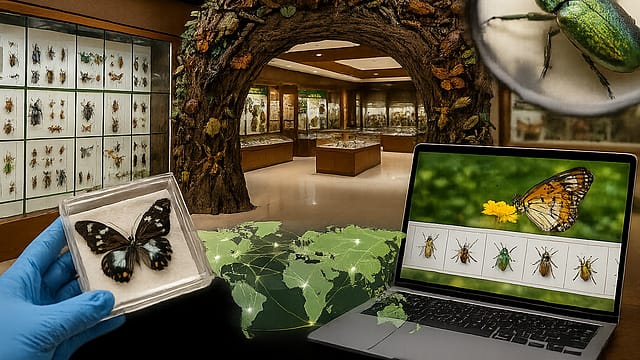
India’s first Insect Museum, housed at the Tamil Nadu Agricultural University (TNAU) in Coimbatore, is preparing to take its vast collection of insect specimens to a worldwide audience through a new online gateway expected to launch within the next month.
The digital initiative aims to make one of the country’s most significant entomological collections accessible to researchers, students, farmers and insect enthusiasts across the globe.
Online Access Set to Launch Soon
According to officials, the museum’s online platform is in the final stages of development.
"Most likely in a month or so, sir. We are almost in the completion stage," said Murugan Marimuthu, Incubant Head of the Department of Entomology at TNAU.
The upcoming portal will operate on a payment basis and is expected to cater to both Indian and international users seeking access to the museum’s resources and collections.
Greening the Future
23 Jul 2026 - Vol 05 | Issue 30
Securing a sustainable India
Dr. M. Shanthi, Director of the Centre for Plant Protection Studies at TNAU, confirmed the timeline, saying: "We are now working for the online gateway... it will be shortly open, within one month."
A Legacy That Dates Back More Than a Century
The roots of the museum trace back to the early days of agricultural education in India.
"Originally, the Madras Agricultural College was started during the imperial period, during the British rule. In 1906, the college was established in Coimbatore," Marimuthu said.
The Department of Agricultural Entomology was established in 1912.
"By the year 1912, under the first government imperial entomologist, Dr. Fletcher, the Department of Agricultural Entomology was started by 1912," he said.
The department later expanded into advanced education, introducing postgraduate programmes in 1959 and doctoral programmes by 1961.
What Makes the Museum Unique?
Spread across 6,000 square feet, the museum features seven thematic galleries and preserves insect collections dating back to 1906.
The museum officially opened to the public in 2019 and was built with combined funding from the Tamil Nadu government, the university and private-sector partners. Officials say the total investment reached nearly Rs 10 crore.
The collection itself is enormous. Around 1,14,000 insects were gathered from 55 locations across Tamil Nadu and other parts of India through extensive field surveys, including night-time collection using light traps.
Today, the museum showcases more than 10,000 insect species, including beneficial, harmful and neutral insects.
Why Scientists Around the World Value the Collection
Many specimens in the collection hold historical and scientific significance.
Marimuthu explained that important specimens collected during the institution’s early years were sent to the British Insect Museum for classification.
"Thousands and thousands of type specimens were maintained at the centre for the benefit of the scientific community, not only for Indians, but also for the global scientific entomologists," he said.
He added that century-old specimens preserved by the department continue to help scientists classify newly emerging pest species around the world.
Changing How People View Insects
A key objective of the museum is to challenge the perception that insects are merely pests.
"Generally the public feel that the insects are, you know, untouchables. It's not so, because insects are our friends for the crop production," Marimuthu said.
He stressed the importance of pollinators to global food production.
"The role of insects is 75 per cent. That means whichever the food we are eating today, it has been the work of the insects, especially honey bees and other kinds of bee insects," he said.
Marimuthu also issued a stark warning about the consequences of losing insect populations.
"If we kill all the insects, within another five years, our food will be vanishing."
Dr. Shanthi echoed that message, saying the museum aims to showcase insects in a different light.
"Now we are having the thought of insects... they are the pests or which are the causing damage to any organisms. So that is the thought about the insects by the human being," she said.
"But here we are projecting the insects as a bugs or kings. So they are the kings in the world. They are dominating in the world."
How Insects Help Farmers Beyond Pollination
Officials say the museum also educates visitors about sustainable farming practices.
Marimuthu explained that pest control does not always require chemical intervention.
"It is not mandated that we have to, in the first hand itself, we have to use the pesticides," he said.
Instead, the department promotes integrated pest management, which relies on natural enemies such as spiders, ladybird beetles (coccinellids) and parasitoids to keep pest populations under control.
This approach helps farmers reduce dependence on pesticides while protecting ecological balance.
Inside the Museum: What Visitors Can See
The museum welcomes visitors with its central theme, "Bugs Are Kings."
A striking wooden installation carved from a single Albizia lebbeck log highlights the diversity of insect life. The display is inspired by a tree species known for hosting a wide variety of insect groups.
Visitors can also explore illustrations from Edward Donovan’s "Insects of East Indies," one of the earliest books documenting Indian insects, published in 1800.
Among the museum’s exhibits, beetles account for 38 per cent of displayed species, while moths and butterflies represent 16 per cent and wasps and bees 12 per cent.
The facility also includes an Insect Discovery Hall, exhibits dedicated to social insects and a 150-seat auditorium screening insect-related documentaries.
Why Insects Matter to Food Security
Museum officials argue that insects play a far greater role than most people realise.
Shanthi highlighted their contribution as decomposers.
"It is acting as a decomposer. So if there is no insects, there is no possibility for decomposing any waste. So it is helping the world for having the food security and also to lead a happy life," she said.
Beyond pollination and decomposition, insects form essential links in ecosystems as predators, prey and scavengers.
A Museum for Scientists, Students and Farmers
The museum serves multiple audiences.
Students use preserved and live specimens for learning and research. Farmers can identify pest damage and understand the natural enemies that help protect crops. Researchers gain access to valuable taxonomic resources.
Officials say the museum remains the only facility of its kind at the national level and carries a clear message: "Insects are Friends of Farmers."
An Open Invitation to the World
With the online gateway nearing completion, TNAU hopes to bring its collection and educational mission to a much wider audience.
"I invite all the visitors, that is the global level and also Indian different state level to visit our insect museum to explore the magnificent collection of insects," Shanthi said.
"It is not only collection, it will be an interesting feature to have the knowledge on the insects."
(With inputs from ANI)