India-EU FTA: A Deal for the Times
AROUND THE TIME MAROS SEFCOVIC WAS APPOINTED EUROPEAN Commissioner for Trade and Economic Security in December 2024, a top European Union (EU) official conveyed to the Indian political leadership that the bloc’s best negotiator had been assigned the task of quickening negotiations for a free trade agreement (FTA) that had taken a backseat because of elections in India and in Europe. The re-election of Ursula von der Leyen as president of the European Commission for a second five-year term in July 2024, soon after Prime Minister Narendra Modi returned to office for a third term, set the stage for accelerated dialogue on a trade deal often bogged down in bureaucratic banalities.
Yet it was around February 2025 that the heavy lifting on sealing the “mother of all deals”—as Leyen called the India-EU FTA—began and seemingly insurmountable hurdles began to be resolved. The trade talks gained momentum after Modi held discussions with EU leaders and gave a clear political directive to conclude the deal. “Once the political will on both sides was evident, the negotiations progressed with the shared intent to find solutions,” said an official source. Sefcovic’s appointment did make a difference as problems were quickly escalated to the level of government leaders and Commerce Minister Piyush Goyal joined his EU counterpart in reaching an acceptable middle ground. Getting through the maze of European regulations and political sensitivities on issues ranging from the Ukraine war to carbon tax was not easy, but powerful forces were at work to ensure an unprecedented convergence of interests.

Travel Issue 2026
15 May 2026 - Vol 04 | Issue 71
The Cultural Traveller
Modi was prepared to move proactively on the deal and Indian negotiators were empowered to offer quota windows to European exports in a manner that sought to obviate any likely backlash. The negotiations over apple imports to India offer a lesson in balancing trade and politics. The FTA allows import of apples at a landed price of not less than `96 per piece. In 2024, India’s apple imports were about five lakh tonnes, with the EU accounting for less than 60,000 tonnes. Now the EU can export a maximum of 50,000 tonnes rising to 100,000 tonnes in 10 years at 20 per cent duty. On the other hand, Indian apples get zero duty over five-seven years, accessing a premium segment in the EU. The deal offers a choice to Indian consumers, protects fruit growers, and encourages farmers and exporters to consider the benefits of a new stream of income. The government is actively trying to explain the nitty-gritty of the FTA in a bid to bridge the trust deficit with fruit growers and the Indian agro-industry on a politically sensitive farm issue.
When Goyal met German automakers on a visit to Europe, they cut to the chase and said they understood that competing with cost-effective cars manufactured in India was a tall order. But they were keen to “test” the market and sought access to the upper-end auto segment. Although not exactly comparable, thoughts about how the demand for Apple’s iPhones soared in India came to mind. Not many people had foreseen that an iPhone costing `1 lakh and more could command a large market and yet the availability of the phones—and attractive payment options—spurred a phenomenal demand. German automaker Mercedes-Benz said its Global Capacity Centre in India was involved in the design and innovation of new models and was also a major foreign exchange earner. Large-engine-size vehicles have been offered a quota while liberalised CKD (completely knocked down) imports are intended to encourage the EU’s original equipment manufacturers (OEMs) to opt for local assembly lines, accelerating localisation already underway. If a segment of consumers wanted to buy costly vehicles, it did not impact 90 per cent of auto sales in India. The terms of the deal also provide a hedge against non-European companies, whose base of operations may be of concern, from exploiting the FTA to route auto exports to India.

Yet the elements were not always so propitious. Speaking at the GLOBSEC 2022 Bratislava Forum, External Affairs Minister S Jaishankar’s admonition—“Somewhere Europe has to grow out of the mindset that Europe’s problems are the world’s problems but the world’s problems are not Europe’s problems”— went viral, capturing India’s exasperation at European attempts to pile the pressure on New Delhi for its ties to Russia and import of Russian oil. The Modi government found the moral indignation preposterous given Europe’s own dependence on Russian gas and import of refined petroleum products from India. But the animosity towards Russia after its invasion of Ukraine had peaked and European officials lashed out in all directions. It is an irony, an official pointed out, that the cost of power in Germany is much more prohibitive than in India and that this has a lot to do with the decision of Angela Merkel’s government to phase out nuclear power in 2011 and increase dependence on Russian gas.
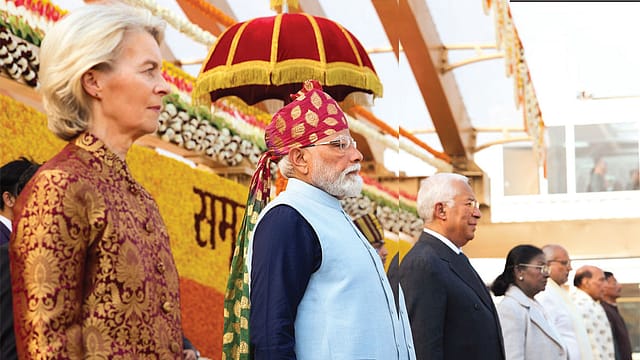
The meeting between Modi and von der Leyen and António Costa, president of the European Council, in New Delhi on January 27 did discuss the Ukraine war. The very last question by a European journalist to Goyal and Indian officials at a press conference that day zoned in on Ukraine and asked if India is ready to scale back its defence cooperation with Russia. Foreign Secretary Vikram Misri, quick to grasp a tripwire question, said the India-Russia relationship stands on its own. He then added: “PM indicated he had been in contact with both countries [and] favoured a negotiated solution. The PM himself has played a role whenever he met the two sides and said India is ready to do whatever to support a negotiated solution. We are keen to see the earliest possible cessation of this conflict.” In this manner, both sides negotiated a difficult bend and moved on.
THE UNSETTLING EFFECTS OF Donald Trump’s election as US president in November 2024 and his unbridled weaponisation of tariffs was no doubt a strong prod to both sides to conclude the FTA. After initial attempts to resolve differences, Modi refused to budge on India’s red lines, such as dairy, agriculture and GM foods, in negotiations with the US. Modi did not rise to the bait when US officials like Howard Lutnick and Peter Navarro heckled India on tariffs, choosing to ignore the salvos though he said India would respond to “economic selfishness”—a fairly apparent reference to Trump tariffs—by building its own strengths. While Trump slapped cumulative 50 per cent tariffs on India, European leaders were staring at the breakdown of the North Atlantic Treaty Organization (NATO), the most significant of post-Cold War security arrangements that wedded the US and Europe to a mutual defence matrix. But while the “Trump factor” played a role, the negotiations required a strong commitment to stay the course and find innovative solutions to differences that had defied resolution for decades.
Trump’s threat to take over Greenland, by force if necessary, might have been the last straw for European leaders but the details of the FTA with India were worked out painstakingly over months of negotiation. On September 4, 2025, Modi held a joint phone call with von der Leyen and Costa and while welcoming progress in bilateral relations in key sectors, they reaffirmed a shared commitment to an early conclusion of the India-EU FTA. Both sides were realising that an FTA between the two large economies would be a powerful statement reaffirming the value of multilateralism, trade, trusted partnerships and integrated supply chains. The trade deal would be a new compact that stood in contrast to Trump’s “chainsaw” approach to longstanding alliances and global institutions the US had helped build. In 1991, a severe balance of payments crisis jolted the PV Narasimha Rao government into taking measures that were hailedas India’s economic liberalisation. But it still required immense political resolve and courage to abandon socialist planning and embrace globalisation.
With the backing of the political executives, solutions were found to contentious matters like the EU’s Carbon Border Adjustment Mechanism (CBAM) by working out commitments towards technical dialogues and a pledge that any concession extended to other parties would apply to the India FTA as well. Indian negotiators are confident that the final outcome will not impact India’s interests and point out that European businesses are also finding the new carbon regime onerous. “They feel the rules are reducing their competitiveness,” said a source. Similarly, the discussions on Indian steel are likely to result in arrangements that will ensure minimal impact on exports at the current level. Both sides have reposed faith in mechanisms provided by the FTA to address complaints or conflicts of views that impact market access and hinder the deal’s operationalisation.
As the larger dimensions of the deal become apparent, the terms on which India is ready to negotiate and conclude trade deals have become clear and have a bearing on the stalemated India-US Bilateral Trade Agreement. US trade representative Jamieson Greer, in his initial reaction to the India-EU FTA, said that India seemed to have come out on top. He complained that Europe was “doubling down” on globalisation while the US was trying to fix problems at home. Indian officials maintained that discussions with the US were continuing on a “cordial” note and a deal would be inked as soon as a fair balance of interests was achieved and green-lighted by the respective leaderships. It does seem that sealing deals with major developed economies will strengthen the Modi government’s determination on keeping certain sectors out of trade deals even as officials point out that the Trump tariffs are hurting less than anticipated. Meanwhile, the access provided by the EU FTA is a boost for precisely some sectors like marine food, leather goods, and textiles hit by the US tariffs. This does the National Democratic Alliance (NDA) no harm ahead of state elections in Tamil Nadu where these industries have a major imprint.
The FTA with the EU has a strong inward dimension even as it aims to open EU markets to Indian goods and services. Indian businesses will need to meet quality specifications to access new markets and this requires abandoning over time a dependence on import-duty protections and becoming competitive. Modi’s January 25 radio talk Mann ki Baat began with an exhortation. “Today through my talk I want to say to youths associated with industry and startups that India’s economy is growing rapidly and the world’s eyes are on India… all of us share a big responsibility to concentrate on quality. Things will happen, things will get by… this era is over. Let’s give priority to quality. Our mantra this year should be quality, quality, and only quality,” he said. This was not the first time Modi had made the point, but the reference was not casual.
As an Indian official put it, the benefits of the deal and those signed with other nations will require Indian enterprises to abandon a play safe mentality. In 2025 decisions like the reduction of Goods and Services Tax (GST) rates and slabs, implementation of the labour codes, and opening nuclear energy to private and foreign participation helped beat any downturn in consumer sentiment that might well have happened after the Trump tariffs.
The India-EU FTA can be expected to help maintain an upbeat mood and a sense of anticipation about the Indian economy. The FTAs concluded with the UK and with the European Free Trade Association (EFTA, comprising Iceland, Liechtenstein, Norway, and Switzerland) now potentially provide access to the entire European continent. The Modi government will be busy hereafter completing trade agreements with Chile and revising previous deals with Japan and ASEAN. The FTAs signed in recent months will go through a process of legal scrubbing but their rollout on the ground may not take too long. In the case of the EU FTA, there is a role of bilateral diplomacy in quickening ratification and India has improved ties with the 27-nation bloc. For example, events such as the India-Nordic Summit regularly bring together India and Denmark, Iceland, Sweden, Finland, and Norway. The India-EU FTA is a crowning moment as the bold political moves have opened the path for India’s rise to the global high table.