India-EU Deal: The Ultimate Bargain
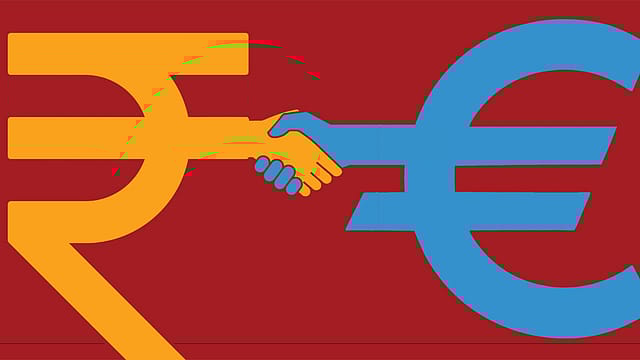
SOON AFTER INDIA AND THE EUROPEAN UNION (EU) agreed on a Free Trade Agreement (FTA), the president of the European Commission, Ursula von der Leyen said she wanted to speak about an event that held deep meaning. In her remarks on Tuesday, January 27, she said, “Two weeks ago India marked Makar Sankranti, it is the beginning of uttarayan, the sun’s northward journey, from darkness to light, from stillness to growth, from what was to what can be, and that is what makes our summit so unique.”
The words were appropriate but the sentiment behind them reflected not just the current state of global politics and trade but also what could be possible. It is not surprising that it was India and the EU that seized the moment and agreed on “the mother of all deals”. The repeated emphasis by leaders from both sides about reliability, trust and upholding a rules-based global order is akin to shining a light on a world beset with renewed imperialist dogmas and trade being seen as a zero-sum game.
The visit of von der Leyen along with António Costa, president of the European Council, culminated not just in the announcement of the FTA but also 12 other outcomes, including one on security and defence partnership. In all, these outcomes signal a much deeper engagement between India and Europe than ever before. Unlike other countries and trading blocs, trade with the EU is not just about export and import of goods and services but akin to a lock-in into a regulatory ecosystem. From regulatory oversight over clearing houses to administrative arrangements on advanced electronic signatures and seals among a host of other arrangements.
The Grand Design
17 Jul 2026 - Vol 05 | Issue 29
How the Modi government is planning to get its biggest political agenda passed in Parliament

In 2025, bilateral trade between India and the EU stood at $136.4 billion, with India enjoying a modest trade surplus of around $15 billion. In 2021, bilateral trade stood at $81 billion and has inched up to the $135 range in the last three years. Once the FTA is operationalised, there is good reason to believe this figure will quickly ratchet up to $200 billion.
In a preliminary assessment, the Kiel Institute for the World Economy said, “Model simulations suggest that a comprehensive agreement could increase Indian exports to the EU by 41% and EU exports to India by 65%. The resulting income gains— equivalent to roughly 22 billion Euros for the EU and 4.2 billion Euros for India—are predominantly in export-oriented sectors such as IT services, textiles, chemicals, machinery, and food processing.” This is, however, just the start.
Under the FTA, nearly 99 per cent of Indian exports will see tariffs being eliminated in the medium to long run while the EU will see tariffs being eliminated on 97 per cent of its export lines. For India, key sectors such as textiles, apparel and clothing will see tariffs being cut to zero from the current 12 per cent; for leather and footwear to zero from 17 per cent; electronics to zero from 14 per cent; gems and jewellery to zero from 4 per cent; chemicals to zero from 12.8 per cent; and on marine and seafood products to zero from 26 per cent. Agriculture, a sensitive area, has been kept out of the FTA. The EU will sympathetically treat Indian concerns about the Carbon Border Adjustment Mechanism (CBAM), a European red line of sorts.
For India, the EU FTA represents a geoeconomic opportunity that it has been seeking for a while. Let’s consider just two lines of items in the thousands of product lines that make up India’s export basket: marine products and textiles and apparel. These are lines where India has a comparative advantage over a large number of countries but because of skewed trade arrangements and, of late, punitive tariffs, these exports have not increased to the level possible. Take marine exports. The US is the largest export market for Indian products, especially the Vannamei (Whiteleg) shrimp. Andhra Pradesh was the biggest exporter among Indian states. But with tariffs, tailored to hit this product, Indian exports have gone down even as those from Vietnam have gone up. The tariffs have made even the downright uncompetitive Louisiana shrimp catches competitive.
The same story was repeated in the case of apparel and textiles. Countries like Bangladesh and Vietnam did well. The former due to the very generous arrangements under the EU’s Generalised System of Preferences (GSP), the set of tariff exemptions accorded to least developed countries, and the latter due to exceptionally strong trade competitiveness. India exited the GSP system earlier this year but even then, did not enjoy the same exemptions given to Bangladesh, the so-called Everything but Arms (EBA) under which it could export duty-free and quota-free to EU countries.
With the EU FTA, tariffs on Indian exports of textiles, apparel and clothing will be reduced to zero from the current 12 per cent while in the case of marine and seafood products, India will get preferential access with tariffs going down to zero from the current 26 per cent. India’s exports of marine products (bunched together as 03 in the harmonised system of classification) to EU countries were barely a tad above $1 billion in 2024-25 while its apparel and textile exports stood at $7.6 billion. Between January and November 2025, Bangladesh exported $21 billion worth of apparel to the EU, three times the amount India exported to the EU despite having better infrastructure to manufacture and export these goods.
That is set to change for both marine and apparel lines. In one case, marine products, not only will India make more gains in the European market but will also diversify from an unhealthy dependence on the US market. In the other case, apparel and textiles, India now has a chance to grow its exports with a more level playing field.
In a world where possibilities for trade are receding and where mercantilism is the dominant theme in large exporting countries like China, the India-EU FTA sends a positive signal that trade can benefit everyone engaged in it, the original message behind globalisation that began in the 1990s but one that has been lost in the first quarter of the 21st century. Unlike the US, a trade agreement for the EU and India means what it is: a predictable set of commitments not reneged on because of whims.
EACH FTA SIGNED BETWEEN two different partner countries or, as in the present case, a bloc of countries and its partner, has its own economic and political dynamics. In the normal course, the political considerations are usually domestic: countries are worried about creating too many losers from trade while too few gain from liberalisation. The risk of a domestic political backlash is very real.
Or that was the theory, until very recently. Now, the political considerations are global. All this was in play in the weeks and months before the India-EU FTA was agreed on January 27.
In July last year, the US and the EU arrived at a ‘trade deal’ under which exports from the EU to the US would attract a 15 per cent tariff with “no stacking” above that figure, in effect the 15 per cent tariff was to be a ceiling. Even as proceedings to ratify the deal were going on in the European Parliament, earlier this month US President Donald Trump threatened to impose a 10 per cent tariff on goods exported by key EU member-states—Denmark, France, Germany, Norway, Finland, Sweden, and the Netherlands— and the UK as leverage in his attempt to wrest Greenland from Denmark. This 10 per cent tariff was to come into force from February 1 followed by an increase in tariffs totalling 25 per cent by June 1 if “negotiations” on Greenland did not progress.
A united EU gave an unambiguous signal to the US that Greenland was not up for grabs. This averted the fresh Trump tariffs but left Europe in an unenviable position. In 2024, exports to the US accounted for 20.6 per cent of the EU’s total exports. In contrast, China’s exports to the US stood at 15 per cent in 2024. Europe’s dependence on the US for exports is significantly higher than that of China. Trump is aware of this vulnerability. His actions are calculated on the basis of that fact.
What the world is witnessing is an age of “diminished expectations”, to use the expression popularised by Paul Krugman. On the one hand, Trump is in no mood to allow trade as usual. Just days ago, he ripped up another trade deal—this time with South Korea—and said he was increasing tariffs on automobiles, lumber, and pharmaceuticals imported from South Korea from 15 per cent to 25 per cent. On the other hand, the world’s second-largest economy, China, amassed a trade surplus of $1 trillion in 2025, with export growth remaining undiminished even after the “Trump shock” last year. Europe does not have an FTA with China and talks have remained stuck. In 2024, the EU imposed tariffs of up to 45.3 per cent on electric vehicles (EVs) from China, a segment in which China has overwhelming dominance compared to any manufacturer in Europe.
That left the EU with very few options for furthering trade in a world where barriers against trade are being erected swiftly. India, for long maligned as a protectionist outpost in a free-trading world, was considered an unlikely choice at one time. But since 2021, India has concluded eight FTAs, a signal that it is open for business.
India and the EU have been negotiating an FTA for the past two decades and talks over a trade agreement came to a halt in 2013. But last year in February, the EU’s College of Commissioners visited India and trade talks began in earnest once again. Less than a year later, a landmark trade agreement has been agreed upon. It is worth noting that the renewed impetus on trade talks began well before Trump imposed punitive tariffs on India. Since then, the world has seen considerable political and economic turmoil.
Going by the biannual updates from the International Monetary Fund (IMF), the global economy continues to exhibit some growth. But it is interesting to note that since 2022, the global economic growth has remained hidebound in the 3.2 per cent to 3.3 per cent range. The average for the decade from 2006 to 2015 was 3.7 per cent. The way out of this stagnation at the global level is to push for greater trade and lower trade barriers. Since 2016, when Donald Trump was elected US president for the first time, the world has become more protectionist and trade is not a policy of choice for the US. Only trade dependent countries have sought greater market access.
In this context, India, a country that has a history of protectionism since Independence, has sought and charted a new course in the past six-odd years. Where necessary, it has shied away from trade agreements inimical to its economic interests. The Regional Comprehensive Economic Partnership (RCEP), an Asian FTA that would have opened the floodgates to Chinese exports, is a case in point. India did not subscribe to the agreement when it was signed in late 2019. With loose rules of origin, it was a certain recipe for Chinese goods into India, something New Delhi discovered to its detriment in the case of its FTA with ASEAN countries. Those countries are resistant to renegotiating the agreement in any way.
In the 20th century, if not earlier, trade has always been intertwined with politics. In the case of India and the EU, political barbs were thrown regularly at each other until very recently. Things changed dramatically after the Trump tantrums last year. Europe, which routinely berated India for buying Russian oil, has now fallen silent, at least publicly, on the issue. India, for its part, has discovered that it makes much economic (and political) sense to deal with Europe with an open mind. If India felt that Russia was, and remains a great partner, can one rule out that Russia will get closer to the US, a country that has turned hostile towards India? The current conjuncture is such that each country has to make the best of what it can. India is no exception to that and neither is the EU. The FTA represents an effort to shore up stability in a world where turmoil is the norm.