In the Footprints of the Bhutia: In search of the Himalayan sheep dog
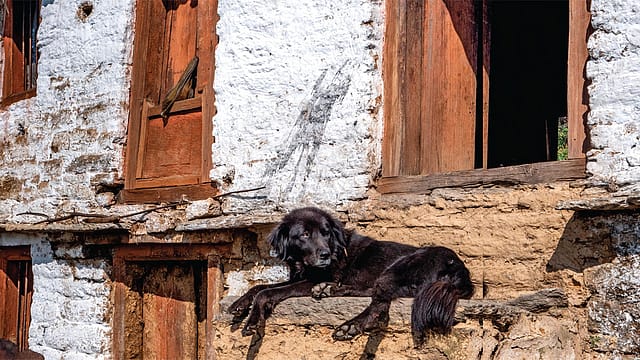
THE TWILIGHT CAST AN orange hue on the snow-capped Panchachuli peaks, as the small market in Munsiyari, a Kumaoni town in Uttarakhand, came to life at a quiet, laidback pace. All of a sudden, from somewhere down the street, a large furry black dog came sauntering down, weighing each step, his gait that of a king. Someone on the road said “Bhutia hai”. Unable to resist the temptation of befriending this bearlike dog, I bought a packet of biscuits to feed him. He barely sniffed the biscuit, stared at me with his topaz eyes, almost orange in the reflection of the setting sun, turned away and sat in a corner of the street. I tried again. No response. The shopkeepers looked, expressionless, like they knew he would turn down my offer. Other smaller dogs ate the biscuits. The Bhutia did not budge. For me, it was love at first sight. Unrequited.
That was my first encounter with a Bhutia, a Himalayan Sheep Dog, which is called by several names: Gaddi in Himachal Pradesh, Bhote Kukur in Uttarakhand and Nepal or the Himalayan Mastiff. It remained etched in my mind, eclipsing all other memories of Munsiyari. On every trip to the hills, I would look for a Bhutia, almost as elusive as the leopard, which also inhabits the areas. I discovered that every year, in the middle of January, on Makar Sankranti, local breeders would sell Bhutia pups at the annual Uttarayani Kauthik mela in Almora’s Bageshwar district, at the confluence of the Saryu and Gomti rivers. Amidst the traditional dances, cuisine and trade in local produce, local men and women bring pups from the higher reaches in large cane baskets, wrapped in light cloth, to sell at the mela, one of the oldest fairs with historical, spiritual, cultural and social significance. After all, the majestic Bhutia dog, with its legends and lore, known to take on leopards, guard livestock and lead people who lose their way in the forest, is an undeniable part of the state’s heritage. And, its numbers are on the decline. I added the Bageshwar mela to my bucket list.

Survival Instinct
22 May 2026 - Vol 04 | Issue 72
India navigates global economic turmoil with austerity and smart diplomacy
Years after the Munsiyari visit, on a cold evening, having tea and pakoras with friends and local villagers around a sigri, a portable iron fireplace, at a Kumaoni village in Nainital district, I mentioned that I wanted a Bhutia as a guard dog in the hills, knowing that the Delhi heat could be disagreeable to a breed that was accustomed to the snow. By then I had rummaged through every bit of information I could find about the Bhutia, considered a sub-breed of the Tibetan Mastiff, powerful and protective, once a lifeline for the inhabitants of the Himalayas. A driver, who belonged to Munsiyari, said finding a Bhutia would mean going to the higher reaches like Pindari, famous for its glacier. The breed, in its original form, was dwindling in numbers. I gave my number asking
him to call if he ever found one. Around eight months later, he called. “Ek hai Bhutia, aapko chahiye toh. Pure hai. (There is a Bhutia if you want. It’s a pure breed),” he said. I told him that I would take a call once he sent a photograph, sensing deep down that I had already made up my mind. He sent a picture—a black pup, the size of a palm, sitting calmly on the roof of a car. It had to be brought from a forest near Munsiyari. When he got it, he held the pup by the fur on the head, torso and paws hanging down, saying this is one way of checking if it is really a Bhutia. The pup did not cry, passing the test. But, by then, it did not matter to me whether he was really a Bhutia or not. They say dogs find you. I wanted to believe that.
From the moment he came, a spritely pup biting everything that his eyes fell on with his tiny, knifelike teeth, he turned the house and my life upside down. As mischievous as a pup can be, he used all his intelligence to play new pranks. But, as he started growing up, at a pace I had not imagined, he calmed down, though still mischievous, reminding me of a young monk. When the veterinarians said he will grow bigger than a Labrador, it was hard to believe. He did. The bigger he grew, the gentler he became, his looks and gait similar to the one I had seen in Munsiyari.
A few days after the pup came to our house, a friend had started looking out for a Bhutia. “It is difficult to see a pup and gauge if it’s a pure Bhutia. You have to see the parents to know how he will grow up,” the driver said. After much exploring, the friend found that someone was bringing pups from the hills of Kumaon to sell in Delhi. He picked up one pup, and then another, which followed him limping, caused by the cramped manner in which the pups were transported from the hills. The three Bhutias—each different in appearance, temperament and traits—became friends. At times, there would be signs of a leopard lurking around. One evening, seeing a leopard walk down the road below, one of the dogs started barking, drawing the attention of the other two. They joined him, barking and moving along the hill, parallel to the road, till the leopard disappeared, its smell fading as it went farther away. In the hills, the fear of the leopard coming for the dogs hangs heavy. The three grew up together, their double-coated fur shedding in summer and regrowing in winter, playing, fighting, resilient and rapturous when it snowed. Like any dog, they would jump excitedly to greet, ecstatic and grateful, making every homecoming feel like one of life’s happiest moments. But a Bhutia’s lunge could topple you, and three together could crush you in their affectionate embrace.

THE VETERINARIANS IN Delhi advised neutering them for physical and psychological benefits, assuring they would be temperamentally much calmer. Laws in several states of the United States, for instance, make it mandatory to sterilise animals adopted from shelters and rescue groups. It was a tricky call—besides the arguments between ethics and benefits, there was also considering the fact that the species were hard to come by. After some mulling over it, all were neutered, something which rankles at times, more with the realisation that the Bhutia, in its original form with all its characteristic traits, is a rarity. I convinced myself saying where would one find a female Bhutia to crossbreed them with.
Named after the Bhotia, Bhutia or Bhote tribe living in the higher altitudes of Himachal Pradesh, Uttarakhand, Sikkim and Nepal, the breed has a striking resemblance to the Tibetan Mastiff, a flock guardian dog with its thick fur, a fluffy bouquet-like tail, drooping ears, large snout, strong paws. It comes in a variety of colours—black, deep brown, light brown, tan, white, grey or a mix. “The dogs of Tibet are twice as large as those of Hindustan; they have large heads and long coats, and are very strong and fierce, and are said to be a match for a lion. They are good watch dogs at night,” wrote Mir Izzet Ullah in Travels Beyond the Himalaya, an early 19th century account of his journey in the hills from India to Tibet, undertaken on the instance of English explorer and veterinarian William Moorcroft.
While male Tibetan Mastiffs stand at 26-29 inches, weighing 40 to 70kg, and female at 24-27 inches, weighing 30 to 55kg, the height of male Bhutia is in the range of 20-25 inches, weighing 25-50 kgs, and females are slightly smaller. The Bhutia traders at Bageshwar quote between `2.000 to `10,000 for a pup, much lesser than the price of the Tibetan Mastiff, a globally acknowledged breed, which can cost anything between `60,000 to `1 lakh. The Tibetan Mastiff was, in 2006, recognised by the American Kennel Club (AKC), in the Working Group category, and The Kennel Club (UK). In India however, the Tibetan Mastiff was included in the list of 23 banned breeds in March 2024, following rising complaints of dog attacks.
Early this year, I came across a news item that the Gaddi, as the Himalayan Sheep Dog is called in Himachal Pradesh, has been officially recognised as a registered breed by the National Bureau of Animal Genetic Resources (NBAGR), which falls under the Indian Council of Agricultural Research (ICAR). The agency has also undertaken characterisation of the Bhutia dog, for consideration in time to be registered as a distinct breed. “The population of these Bhutia and other Himalayan dogs seem to have dwindled in recent times due to declining pastoralism, an age-old practice, in the Himalayan state. Recognition of the Bhutia dog as an indigenous breed would help in protecting and conserving this precious germplasm and would open new vistas for their alternate utilisation in defence and guarding the borders,” says Dr NH Mohan, Director, ICAR-NBAGR.
It is high time that drastic steps are taken to preserve the species in its original grandeur. Describing the Bhutia dog as the closest companion to humans in the mountainous region, Dr Mohan says they are an integral part of the Himalayan pastoralist tradition due to their adaptability to high altitudes where they remain along with herders, managing livestock and protecting them from predators while grazing in alpine and temperate pastures. The ICAR-NBAGR, which initiated registering indigenous dog breeds in 2020, has so far registered five indigenous breeds, which includes two breeds from the Himalayan region: Gaddi of Himachal Pradesh and the Changkhi which thrive in the cold Ladakh desert. The other three are hounds—Rajapalayam and Chippiparai from Tamil Nadu and Mudhol of Karnataka. These breeds have been notified in the central government’s official gazette.
Dr Raja KN, Principal Scientist, ICAR-NBAGR, Karnal, who is working along with his team on the characterisation and documentation of indigenous dog breeds of India, says there are similarities between Gaddi and Bhutia in terms of physical appearance, utility and altitudes where they are found. However the Tibetan Mastiff is heavier than both. “Once we find the maternal lineage through genetic analysis, we will compare the genetic characteristics to find out how far they are similar and different,” he says. He and his team are collecting DNA samples of the Bhutia to determine their origin and whether the Bhutia and the Gaddi are genetically different or similar. The study may also verify the theory that both the Bhutia and the Tibetan Mastiff are descendants of the mastiff-type dogs used by nomadic people and in monasteries across Tibet, India and Nepal.
IN MY MYRIAD trips to the hills over the years, I may have come across just around five Bhutias. Dr Himanshu Kumar, a Haldwani-based veterinarian who, having realised that taking three adult Bhutias on a three hour journey to his clinic required three vehicles, would drive up the hills himself, says that there is one Bhutia for every hundred dogs. With its sheep-like heavy fur, the dog can camouflage in the flock, taking the leopard by surprise if it attacked. “There was very little awareness about the Bhutia breed. It was found in far flung higher reaches, where the older folk know about it. Outsiders who visited these areas, driving or trekking up, would come across these dogs and that is how they started becoming known in other parts. Breeders started trekking to the higher reaches to pick up the dogs to sell,” he says. As for its temperament, he says it is friendly by nature and gets aggressive only when it sniffs something suspicious.
While scouring for information on the breed, I read that the first dog to conquer a Himalayan peak of over 23,000ft was a female Bhutia. Named Mera by trekking guide Don Wargowsky, who was part of a Seattle-based team, as she was found near Mera peak, the animal had joined the climbers to scale the Baruntse peak in Nepal. Another feather in the Bhutia’s cap.
Concerned that what has been a “pride of Uttarakhand”, was diminishing slowly, in Ranichauri, on the Garhwal side of Uttarakhand, a local youth Akhilesh Dangwal, began his quest to run a kennel for Bhutia dogs in 2018. He treks up to the higher reaches, the remote areas of Uttarakhand and Himachal Pradesh, and sitting at dhabas, sipping tea, finds out any information possible from the locals about the dogs. He then goes on a two-wheeler or treks in their search. When he finds one, he, at times, bargains and buys it. “Earlier, the shepherds knew about them, but later they compromised on the breed. They passed on knowledge about maintaining the blood line of livestock to their children, but not about retaining the purity of the Bhutias. Now, the locals let them mate with any dog. But I realise their value,” he says, as he treks up the Uttarakhand-Himachal Pradesh border looking for large Bhutia dogs.
It had all started with a trek along with his friends in Uttarkashi, 10 years ago, when Dangwal was 20. He saw shepherds with 4-5 Bhutia dogs and requested them to give him a black one. They refused. Determined to get one, he trekked to Pilang Gaon, a village at around 8,000ft. He managed to get a female Bhutia pup from the locals. By 2020, he had three, and he started putting out videos on YouTube, drawing responses from people. He now has over a dozen Bhutias. If a buyer wants to take the dog to the plains, he tells them that it will require an air conditioner in the summer. He believes that the Bhutia has been neglected over the years. “The big Himalayan Sheep Dogs and the Tibetan Mastiffs look so similar, but how much awareness is there about the Bhutia?”
Somewhere amidst the rage for imported pedigreed breeds, the Bhutia, unwavering in its loyalty and tasks as a working dog in the difficult Himalayan terrain, started fading into obscurity. If you are fortunate, you may find a Bhutia, shepherding a flock, following a shepherd, walking through a market or lazing in the sun, on a trip to the Himalayan ranges. I was. It sent me on a life changing trail. Meanwhile, the teeth marks on the furniture remain, a reminder of a time that will never return.