In Spite of Jantar Mantar...
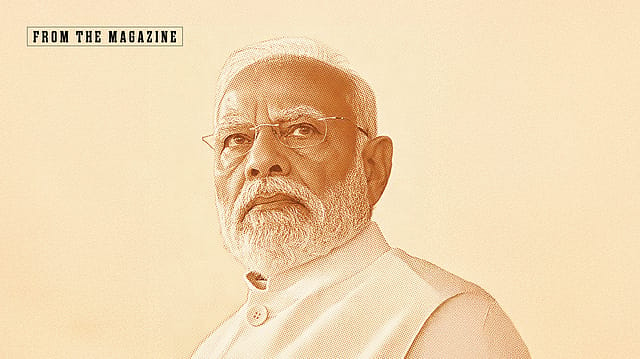
NARENDRA MODI IS THE ULTIMATE IN-SPITE-OF MAN IN POLITICS. The arc of his life in power is an epic in overcoming the odds, and the uneven text of which has only one constant: adversity advances reinvention. He is there again, staring at a narrative rupture in the story he has been telling about India, relentlessly adding cultural motifs to it to keep the largest audience in a democracy hooked. When the genuine generational disaffection at Jantar Mantar—no matter how political piggybacking and well-heeled protest tourism stole the camera time—intruded into the plot, the story lost the frisson. In spite of Jantar Mantar, will he have the space and creative resources to rephrase the story and win back the argument?
Travel back in time to realise the possibilities of in-spite-of politics in the life of a man who has perhaps travelled the longest distance to remind India that the journey is more thrilling than the destination.
In the early Noughties, the chief minister of Gujarat could have lost the way when communal hatred raged in the street. The embers burned for long, and the horror was constantly modified in retellings. Modi was the only punishment his adversaries sought for the crime, which defied the administration with the spontaneity and intensity of raw emotions. He would go on to become the “Chief Minister of India”, and it was in the uneasy aftermath of 2002 that he began the nationalist project. The size of the stage did not restrict a performance, the impact of which went far beyond Gujarat.
Even then, within the Parivar and without, the harrumphing class wanted his story to be told in the vocabulary of a past he didn’t fully own. A Modi confined to a bad memory was more bearable than the one in a captivating conversation with India for those who were unnerved by his pace and voice. He fought every election as the chief minister directly talking to India, and the thematic variety of his stump speeches, ranging from 9/11 to global terrorism to Mian Musharraf, and told every time with a flamboyance that electrified the base, gave early signs of the trajectory the Modi surge would take. He never lets others alter the text.
Which was evident when the surge took him to Delhi in 2014. He made himself the choice in spite of a party establishment that was slow in reading the enormity of the cultural shift taking place in front of them, all in the shape of one man who refused, all along, to be shown the path—or the place—by others. And as prime minister, the priesthood of the right expected him to be a Reagan or a Thatcher with an Indian accent, not bothering to consider the inevitability of the state in a woefully unequal country like India. The grand gestures on the stump (or what the late American politician Mario Cuomo called the poetry of campaigning) were followed by the prosaicness of governance. He was not too eager to win the economic war, as the rightwingers did elsewhere, at the cost of losing the culture war. A gradualist in the marketplace and a revivalist in the cultural place, Modi’s modernisation programme didn’t follow an ideological script; neither did it adhere to ideas that clashed with the cultural traditions that shaped him. It is the clarity of the India on his mind—the argument on which is not yet concluded—that made the popular mind so easily accessible to him.
He continued to win because his message bridged the demographic divides. Two of his strongest constituencies were the young and women, who shared, with the kind of trust most politicians nowhere else ever gained, the future he presented. He tapped into the aspirations and anxieties of the young that extended beyond the cities, to the villages, and in him they could see the possibilities of pursuit, not of power. For a politician to achieve that level of electoral intimacy was the victory of imagination over his opponents’ rejectionism. Modi prevailed in spite of being rejected, as against being engaged with, by a section of India and its political endorsers because power, in his book, was a campaign without a pause. As he conversed with India, others just conversed with him, and consistently lost the argument.
And then came along Jantar Mantar, and those who dared him were a familiar lot, and in the past, Modi had never missed the sweep of their resentment. The bathetic sight of his shrill opponents piggybacking on the young protesters may have marred the moral content of the protest. It didn’t minimise the authenticity of the grievance, and it took a while for him to accept it, which was very unlike him. When he did, it was apparent that he was acknowledging a sentiment larger than the theatre of the cockroach. And by so doing, he once again proved to be better than his cheerleaders on social media in gauging the mood.
Being Modi is harder than being an idea trapped in political iconography. In the former, power grows from the emotional depth of a politician’s relationship with his country. It’s a lonely leap of faith when an icon breaks the mould and reaches out to a constituency he was on the verge of losing. To renew the conversation with an idealistic generation, you should not allow your conscience to be conditioned by iconography. For someone who spent an uninterrupted quarter of a century in power, it takes that kind of freedom to keep the people not as a useful mass but as a live, restless reminder of what you are. Jantar Mantar held a mirror, and he read himself correctly. Such reckonings are redemptive.