Humanising Intelligence
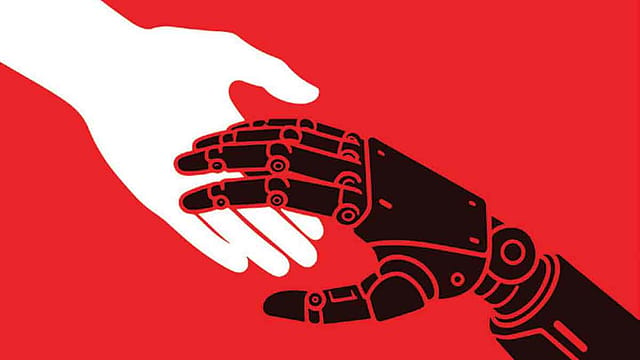
WE ARE STILL FIVE HUNDRED YEARS AWAY from Aldous Huxley’s World State, where technology-curated intelligence determines social hierarchy. Doom-mongers are prone to place the dystopian vision of Brave New World just here, and now, in a world where, it has been reported, Anthropic’s popular AI chatbot Claude has been used in the abduction of the Venezuelan dictator Nicolás Maduro. And, according to the Wall Street Journal, Anthropic, which has a relationship with the Pentagon, is not happy about the use of its AI tool for such an operation. The Pentagon is not happy about Anthropic’s unhappiness either. In the end, this has only anecdotal relevance as the AI boom, the biggest technological revolution humanity is staring at with awe and anxiety, continues to defy a consensus on the future. For the negativists with an ethical excuse, it is the death of scientific imagination by the hands of its own creation: the digital Frankenstein is on the run as his monster prompts apocalypse. This is a familiar alarm that rings whenever the speed and the volume of the new threaten your sense of security—and the power of the unknown feeds on your fears. For the optimists who won’t allow any clause to spoil their preprogrammed text, it’s not that you become slave to the machine. It’s that humanity will be redeemed by extra-human intelligence. The conversation on the AI moment veers to the extremes.
And it’s not as simple as the question of who will own the future, man or machine. It’s not even about a possible clash between techno-absolutists and techno-moderates. It’s about managing the trajectory of lab-born creativity, and the struggle to comprehend its possibilities. The moment resembles, in its promises and its power to influence the mass mind, what religion and then ideologies did to humanity: a heaven on the wretchedness of the present—the ordeal of reaching there is a test of moral as well as social obligations. Heretics and apostates make the parable contentious—and contemporary.
Survival Instinct
22 May 2026 - Vol 04 | Issue 72
India navigates global economic turmoil with austerity and smart diplomacy
The moral quotient of the machine age seems to have got its apostle in one of the AI visionaries. And everyone is reading Anthropic CEO Dario Amodei’s essay ‘The Adolescence of Technology’, a kind of manifesto for the humanisation of artificial intelligence. Amodei, seen as woke in the Trumpverse, is not a doomsayer but a proponent of what he calls Constitutional AI. At a time when badly behaving (from scheming to sycophantic) intelligence systems are a reality, his caution is a sign of god’s own nervousness. By constitutional he means behavioural restrictions on autonomy-craving AI tools. As AI models are good enough to be used by terrorists against governments and individuals (prompted annihilation rivalling 9/11), or by sundry autocrats to digitalise their paranoia, Amodei’s creator-caution is bound to have an audience. He remains optimistic, asking the creators to be honest about the inherent risks. In his conclusion, he acknowledges that ‘human’ is a more futuristic adjective to ‘intelligence’: “The years in front of us will be impossible hard, asking more of us than we think we can give. But in my time as a researcher, leader, and citizen, I have seen enough courage and nobility to believe that we can win—that when put in the darkest circumstances, humanity has a way of gathering, seemingly at the last minute, the strength and wisdom needed to prevail. We have no time to lose.”
This could be the last minute. Technology is power—and it’s freedom too. Artificial intelligence, all said, seeks its newest frontiers in private research labs, except in China, which is fast emerging as an AI superpower. Still, it is not the politician, again except in China, who will have the control over technology’s evolution. The mind that empowers the machine, hoping to make it smarter than humans, answers not to the political class but to dreams that could rival the divine history of origin. Being privatised gods has its advantage: they still have the freedom to control the minds of their inventions, rather than being controlled by a political authority. And it’s this responsibility of the creative class that Amodei highlights in his essay. For what we are certain to witness is a new power struggle for the future: between two sets of people, the creators and the political class. The latter, in faux democracies and dictatorships, wants to use technology to retain unfreedom. There is no time to lose because the speed with which AI models evolve threatens, in the researchers’ own admission, the inventor’s most ambitious codes. The future is won not by restricting scientific imagination but by making the artificial human. It takes only a clever prompt to switch from Huxley to Orwell.