Hindu Consolidation: The Murmur In the Core
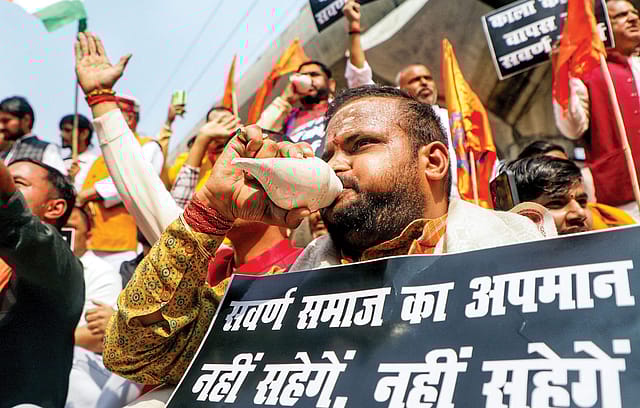
THE RISE OF THE BHARATIYA JANATA PARTY (BJP) has often been attributed to the ascent of a cadre-based movement shaped by upper castes. BJP led by Narendra Modi, though, is defined by mass arithmetic. The party’s ideological project subsumed caste under a broader Hindu identity, a strategy derived from the learnings of the Mandal era. For nearly three decades after Mandal, the significant feature of Indian politics has been a movement towards assertion of backward castes, towards a vocabulary of social justice. Justice has remained mostly rhetoric, but Modi’s social origins have been central to BJP’s appeal among backward classes, especially in the Hindi heartland. The party has invested heavily in cultivating non-dominant Other Backward Classes (OBCs). These are smaller, often locally marginalised groups who felt excluded from the patronage networks of larger OBC blocs empowered by Mandal-era politics. Welfare schemes, calibrated candidate selection and a rhetoric of aspirational nationalism have underpinned this outreach.
This outreach by BJP was to solidify its electoral arithmetic. It no longer wanted to depend solely on its traditional support base of Brahmins and Banias. So, to expand among OBCs and even Dalits in the Hindi belt seemed a wise strategy. This strategy worked well for the party. In a state like Uttar Pradesh (UP), for example, the Muslim vote was made largely irrelevant, and even the core voter base of Dalit leader Mayawati was eroded.
And yet, in 2026, the Brahmin question has returned as a flashpoint. A set of University Grants Commission (UGC) regulations meant to curb caste discrimination on campuses and a war of egos between a Shankaracharya and UP Chief Minister Yogi Adityanath have served as a lightning rod for an anti-BJP sentiment. Currently, it is a low but persistent murmur on social media, but from preliminary evidence, it seems to be growing. Perhaps nowhere is it seen on ground more than in UP where the Brahmin discontent against Adityanath has surfaced repeatedly through anxieties about what the community considers the disproportionate influence of Thakur (Yogi’s caste) networks in policing, district administration, and political appointments.
Electorally, though, the rivalry remained contained. Both communities continued to back BJP in substantial numbers, bound by ideological proximity and a lack of credible alternatives. But then, last month, during the Magh Mela in Prayagraj, tension flared up between disciples of Swami Avimukteshwaranand Saraswati and the fair administration, which has now blown up into a crisis. This has escalated so much that now an FIR has been lodged against Saraswati on charges of sexually abusing and threatening boys. Saraswati has refused to bow down and has instead launched several attacks on Yogi Adityanath, accusing him of failing to protect the cow and of vandalism at temples in the name of development.
Many religious and opposition leaders have also come to his support. Samajwadi Party (SP) leader Akhilesh Yadav, who has been making a larger Hindu outreach, criticised the BJP government. “In our Sanatana system, no Shankaracharya was ever stopped from ablution in the Ganga, but this happened for the first time and now they (the BJP) are making cheap allegations,” Yadav said. After the incident in Prayagraj, Mayawati posted on X: “Not only in Uttar Pradesh but also in other states of the country, political interference and influence in religious festivals, rituals, worship and sacred observances of all faiths have increased significantly in recent years. This has led to new controversies, tensions and conflicts. Such a trend is not appropriate, and it is natural that people feel a sense of distress and concern over these developments.” In protest of the treatment meted out to Saraswati, Bareilly’s city magistrate Alankar Agnihotri resigned from his job and has now announced the formation of a new political party which he has named RAM (Rashtriya Adhikar Morcha). For now, the UGC guidelines have been put on hold by the Supreme Court. But BJP finds itself in a fix over the controversy; so much so that it forbade its leaders from speaking about the matter.
The party’s difficulty lies in asymmetry. Backtracking risks unsettling backward-caste constituencies sensitive to any hint of rollback in representation. Holding firm invites amplification of upper-caste grievance, especially in states like UP. The Supreme Court’s stay has only prolonged the ambiguity, allowing discontent to simmer without resolution.
BJP’s national leadership has tried to contain the damage by using its Brahmin faces in UP. Deputy Chief Minister Brajesh Pathak called Saraswati’s clash with the police as “maha paap” and felicitated 101 Brahmin students at his official residence in Lucknow. But coupled with the anger over UGC guidelines and Adityanath’s consistency in targeting Saraswati, BJP, caught between its past and its expansion, is unable to find an out of the situation.
AS THE CLAMOUR grows over BJP’s purported anti-Brahmin stance, on social media, self-styled “Brahmin voices” have sharpened their tone against both Modi and the Rashtriya Swayamsevak Sangh (RSS), accusing them of ideological betrayal. The anger against RSS stems from what is seen as the organisation’s dilution of the politics of Hindutva and its pandering to backward castes. The recent utterances of RSS chief Mohan Bhagwat has precipitated matters. In Uttarakhand, on February 22, Bhagwat said that the Sangh does not practise Hindutva politics but believes in building a strong society and nation through individual development. Hesaidthatsomepeoplemistakethe Sanghfor aparamilitary organisation, but the Sangh is a social force working beyond these boundaries. This has prompted some handles, including those of popular radical Hindutva voices, to say that RSS should have made it clear in 2014 (when Modi was first elected to Lok Sabha). Bhagwat’s past statements like advocating reservations for another 200 years have also been made objects of ridicule. Posts that once celebrated muscular nationalism now deride the leadership for appeasing caste blocs and tolerating what these influencers frame as institutional marginalisation of the upper castes, especially Brahmins. Hashtags alleging anti-Brahmin bias have trended episodically. But now the rhetoric is incendiary. Accusations like “civilisational ingratitude” are amplified in an algorithmic velocity which is gaining momentum. What was once intra-movement grumbling, exchanged in closed circles, now circulates as public indignation, drawing clicks and reposts and leading to politically embarrassing memes.

Can BJP ignore this subtext? In a state where margins can be slender, even small shifts in upper-caste cohesion can alter the local arithmetic. Both Akhilesh Yadav and Mayawati know this and are trying to make the most of it. Yadav has upped his ante against Yogi, highlighting his “anti-Brahmin” stance by making remarks like Adityanath’s government doesn’t like “Haata”, a reference to the Gorakhpur residence of the late Harishankar Tiwari, a Brahmin Bahubali. Mayawati already has experience of social engineering involving Brahmins, and has been making overtures to Brahmin influencers to test waters. In 2007, the Bahujan Samaj Party (BSP) successfully added Brahmin voters to its base with the slogan ‘Haathi nahi Ganesh hai, Brahma Vishnu Mahesh hai’. This strategy was led by the party’s Brahmin face, Satish Mishra. As a result, BSP got an absolute majority in the state in 2007.
With Modi at the helm, Brahmins were steered back to the BJP fold. In the Lok Sabha elections of 2014 and 2019, and Assembly elections of 2017 and 2022, Brahmins stayed with BJP. According to the Centre for the Study of Developing Societies (CSDS), Brahmin voters backing BJP in UP rose to 89 per cent in 2022 from 2017’s 83 per cent. But in 2024, a section of Brahmins, angered by Adityanath’s Thakur push and the police encounter killing of Brahmin Bahubali Vikas Dubey began to vote elsewhere. Last year, in December, the Brahmin MLAs of Adityanath’s government held their separate meeting, which was attributed to their dissatisfaction with the power hierarchy.
For BJP, and for RSS as well, the challenge is delicate. Their central claim has been that Hindu unity can prevail over caste fragmentation. But if the upper-caste unease hardens into organised assertion, or if a section of them switches to parties like SP or Congress (or even BSP), then it will cause a rupture.
Whether this remains rhetorical turbulence or hardens into organised dissent will depend less on sentiment than on how deftly the Sangh manages the delicate balance between expansion and reassurance. If the Sangh ecosystem succeeds, the current turbulence will settle into a familiar pattern of negotiated hierarchy within a dominant coalition. If it misreads the signals, allowing grievance to congeal into organised assertion, the costs could ripple beyond UP. BJP’s ascent was built on expanding beyond its original social silhouette; its durability will depend on convincing the original core that expansion need not mean eclipse.
The challenge will be to convince Brahmins to go back to ‘Modi zindabad’ from ‘Brahmanvaad zindabad’.