Happy Birthday: The Constitution of India
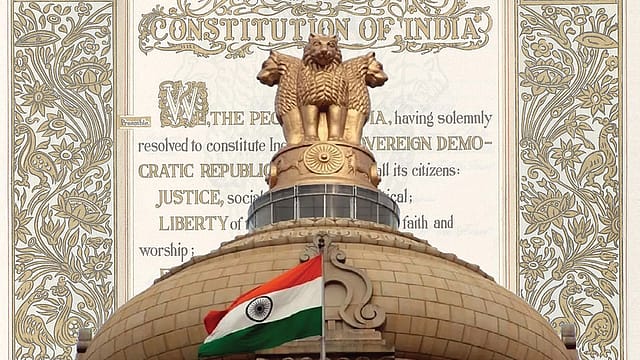
IT IS ALMOST a ritual to pay obeisance to the Constitution on the Republic Day every year. After all, that is the day in 1950 when the People of India gave themselves a blueprint that would govern them for all time to come. Or so runs the myth.
In reality, viewed dispassionately, the Constitution is a set of articles that outline the parts of government, their powers and coordination between them. There is nothing sacrosanct about the text as the 106 amendments to the original Constitution attest. A bare reading of the text only leads to the conclusion that it is, at most, a coordinating device or, as Adrian Vermeule— a professor of constitutional law at Harvard University— describes a constitution: a system of systems.
The theology of the Constitution is, of course, very different. Over time, embellishments and encrustations via judicial interpretation, amendments under controversial circumstances and scholarly interpellation have turned it into a document that circumscribes politics itself. The text, as a certain class of interpreters holds, marks off politics into acceptable and unacceptable spheres. It is another matter that modern politics in India pre-dates the 1950 Constitution by at least 65 years (if one considers the origin of mass politics) or even 93 years (if one considers the first stirrings of modern nationalism). One can extend the timeline considerably further back in time.
Survival Instinct
22 May 2026 - Vol 04 | Issue 72
India navigates global economic turmoil with austerity and smart diplomacy
This Manichaean claim rests on some features of the Constitution or some interpretations of these features. These include the theory of federalism as applied to India and read off from the Seventh Schedule of the Constitution that divides legislative powers between the Centre and the states and those that belong to them jointly. Then, there are articles that allegedly give rise to “asymmetric federalism” such as Article 370 (as it existed before August 5, 2019) and special provisions pertaining to different states and the Fifth and Sixth Schedules. Viewed together, the theory goes, these features act as a brake on the Centre. This last part is the key, so to speak, of this interpretation: it is a political theory that a strong Centre is detrimental to democracy in India and that democracy can be preserved only by having a strong countervailing force at the level of states. This is a reading that is almost identical to the Cabinet Mission Plan of 1946 that proposed a “weak Centre” for the sake of preserving India’s unity. The idea was rejected roundly by India’s leaders at that time. It continues to be rejected by a majority of the Indian people today.
This “political reading” of the Constitution to filter politics into acceptable and unacceptable types is at odds with the written text of the Constitution. States are not a countervailing force, constitutionally or otherwise. No truly federal system allows the federal government to dismiss an elected government in a constituent state. The Indian Constitution does that via Article 356 in case of “breakdown of constitutional machinery” in states. Article 3 allows the Centre to change the boundaries of a state at its volition. The theory in India is not that of “indestructible states” but that of an “indestructible union of perishable states.” The empirical record attests to that claim. Article 249 enables Parliament to make laws in “national interest” on subjects that fall in the State List if the Rajya Sabha passes a resolution to that effect. This list of marked centralising features can be elaborated quite a bit. The theory of federalism—a word that is not found anywhere in the Constitution—does not survive the first touch with constitutional reality. It exists only in the domain of judicial interpretation and wishful thinking on the part of some interpreters.
But this is a birthday party of the founding document of the Republic and in that spirit, one says Happy Birthday.