Greening the Future: Sustaining India’s green transition requires balancing economic growth with environmental safeguards
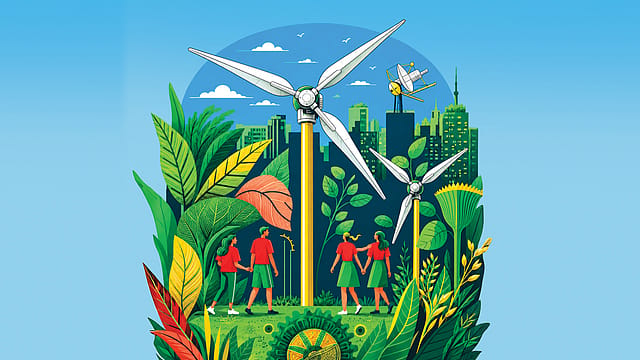
WHENEVER WE TALK OF PRESERVING NATURE BY GOING green, Sir David Attenborough’s 2020 documentary A Life on Our Planet comes to mind, especially because it is a must-watch not only for the general public but also, more importantly, for policymakers. “By the 2040s, throughout the north, frozen soils will thaw, releasing methane, a greenhouse gas many times more potent than carbon dioxide, accelerating the rate of climate change dramatically,” Attenborough prophesies. Now 100 years old, the English broadcaster and natural historian warns that oceans will continue to heat up and become more acidic and coral reefs will die and fish populations crash besides hurtling food output into a major crisis as soils become exhausted by overuse, pollinating insects disappear and the weather becomes more and more unpredictable. He also emphasises rising temperatures will make most parts of the globe uninhabitable.
While advocating the need for innovative ways to revive our diversity and give life a new chance—such as the creation of no-fishing zones, afforestation, use of renewable energies, change of diet from meat-heavy menus to vegetable-rich ones—the award-winning broadcaster devotes time to talk about how some countries have increased their forest cover, reduced dependency on fossil fuels, and devised new ways of sustainable farming in his documentary.
Well, for the most populous nation in the world, India hasn’t done badly in its commitment to shift to clean energy. Very recently, UN Framework Convention on Climate Change (UNFCCC) Executive Secretary Simon Stiell compared our progress on that count to the combined achievements of Sachin Tendulkar and Vaibhav Sooryavanshi. On his visit to India, Stiell was quoted by the media as saying that India has already established an impressive track record in renewable energy while suggesting that its biggest achievements may still lie towards solar energy, EV adoption, lower fossil fuel dependence and climate action, with the government leading from the front with necessary policy push and by enlisting the support of the private sector while ensuring awareness about saving the planet by making small changes in personal habits.
It was not for nothing Stiell praised India’s renewable energy expansion as an example of low-carbon development, saying, “If India keeps doubling down on renewables and clean tech, the next chapters promise to be truly extraordinary. Decarbonisation is central to India’s impressive development strategy, which is forging a new path for others to follow.” Fossil fuel-free electricity, in fact, now accounts for half of India’s installed power generation capacity, a target achieved five years ahead of schedule thanks to stress on solar energy and electric mobility even as high costs of fossil fuel imports are badly hurting nations in the Global South.
The cricketing analogy is something that strikes a chord in India and makes the country proud of its achievements, but just as there are opportunities in going greener there are seemingly insurmountable challenges ahead, and India is on the threshold of that massive shift.
After all, climate change is no longer a distant environmental issue. It is an economic, agricultural and public health challenge affecting millions of Indians. The blessing, however, is that more people are kicked about the opportunities just as India is becoming one of the world’s fastest-growing clean energy markets, proving that economic growth and renewable energy can go hand-in-hand.
As several experts within India and abroad have pointed out, this shift from fossil fuels to renewable energy is creating new jobs, industries and opportunities, especially in solar manufacturing, battery storage and green hydrogen. According to a government statement, “Solar leads the charge with installed capacity crossing 150 GW. Major projects like the 2,245MW Bhadla Solar Park in Rajasthan and massive sites under development in Gujarat—such as the 30 GW clean energy park in Kutch—are scaling output exponentially.” Another official statement says that India ranks fourth globally in wind power capacity, boasting over 56GW of installed operations, with strong geographic hubs located in Tamil Nadu, Gujarat, and Maharashtra. As is well known, India is pioneering next-gen clean fuels through the National Green Hydrogen Mission, driving down production costs and launching indigenous fuel cell technologies.
A striking argument is that our traditional culture has long emphasised harmony with nature—which means modern sustainability can draw strength from indigenous knowledge. Evidently, we are clubbing tradition with modernity. Urban India is witnessing a growing culture of rooftop solar, electric mobility, waste segregation, and sustainable architecture although this adoption remains uneven.
The key point to note here is that the environmental movement should not become a conflict between development and conservation. India needs reconciliation between the two. Protecting forests should also mean protecting the rights and knowledge of indigenous and forest-dwelling communities. Again, farmers should be treated as partners in climate action, not merely as victims of climate change. Also, cities and villages must not be seen as competing interests. Cleaner cities depend on healthier rural ecosystems and sustainable agriculture.
Now, India, which has demonstrated leadership through ambitious renewable energy targets and international initiatives like the International Solar Alliance, has enormous potential to become a global leader in affordable green technology for developing nations. Our forte is our biodiversity—from the Himalayas to the Western Ghats and mangroves to coral reefs—which is not just national heritage but a global ecological asset.
True, the challenges are too many. Water conservation should become India’s next major environmental mission, combining traditional methods with modern technology. Restoring rivers, wetlands and forests is often more effective and cheaper than repairing environmental damage later.
Similarly, electric vehicles are only one part of the solution. Public transport, cycling and walkable cities will have a greater long-term impact. The circular economy—repairing, recycling, and reusing—can generate employment while reducing waste. Green buildings, energy-efficient cooling and smart urban planning could become defining features of future Indian cities if our execution of plans goes well. The country can use artificial intelligence (AI) and satellite technology to help monitor forests, predict floods and improve water management.
Looking at the challenges, what is inescapable is that air pollution remains one of India’s biggest public health crises despite growing awareness. Waste management, too, continues to lag behind consumption patterns, especially plastic waste and electronic waste.
To tide over such problems that come by force of personal habit, climate education should become part of every school’s curriculum. At the governmental level, environmental regulations must be enforced consistently rather than diluted for short-term economic gains. India should invest more in climate adaptation, not just climate mitigation, as extreme weather is already here.
Every generation has its defining challenge. For ours, it is preserving a liveable planet. What does it mean?
It means that reconciliation today is about making peace not only with one another but also with nature. It means India’s greatest contribution may not simply be producing green technology but in demonstrating that sustainable development is possible for a country of more than 1.4 billion people. It means saving the planet is not the responsibility of governments and corporations alone. It begins with millions of everyday decisions made by ordinary citizens. It means the green transition is not about sacrifice but about building healthier cities, cleaner air, better jobs, and a more resilient economy for future generations.
Although our green energy prowess is calculated in gigawatts and is expected to reach 500GW of non-fossil fuel capacity by 2030, getting skilled talent to manage the transition is a matter of concern. Just as there are challenges, there are opportunities and new job functions on the horizon.
According to a study by the New Delhi-based climate think-tank Council on Energy, Environment and Water (CEEW), authored by Deepesh Tourani, Pallavi Girolkar and Rana Pujari, and titled ‘Driving Energy Transition: Workforce, Skills, and Gender in India’s Renewable Energy Sector’, future research should expand to include supporting industries and indirect jobs such as manufacturing inverters and mounting structures, community-based roles in decentralised energy projects, and last-mile clean energy services to capture the full employment impact of the clean energy value chain. The study, published in June, emphasises gender representation which it says is a critical but under-addressed aspect of India’s clean energy transition. “This must be anchored in principles of equity, requiring targeted interventions to recruit, retain, and build capacities to advance women’s contribution across the sector. Companies must move beyond basic hiring mandates to actively employ women in leadership, technological, and entrepreneurial roles and not just in traditionally gendered administrative or support roles,” the study says.
It adds that there is a high requirement of semi and highly skilled workforces, especially in the solar and wind manufacturing sector. “There is an opportunity for the solar and wind industry to develop career advancement programmes that are focused on providing training to their existing workforce to help them upskill from low-skilled to semi-skilled roles or from semi-to highly-skilled roles,” it notes.
India’s clean energy sector is poised for considerable growth, with strong commitments from the government and industry to scale up clean energy capacity. What we need to keep remembering is that the future will not judge us by the wealth we created but by the world we left behind. Therefore, India’s challenge is not merely to grow faster but to grow greener.