From Retreat to Resolve
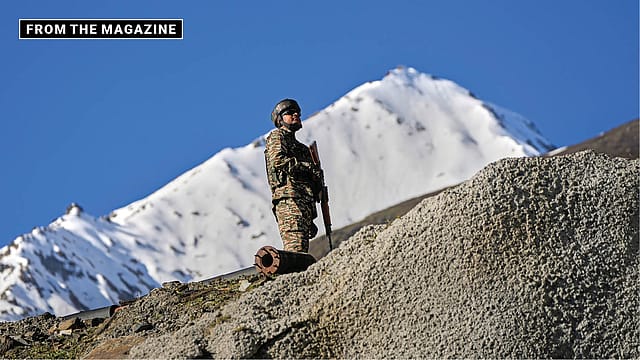
In mid-April 2013, Chinese troops entered Indian territory in the Depsang Bulge area of eastern Ladakh. The following month, on May 25, one of the worst Maoist attacks in Chhattisgarh wiped out the top echelon of Congress in the state. The two events were in no way connected, but they reflected the spectrum of security challenges facing India.
Since then, much has changed, and the balance between external and internal challenges has shifted dramatically. While external challenges persist—as the events in Doklam (2017) and Galwan (2020) demonstrated—the internal security ledger has been largely wiped clean. Long-festering problems, such as insurgency in Jammu & Kashmir (J&K) and Maoist dominance in parts of the country, both of which had persisted for decades, have been brought to an end. Terrorist attacks on trains, bomb blasts in busy markets and religious places are now a distant memory.
The one factor that tipped the balance towards better security was the political resolve to meet these challenges head-on, rather than rely on some faux notion of “negotiations” or “arrangements” with those creating the problems in the first place. It is also worth examining the conditions that enabled this change.
It has long been obvious that India has faced security threats for much of its existence as an independent country. Intense, short-lived external conflicts and prolonged internal security threats have been the norm. India’s inability to manage internal security threats—from terrorism to separatist violence, unpredictable riots and ultra-Left insurgencies aimed at overthrowing the state—has been directly correlated with its weak state capacity. The latter is not simply an independent variable that moves in tandem with economic growth, per capita GDP or some other economic indicator. The ability to devote resources to managing conflicts is undoubtedly an essential part of state capacity, but India’s conflicts also had an aspect that was entangled with the way democratic politics played out over the “dangerous decades”.
Two conflicts best exemplify this muddled politics: the insurgency in J&K and the Maoist insurgency in east-central India. Even the leading lights of Indian policymaking had concluded that New Delhi had to concede autonomy to the erstwhile state if it was to retain control over the territory. The debate was not about the maximum conceivable autonomy, but about finding an optimum degree that would enable continued control. Even imagining that J&K could be integrated in the manner it was after 2019 was beyond them.
In such circumstances, Kashmir’s politicians—past masters of tactical thinking—had evolved their position to the point where a “grey zone” of control emerged. In practice, if not in constitutional interpretation, this meant that India could not claim outright sovereignty even as it maintained some semblance of control. Instead of resolving the situation, this whetted the appetites of separatists even further. This suited Kashmir’s ‘mainstream politicians’ perfectly: they could continue ruling the state, taking turns like Pareto’s lions and foxes, even as the security situation went from bad to worse.
Something similar played out in the Maoism-affected parts of India. For a long time, the government had no presence in the remote, hilly and forested tracts, often hundreds of kilometres from state capitals, in these areas (Madhya Pradesh, and later Chhattisgarh and Odisha, are cases in point). Local politicians, often belonging to a party that had governed India for decades, developed a “via media” with the Maoists. Invariably, legislators elected to state Assemblies and those sent to Parliament had to reach some form of understanding with the Maoists if they were to survive politically in those districts.

At the national level, there were strong enabling conditions that allowed the situation to worsen in both these zones. In J&K, it became fashionable to dispatch “fact-finding” committees and teams of “interlocutors” to find “solutions” to the problem. Most of these efforts ended with the Hurriyat either refusing to meet those sent from New Delhi or separatist groups making conspicuous appearances at iftar parties at the Pakistan High Commission in the national capital. Much of this was “civil society outreach” with the government’s blessing. In Chhattisgarh and Jharkhand—the two states worst affected by Maoism—the thinking was identical, even if couched in different language. In 2008, a government-appointed committee recommended: “Both the central and the state governments should have an open mind about having peace talks with Naxalites without any prior conditionality.” (Paragraph 5.7.14 of ‘Development Challenges in Extremist Areas: Report of an Expert Group to Planning Commission’, 2008). The so-called committee, comprising an array of experts who were more or less sympathetic to the Maoists, came close to suggesting that the government should withdraw its presence from these areas for good.
Predictably, the security situation in J&K and the Maoism-affected areas deteriorated. The grim statistics from that period testify to this. In Kashmir, every major security operation would lead to shutdowns, hartals and stone-pelting on a massive scale across the Valley. In Chhattisgarh and Jharkhand, the Maoists did not care for government “appeals” or anyone else.
The Narendra Modi government decisively dismantled this approach through a series of carefully graded steps after coming to power in 2014. At the time, administrative and scholarly opinion on these matters was divided. The majority believed that the reach of India’s governments, both at the Centre and in the states, was so limited that the only option was to “compromise” in one way or another: essentially, to dilute government authority in Maoist areas and settle for something less than sovereignty in J&K.
Experts and administrators who held a contrasting view, arguing that such dilution of government authority was dangerous for India’s unity and integrity, were, in any case, few. To cite one example, of the 17 experts on the committee that produced ‘Development Challenges in Extremist Areas: Report of an Expert Group to Planning Commission’, only three had any real-world experience in security matters, and two of them opposed the committee’s approach. Their concerns were never incorporated into the report.
Against this backdrop, the Bharatiya Janata Party (BJP) government took several steps. To begin with, it invested heavily in building roads and civilian infrastructure in Maoist-dominated areas, a prerequisite for establishing government authority. This phase lasted until 2018. Then came the heavy lifting: the launch of offensive operations against the Maoists. That took a further eight years. There were setbacks along the way, such as the infamous Tekulagudem encounter in April 2021, in which 22 CRPF troopers were killed. But by the end of 2024, the Maoists were on the run.
In J&K, the Modi government pursued a different course. It initially sought to resolve the problem through the familiar route of forming a government with a local partner in the erstwhile state. That tortuous process led only to Lethpora. The killing of 40 CRPF troopers by a suicide bomber on February 14, 2019 marked the end of political licentiousness in J&K. Six months later, the root of the problem was eliminated.
The BJP government invested in developing civilian infrastructure in Maoist-dominated areas, a prerequisite for establishing authority. Then came offensive operations against the Maoists
Why did these steps, so essential to securing India and safeguarding its unity and integrity, take so long to arrive?
One answer is provided by the scholar Rajesh M Basrur, who identified two reasons for this drift in security affairs. He says: “I attribute the recurrent lack of policy decisiveness to two very different causes: first, the material distribution of domestic political power, for instance the distribution of seats in legislatures, which determine whether a government’s power is firm and self-supporting or dependent on coalition partners; and second, the leadership’s willingness… to meet the obligations of political responsibility and accountability.” (Subcontinental Drift: Domestic Politics and India’s Foreign Policy, 2023).
Basrur’s two factors interacted in complicated ways between 2008 and 2014. The United Progressive Alliance (UPA) government was paralysed by its political contradictions, something that did not afflict the Modi government after 2014.
At every step towards restoring India’s security, the Modi government faced the twin challenge of devoting resources to these tasks—resources that could otherwise have been used for more pressing developmental priorities—and dealing with endless questioning of the chosen path to fixing the broken security system. Take the challenge of terrorism emanating from Pakistan. By 2016, when the Uri terrorist attack took place, the Modi government had concluded that only one strategy—striking at the snake’s head, so to speak—would work. But when cross-border raids on terrorist camps were carried out, they were met with disbelief. Questions ranged from whether the raids had taken place at all, at the crudest political level, to whether they would prevent further attacks, as doubted by security experts. Beyond their futility, these options were questioned for their supposedly “destabilising” effects: India, it was argued, would have to fight Pakistan all the way to the nuclear threshold. The same claims were made in 2019, when India used firepower on Pakistani territory for the first time since 1971. But after Operation Sindoor in the summer of 2025, these scholars and experts have been largely quiet. India will do what is necessary to preserve and protect itself.
That this approach works has been vindicated even in India’s encounters with a far more powerful adversary to its north and east. China’s reactions in the wake of Doklam (2017) and Galwan (2020) reflected disbelief that India would respond in the manner it did. India is, understandably, careful in dealing with all external challenges, whether from Pakistan or China. The variables beyond its control multiply far more rapidly on the external front than they do in dealing with internal threats. But the focus of its responses remains the same: India’s security matters, and it will be preserved to the best of the country’s ability.