Fighting Spirit: India needs to increase military expenditure as the world rearms
LAST WEEK, ARGENTINEAN President Javier Milei took to social media and bluntly stated, “The Malvinas were, are, and always will be Argentine.” The message, delivered in all capitals, came soon after Reuters reported that the US was “reviewing” its position on the islands—also known as the Falkland Islands—in the South Atlantic Ocean that Argentina disputes with Britain. The two countries went to war in 1982 over the islands. The American review came even as King Charles was about to commence his visit to the US.
As matters stand, a re-run of the military entanglement between Argentina and the UK is unlikely as Argentina has called for “talks” on the subject even as the UK has ruled them out. But in today’s world, military solutions are no longer in the realm of speculation. Since 2022 when Russia invaded Ukraine, a number of conflicts—in West Asia and in the Caucasus—have flared up even as more flashpoints are emerging, from Greenland to Cuba and from Taiwan to the Baltic. The renewed quest for national interest is leading to curious results. The UAE has announced that it will exit OPEC—the oil producing cartel—from May 1, even as jihadist groups are on the verge of gaining power in Mali.
In this renewed rush towards conflicts, the world is searching for arms and ammunition, military gear and other modern tools to wage war. This demand is unlikely to be satiated anytime soon. Countries are simultaneously buying as well as manufacturing defence equipment and supplies. Unlike the time between the end of World War II and the end of the Cold War when trade in military supplies had a predictable basis, the era of globalisation produced complex supply chains in which no country could manufacture these goods on their own. To cite an example, the US has proprietary technologies that go into making sophisticated fifth-generation stealth fighter jets such as the F-35; it is China that controls the supply of key rare earth materials without which such platforms cannot be made. If that phase of inter-dependence is not coming to a sudden end, countries are exploring ways to reduce these dependencies. In the last decade, defence expenditures have gone up dramatically even as countries search for reliable partners who will not back out during times of crises.
India has followed these trends closely. Latest data from the Stockholm International Peace Research Institute (SIPRI)—the annual Trends in World Military Expenditure—pegs India’s annual defence spending in 2025 at $92 billion. Officially, the 2025-26 defence budget stood at approximately $76 billion (depending on the exchange rate assumed for the dollar). These figures put India among the top five countries in terms of military expenditure. It is another matter that India ranks behind Germany that began rearming only recently on the basis of threat assessments about an “aggressive Russia”. India’s overall spending in this group of five countries—out of a grand total of $1,686 billion—still remained a paltry 5.45 per cent in the group. Its share in global military expenditures was lower still at 3.2 per cent. As a percentage of its GDP, India’s military spending shrank to 2.3 per cent in 2025 compared to 2.6 per cent in 2016. SIPRI noted: “World military expenditure rose by 2.9 per cent in real terms to reach $2887 billion in 2025, which was the 11th consecutive year of growth. Global spending has gone up by 41 per cent over the past decade (2016-25). The year-on-year increase in 2025 was considerably smaller than the 9.7 per cent rise recorded in 2024 and marked the lowest annual rate of growth since 2021.” The drop is largely explained by the reduction in American spending that declined by 7.5 per cent in 2025-25. Because the US is by far the biggest spender on military hardware and equipment, any drop in its spending is reflected in the global trend. The US outstrips the next four big spenders in the top five by a substantial margin.
That does not mean military expenditures are going down. If anything, countries like Germany and others in Eastern Europe, along Russia’s Western flank, are likely to increase these expenditures. ‘Low’ NATO expenditures may be a pet peeve of US President Donald Trump but the reality is that, given their threat perceptions from Russia, military spending by countries in this part of Europe will only go up in the coming years.
For a country in an extremely hostile part of the world—India has seen a mini-conflict in 2025 with Pakistan and another four hostile encounters with Pakistan and China since 2016—India’s spending remains moderate. What is interesting about India’s military spending and build-up is its efforts to export weapon platforms. These have increased quite rapidly in recent years, especially since conflicts have begun to flare up in different parts of the world. Between 2004-05 and 2013-14, India’s military hardware exports amounted to `4,312 crore, not even $500 million in the current exchange rate. These exports rose dramatically to `88,319 crore between 2014-15 and 2023-24, or roughly 20 times. In the five years from 2021-22 to 2025-26, these exports have gone up from `12,815 crore to `38,424 crore. It is interesting to note the competition between defence public sector units and their private counterparts for garnering a bigger share of exports from India.
India is not an exporter of cutting-edge defence technology equipment and is, instead, a ‘value arms’ exporter. The war in Ukraine has shown that ‘magic bullet’ military solutions, driven by the so-called Revolution in Military Affairs (RMA), seldom work in wars of attrition. The scale at which Ukraine exhausted arms and ammunition and the subsequent difficulties faced by Western countries to replenish their stores shows that mass manufacturing of arms did not keep pace with the new era of war. Military planners in the West assumed that the “long peace” that began at the end of the Cold War would continue indefinitely. The result: crucial value items like artillery shells, ammunition for tanks, and high-calibre rounds among other items are in short supply. Countries like Germany, with an established industrial manufacturing base, are stepping into this gap.
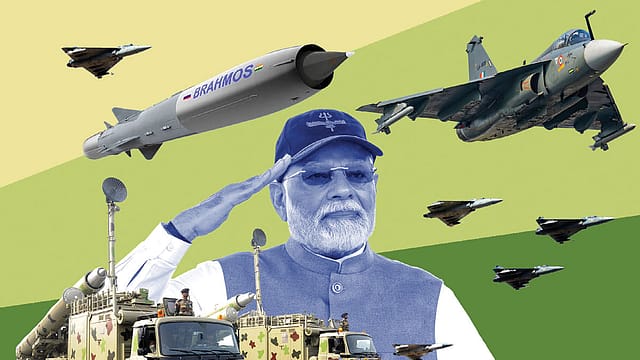
India, too, has entered this market. But apart from low-end items needed in large volumes, India has also entered the niche market for missiles. India has sold batteries of the BrahMos missile even as it has sold air defence systems to Armenia while the latter considered purchasing Russian-origin fighter aircraft from India to obviate supply disruptions and delays in buying those planes directly from Russia.
Does rearming make economic sense for countries like India?
A recent IMF report tried to find answers to the question of defence spending. The April edition of the Fund’s World Economic Outlook (WEO) noted: “In the short term, defense spending boosts private consumption and investment, through positive demand-side effects, especially in defense-related sectors, leading to higher output and prices... On the supply side, booms are followed by a higher capital stock and an increase in total factor productivity over the long term.” While the Fund gave a careful, variable by variable, answer to the question of defence spending, booms associated with defence spending during wartime as well as peacetime are known to boost output even if side-effects, such as inflation and higher debts, are known to accompany such build-ups.
The IMF report notes that the world is rearming itself once again. The trend of countries that spent more than 2 per cent of their GDP on military spending fell from 65 countries in the late 1980s to around 28 by 2020. That trend has reversed since. Today, 40 countries spend more than 2 per cent of their GDP on defence. The trend in terms of global GDP spent on military spending is still cloudy—the data at the country level is clearer—the amount spent is now close to 2 per cent of global GDP. But this figure is rising. The target for such spending set by NATO by 2035 is 3.5 per cent.
The current defence spending boom is now at par with that seen during the early 1960s, a decade after the Cold War had set in. The WEO report has a schematic analysis of the economic effects of these booms. But this mechanism is based on what investment and consumption of military hardware do in the short and medium runs to individual economies. In the short-run, investment, consumption and output all go up, even if the size of the multiplier depends on several factors. In the medium-run, however, public debt is likely to go up.
There is, however, another aspect to this situation. Only a select few countries can reap the benefits of defence spending. These countries need to have domestic manufacturing capacity, a pool of technically equipped manpower and, above all, the ability of their governments to spend more on defence by shifting allocations from other sectors. India is one such country even if its spending on defence manufacturing and investment in defence-related technologies have picked up only in recent years. India’s defence exports in 2025-26 are pegged at $4.15 billion, rising more than 60 per cent over 2024-25. In the coming years, this figure will go up.
But the economics of conflict is a mixed bag. Only a few countries can gain while the majority have to suffer from the consequences of broken supply chains and rapidly rising prices of key commodities. In the Ukraine conflict, prices of wheat, fertilisers and other commodities shot up to the point that many countries could not afford these goods. In the on-going conflict in West Asia, oil prices are imparting a global economic shock where no country is immune. India falls in this bracket as well.
It makes good economic sense for India to increase military expenditure, not only on salaries and wages of its armed forces but also in building the necessary industrial base for key pieces of equipment it will need in the near future. From fighter-jet engines to miniature nuclear reactors for nuclear-attack submarines and from stealth materials to specialised steels, India needs them all. It’s time to show India means business by allocating more resources to these ends.