“Everyone has to do their bit”: Industry echoes PM Modi amid Middle East oil crisis
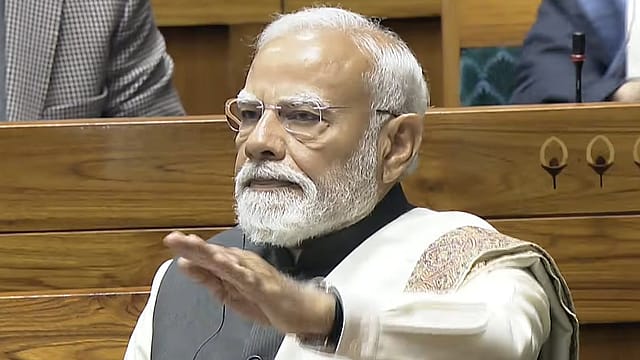
As global tensions in the Middle East push up oil prices, Prime Minister Narendra Modi has urged citizens and industry to act responsibly—cutting waste, conserving energy, and adapting work practices where needed.
At the CII Annual Business Summit 2026, business leaders signalled broad agreement: while external shocks are unavoidable, India can cushion the impact through internal strength and smarter resource use.
How are industry leaders viewing the government’s response?
Kris Gopalakrishnan, Co-Founder of Infosys, struck a measured tone, saying the government has done a “reasonably good job” in shielding India from global shocks.
“Every policy that the government comes up with, there is typically a consultative process with the industry,” he said, noting that India has kept inflation under check and remained one of the fastest-growing large economies.

Losing Memory
16 Oct 2026 - Vol 05 | Issue 42
The making of a medical and social emergency
However, he acknowledged that the crisis is not without consequences. “It definitely has an impact in terms of the energy cost, in terms of logistics cost, the time taken,” he said.
Can work-from-home and conservation actually help?
Gopalakrishnan suggested a balanced approach rather than extreme shifts. “Probably we should be... at work from home, et cetera, in a partial way, fully, maybe one day or something like that, not all the people together, because we have all gone back to offices. Now, going back completely also is not warranted, I think.”
He emphasised shared responsibility, invoking lessons from the pandemic: “Everyone has to do their bit, industry, individuals, whatever we can do, because government alone cannot do something like this.”
Why is technology adoption being seen as a key solution?
Deepak Shetty, CEO and Managing Director of JCB India Ltd, framed the crisis as a moment to rethink efficiency.
The Prime Minister’s message, he said, is “always a very forward-looking... message that he has given. And it is not only for these tough times but also in the future.”
He stressed that companies must focus on what they can control. “We can't control what is happening geopolitically, but what we can control is how we adopt new technologies... to ensure that we don't spend, we don't waste, but we contribute to the national cause,” he said.
Is India’s growth story still intact despite global volatility?
Shetty pointed to continued government spending as a stabilising force. “One very positive thing is that despite all the challenges, the investment and focus on CAPEX, infrastructure-related CAPEX continues from the government side,” he said.
He also highlighted strong export performance: “Short term, there will be challenges, but we all play for the long term,” adding that India will “continue to grow between 6, 7, 8 per cent.”
Calling India the “third largest market in the world for our equipment,” he urged companies to leverage scale and collaborate to “take advantage of the size of our economy and grow further.”
What are global industry leaders saying about India?
George Young of Rockwell Automation said India’s momentum is being driven by structural shifts.
“We think those will continue to propel India, and we really think a lot of the growth will come from the micro and small manufacturing enterprises as they mature and go into... the middle of the economy,” he said.
He also noted a shift in how India is perceived globally. “It used to be that India would look externally for inspiration and innovation. Now I was encouraging India to look internally for inspiration and innovation,” he added.
Young even urged global leaders to learn from India’s unique approach, saying, “Indians, Indian companies' excellence and the culture of jugad to drive innovation.”
Which sectors could lead India’s next growth phase?
According to Young, sectors like automotive, semiconductors and electronics are already gaining momentum. He added that pharma, chemicals, metals and sustainable mining are areas where “you're going to see real excellence emerging in the future.”
What is the broader takeaway from industry voices?
The consensus is clear: while the oil crisis may raise costs and create short-term disruptions, India’s fundamentals remain strong.
The way forward, industry leaders suggest, lies in combining policy support, technological adoption, responsible consumption, and leveraging domestic demand—turning a global challenge into a long-term opportunity.
(With inputs from ANI)