EV Revolution Shifts to High Gear
DELHI-BASED FITNESS coach Jyotika Rawat bought her Tata Punch EV three years ago to fulfil her desire to lead a more sustainable life. She soon realised that this philosophy need not come at a high cost. The 26-year-old says a full charge keeps her car running across Delhi for days, and even on occasional trips to Dehradun and Chandigarh, she has faced little hassle.
“On my trips to Chandigarh and back, I stop at the fast-charging station at Mannat Haveli in Murthal, Haryana, where I usually charge my car. Instead of spending ₹5,000 to ₹7,000 on fuel, the EV (electric vehicle) takes me there and back for less than ₹500. If you use the technology properly, you can find all the charging points along your route. You get to practise high living and simple thinking,” says Rawat, laughing.
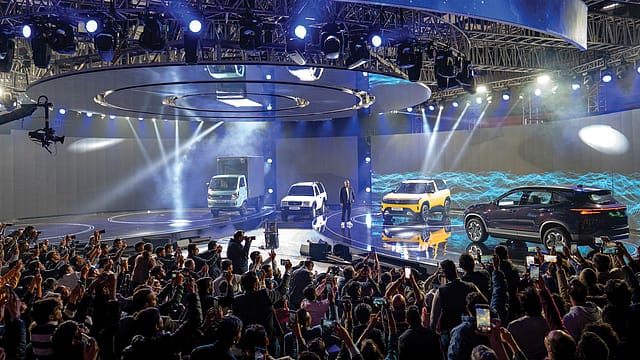
Since Open published its last cover story on EVs (‘Embrace the Evolution’, December 6, 2021) close to five years ago, a lot has changed in the segment, driving up EV adoption, backed by the Union government’s production-linked incentive schemes (PLIs) for automobiles, batteries, subsidies, rare earth magnet manufacturing, and so on. Interestingly, while EV growth was initially driven by hatchbacks and compact cars, manufacturers are now zealously launching midsize and premium electric SUVs. In fact, over the past five years, the number of EVs has risen, as evident from registration figures on the Vahan portal, by 91 per cent to 19.68 lakh in the last fiscal from fiscal 2020. The key measures partly responsible for this growth, besides the desire to cause less harm to Mother Earth, are the PLIs for automobiles and the auto-component industry kickstarted in 2021 (meant essentially to enhance domestic manufacturing, including batteries), the PM Electric Drive Revolution in Innovative Vehicle Enhancement Scheme notified in 2024, and others. According to official data, electric two-wheelers accounted for about 8.4 per cent of new registrations by mid-2026. The electric goods vehicle (E-GV) segment, including e-trucks, grew by 172 per cent year-on-year.
The Indian EV passenger vehicle market is led by domestic players such as Tata Motors, which accounts for the largest market share with models like the Nexon EV and Punch EV. Other major local automakers producing electric cars include Mahindra & Mahindra (XEV 9e, BE 6) and Maruti Suzuki (e Vitara), among others. International and joint-venture auto companies that manufacture or assemble electric cars locally in India include MG Motor India (Windsor EV, ZS EV and Comet EV), Hyundai, which sells locally produced and imported EVs such as the Creta Electric, and the behemoth BYD, which sells premium and luxury models. Among others, VinFast, the Vietnamese manufacturer, has recently expanded its operations into India with a localised production plant in Tamil Nadu.
SOME OF THESE companies have ambitious plans, and more entrepreneurs are entering the segment thanks to record EV sales. For instance, the Tata Sierra EV recorded 1,516 wholesale dispatches in June 2026. Similarly, Mahindra’s upcoming BE 07 electric SUV has been spotted testing in India. While auto magazines keep talking about new launches, the concept of battery-as-a-service, or BaaS, is simply appealing to the masses. It goes this way: you buy a car and the company owns the battery. All you have to do is pay a small per-kilometre fee for using it, depending on the model. This means EVs are becoming affordable to a large chunk of people who thought they could not afford them.
BYD, meanwhile, is shifting to a premium, technology-led strategy in India, targeting double-digit growth. It has recorded growth of 84 per cent. Strikingly, unlike in China, BYD operates in the premium and luxury EV space in India, selling models like the Atto 3, Seal, Sealion 7 and eMax 7. The company also envisages designing EVs tailor-made for the Indian market, focusing on longer-range hybrids (PHEVs) and localised features to capture a broader audience, according to various reports.
As we said earlier, electric SUVs are becoming more fashionable, with utility getting the upper hand and families preferring EVs for long-distance trips. Experts tell Open that battery swapping is finally gaining momentum. This means that instead of waiting 30-60 minutes for charging, battery swapping allows users to exchange depleted batteries within one or two minutes. The biggest beneficiaries, according to reports, are delivery fleets, auto-rickshaws, commercial two-wheelers and so-called urban taxis. The Centre has plans to support indigenous automated battery-swapping technology to speed up commercial EV adoption.

Again, technology is playing a bigger role in EVs. They are becoming more software-driven, with features such as AI-powered battery management, advanced driver assistance systems and so on. Ultra-fast charging infrastructure is emerging rapidly, contributing to the ease of using EVs. For example, DC fast chargers are becoming more common on highways as private companies expand charging networks in major cities.
Meanwhile, experts say India is investing heavily to reduce dependence on imported battery cells. Major areas of investment so far include lithium-ion cell manufacturing, battery recycling and domestic battery R&D under the “Make in India” initiative. They also say solid-state batteries are on the horizon. Notably, India’s EV growth is no longer confined to private cars but extends to electric buses, three-wheelers, logistics operators, and so on.
Reports suggest that Indian manufacturers are increasingly adopting lithium iron phosphate (LFP) batteries over the older nickel manganese cobalt (NMC) chemistry. According to various studies, LFP batteries typically last two to three times longer than traditional NMC lithium-ion batteries, and there are more efficient alternatives on the cards. The Government of India and the European Union have launched a Euro 15.2 million joint programme to strengthen EV battery recycling technologies, according to official communication. According to an official statement on this joint venture, itwillfundthedevelopmentofaninnovativepilotlineinIndia, demonstrating processes that go beyond the current state of the art.
“Key technical priorities include advanced processes for lithium and CAM-ready purity; developing flexible recycling methods for current and future battery types; digitalised collection and sorting systems that integrate the informal sector to ensure safe and zero-risk logistics; and advanced diagnostics for second-life applications and active safety monitoring.”
As regards Tesla, it looks as though the Elon Musk-steered EV maker is not too keen on India following the government’s refusal to drastically reduce import tariffs and also because the company is not interested in local manufacturing. The government is in no mood to yield to such demands. As a result, according to a Moneycontrol report, Tesla sold fewer than 500 cars in the past year, while during the same period (September-June 2026), BMW sold 3,433 cars and Mercedes-Benz 1,116, according to industry sales data reviewed by Moneycontrol.
Now, offering more insights into new trends in the EV segment, Farah Halim, director at PluginIndia Electric Community, which was launched by eco-activist, EV aficionado and techie Kamlesh Mallick in 2013 and is often called the country’s oldest EV advocacy group, says, “Over the past decade, we at PluginIndia have not only seen rapid EV adoption but also growing acceptance of alternative fuels. Choosing to move beyond petrol and diesel is ultimately a decision to diversify, reducing dependency on a single fuel source, region or nation. It is both a strategic economic choice and a commitment to sustainability by our government and citizens.” Today, OEMs are introducing long-range vehicles, e-SUVs with super-fast charging capabilities, and an expanding charging ecosystem is emerging to support long-distance travel, she emphasises, adding, “However, even as EVs require significantly less maintenance than traditional ICE vehicles, establishing a robust network of reliable repair centres and a steady supply of spare parts remains critical for widespread, long-term adoption.”
Now, there are a few tips that former McKinsey senior executive PR Rajasekharan has for all EV users. This Singapore-based NRI, who spends many months a year in India, says he used to drive an Innova (diesel) and a Volkswagen Taigun before purchasing his EV, an MG Windsor. “The primary reason was that I am an ESG [environmental, social and governance] enthusiast who runs a company in the segment,” he says, detailing the advantages he found in the car. “Earlier, I had to pay more than ₹25,000 a month on fuel costs, which are now around ₹500, apart from when I do long-distance travel, for which, too, the cost is negligible. I have a solar electricity system at home, and that is an added advantage in terms of saving costs and earning more thanks to surplus power. Then maintenance costs are almost nil in most months.” But initially, you have to work on yourself to change your mindset and plan for EV drives by keeping yourself abreast of the charging infrastructure around you, he says. Another challenge where innovation has to focus more is the price-range issue, adds the former McKinsey executive. “Safety of batteries is also a major concern, but since big brands are investing heavily in this area and are planning to scale up, EVs are expected to grow rapidly and become cheaper.” Innovation must also come in the area of battery disposal and ultra-fast charging, he avers.
He is right. And, amidst challenges, there are rays of hope, with both the government and the private sector being gung-ho about EV research and development and thrilled about new opportunities to meet people’s “go-green” aspirations.