Eternal Yarn: The evolution of khadi continues to update aesthetics—and how
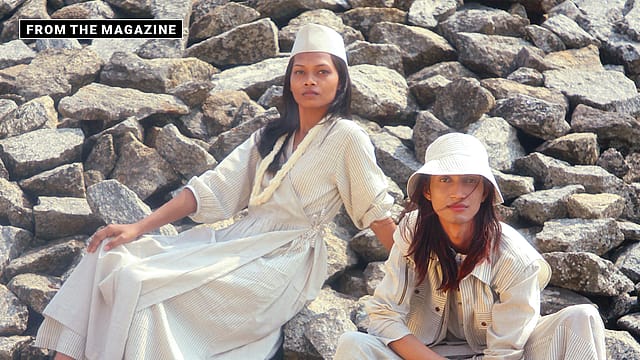
“I THINK OF KHADI AS MY SECOND SKIN,” says Ashish Satyavrat Sahu. “I’ve been wearing Khadi since 2012 and I’ve worn Khadi from across the country.” The Ranchi-based designer fell in love with Khadi as a student at the National Institute of Fashion Technology (NIFT), Gandhinagar, to the extent that people nicknamed him the Khadiwala designer. Sahu is best known as the founder of Johargram, the streetwear-inspired label crafted using tribal textiles and handlooms. But he has simultaneously spent over a decade wearing and engaging with Khadi, in collaboration with Khadi boards, institutions and government bodies.
Now, Sahu is aiming to bring his Khadi designs directly to consumers, with the launch of his eponymous label. “I recently received the Khadi Mark and we are launching on August 15,” he says, noting that Khadi’s history inspired his choices. Travelling across different states, he has collected countless stories of the textiles—from finding trees in Khadi institutions planted by Mahatma Gandhi and foundation stones laid by Rajendra Prasad to meeting Gandhians and Khadi practitioners in their 70s and 80s who equalled the act of spinning and weaving the cloth to serving the country. “Meeting older Gandhians, I realised that they saw their work with Khadi not as a way to make money but as an act of public service. It is a form of shramdaan,” he says. “I want Indians to know that Khadi is not just thread or cloth. It is an emotion.” As he launches his label, his other dream is to embark on a Khadi Yatra, documenting such stories from institutions all around India.
At 35, Sahu speaks about Khadi with a joy and excitement that echoes the voices of older practitioners. “When I wear khadi, I embody a worldview,” Ela Bhatt once said. Bhatt, the visionary founder of SEWA (Self-Employed Women’s Association of India) who died in 2022 at the age of 89, was known for wearing Khadi saris for most of her life. The handspun, handwoven cloth has been embedded in the national imagination since Gandhi positioned it as a symbol of self-sufficiency and the Swadeshi movement (deriving the word from Khaddar). Today, Khadi remains emblematic as the cloth of freedom. Yet, as it is fashioned in contemporary looks and designs, the textile has also come to represent fresh ideals and values.
The story of Khadi is rooted in colonial rule, which among other travesties caused irreparable damage to India’s textiles ecosystem. Long before Indian textiles’ contemporary global demand, the country’s intricately handwoven fabrics, embroideries, hand-painted and dyed textiles made their way to the wardrobes of royalty and aristocracy from Southeast Asia to the Roman Empire. As the British Raj produced and flooded the market with machine-made goods and imposed crushing tariffs, indigenous textiles and their makers crippled under the weight of discrimination and neglect.

Emerging from this history, Khadi, homegrown and handmade from the act of spinning the yarn to weaving the fabric became a symbol of resistance in a way few textiles have managed to do. Yet, there is more to Khadi than its association with a coarse, plain fabric. Even in its early days, many women—including Gandhi’s wife, Kasturba—argued against wearing the white fabric due to its association with mourning and widowhood among Indian communities. Kamaladevi Chattopadhyay came up with the idea of dyeing the textiles in a shade of orange—leading to the name, Orange Brigade. Poet and freedom fighter Sarojini Naidu observed, “For me, Swadeshi begins with Mahatma Gandhi’s charkha but does not end there”; she contended that an excessive emphasis on Khadi could come at the cost of the country’s multi-hued textiles and crafts traditions.
Eight decades since independence, Indian textiles have arguably sustained in all their variety, despite the challenges of fast fashion, machine-made textiles, rising prices and dwindling livelihood opportunities for artisans. Driven by artisans, textiles and crafts practitioners, designers and consumers, Khadi has found a new spin in this milieu. It has also become a thread that stitches together the past and the present. Indian fashion is a much younger industry compared to its global counterparts, having found its growth curve since the turn of the millennium. Yet, it’s connected with a history so rich and layered that few fashion cultures can match up to. Khadi becomes its specific link to the struggle for independence—the cloth of freedom translated into contemporaneity and combined with different practices and designs. As designer Chinar Farooqui says, “Khadi has a significant history in India, and its association with the freedom movement is an important part of that. But I am equally interested in Khadi as a textile that continues to be made and used today, and in the communities and skills that have kept this practice alive.”
Farooqui is the founder of Injiri, the Jaipur-based label known for its engagement with handlooms and handmade techniques in fashion, home textiles and art. “My interest in Khadi comes from a larger interest in Indian textiles and the processes behind them,” she says. “The texture and character of the cloth already say a lot. We work closely with weavers
and craftspeople, and for me, the process of making is just as important as the garment itself.”
Another designer working with Khadi is Shruti Sancheti who has incorporated the textiles in various collections for the past 12 years. Sancheti was, in fact, a history student before she pursued fashion and Khadi’s past and its ethos sparked her interest. “Khadi was a medium of restoring a sense of dignity and there’s an emotion attached to it. But it is also a beautiful and versatile fabric. It is sustainable and has unique properties which work for our weather.” These functional qualities also played a role in her choice of Khadi. Sancheti is from Kolkata and now based in Nagpur; apart from using Khadi in her label, she has also worked with local artisanal communities and institutions such as Sevagram (in Wardha) as well as the Maharashtra State Handloom Corporation.
When Sancheti started working with Khadi, its historic and symbolic value came to mind first but she has seen perceptions evolve to see Khadi as relevant to contemporary lifestyles and consumers. Her designs add different elements to Khadi, including prints, embroidery and mirrorwork. “I made it a little more luxurious and contemporary in terms of colour combinations and motifs,” she says. “All my best moments have come with Khadi, whether it is in appreciation or buyer’s response.” Sancheti has showcased her Khadi designs at Lakme Fashion Week in association with FDCI (the Fashion Design Council of India); most recently, the label was part of Dhaagon Ki Sargam, a showcase for National Handloom Day. Next, Sancheti’s designs are set to appear at Khadi Beyond Borders in New Zealand this month in a collaboration between the New Zealand Fashion Week and FDCI. Other Indian designers who will be part of the showcase are Rajesh Pratap Singh, Samant Chauhan and Pawan Sachdeva.
The historical significance of Khadi may recede to the background when conflated with fashion—an industry that thrives on trends and capturing contemporary zeitgeist. But it also makes space for aspiration and innovation. Today, one sees Khadi being translated into denim, Pashmina and numerous other textile traditions. At Advaya, the luxury design label from the House of Angadi—one of its key textiles innovations has been a Khadi Kanjeevaram, blending two traditions. “Tradition is not something we inherit unchanged. It is something we return to, question, reinterpret and carry forward,” says KH Radharaman, founder and creative director of Advaya. “The Khadi Kanjeevaram came from that same thinking, bringing handspun khadi into the traditional design vocabulary of the Kanjeevaram and exploring what new possibilities could emerge from bringing the two together.”
FOR MANY YOUNGER Indians, Khadi is a fresh discovery. Sudha Dhingra, professor at NIFT and project director at the Centre of Excellence for Khadi (CoEK), notes that while Gen Z and students may be aware of Khadi’s significance in the freedom movement, they also associate it with trendiness and the fact that respected Indian designers are working with the fabric. “We asked our students to model the collection for our first fashion show in 2022. Many wore Khadi for the first time and they said that they had never worn fabrics like these,” says Dhingra. “Once they wear Khadi, and they want to have the textiles in their wardrobes. The fact that it is made by hand also make it more valuable for them.” Over the past five years, many young design professionals have worked at CoEK. The organisation asks everyone working there to wear Khadi or handloom on Mondays but Dhingra observes that many now wear Khadi on other days too.
Dhingra has worn Khadi in the past but her perception of the textile evolved over the last few years helming CoEK. Inaugurated in 2022, CoEK was conceived by the Ministry of Micro, Small and Medium Enterprises (MSME) to bolster design innovations and market linkages for Khadi, with NIFT as the central hub. “The mandate given to us was to make it attractive to younger generations. We brought new colours, patterns and silhouettes in Khadi,” says Dhingra, noting that being situated within the NIFT campus and working with young people and industry consultants bolstered its practices. “Khadi has a huge variety. Even when compared to handlooms, Khadi has wide range of textures. Hand-spinning gives a character to it and the feel of the fabric is very different,” she says. Designs by CoEK have been shown not only in India but also internationally at destinations like Moscow, and the team has worked with artisans and Khadi institutions across the country.
Khadi has always contained ideals of livelihood generation and sustaining local economies. These continue to resonate in fresh ways. Take for instance Colors of Resilience, a project by Save the Loom, a non-profit founded by Ramesh Menon in Kerala. Conceived in response to the 2018 floods in the state, the project has engaged more than 20 designers to create new garment designs using Khadi produced in Kerala. The project is now in its eighth year and remains on display. “It operates simultaneously as exhibition, archive, and retail—an unusual hybridity that mirrors the textile’s own dual life as everyday cloth and symbolic fabric,” says Menon. Artisans are at the heart of the project. While designers bring visibility to the work, “the true centre of gravity remains with the artisans.” Menon adds: “The handspinners and weavers of Kerala—many of them women—form the backbone of this narrative. In a sector where women constitute a significant majority of the workforce, their labour sustains both tradition and innovation. Through collaborations such as this, their work enters wider national and global circuits without losing its geographic specificity.”
At a time when the industry grapples with challenges of fast fashion, overproduction and waste, pollution and labour rights, Khadi offers the solutions—handspun and handwoven, slowly and mindfully crafted, and enabling livelihoods. “I think Khadi is important today because it makes us think about how clothes are made. It offers something very different from the speed and uniformity that has come to define much of the fashion industry,” says Farooqui. “I also think people are increasingly interested in understanding what they buy, who made it and how it was made. Khadi offers a way of looking at clothing that gives importance to the maker, the process and the time involved.”