Eternal Sisters: Limits of the Lata-Asha comparison
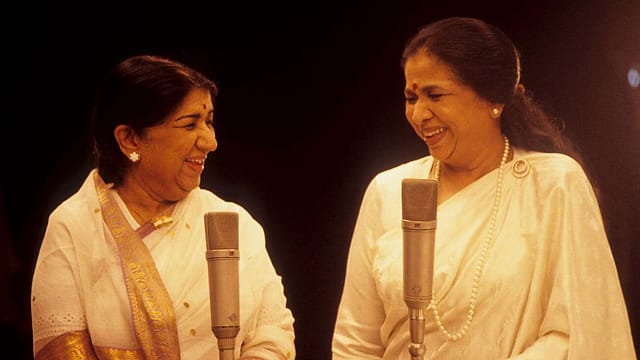
ALTHOUGH SHE was 92 years old, Asha Bhosle seemed timeless, keeping ahead of the youth with her lifelong engagement with trends in music as well as its traditions. She was the last of the great singers who shaped the Hindi film song in the 1950s and 1960s. I was glad I had a chance to pay a brief tribute to her immense talent on BBC radio recently. Even though I met her only once—and was too overawed to ask questions—her voice has been very much present in my life for many decades and will remain so.
Her extraordinary output and 60-year career show Bhosle’s versatility and talent. It is hard to sum up her career which ranges through songs in many languages and her work with non-Indian musicians.
While I would never argue with Lata Mangeshkar’s standing as the prima donna assoluta of the Hindi film song, it is hard not to keep comparing the two sisters endlessly. It is mostly true that Lata’s voice became the template for the Hindi film heroine, and Asha was the cabaret artist, the sister, the second heroine; yet, it is far from a simple division, and the story is told in the form of Hindi cinema’s melodramatic trope of a good sister and a bad sister. This division was not absolute. Asha could sing for innocent heroines too, for example in Gulzar’s films including Ijaazat (1987), where she sings for Rekha as well as Anuradha Patel with ‘Mera Kuchh Saamaan’.

Lata also sang for the heroine when she was a courtesan in Kamal Amrohi’s Pakeezah (1972) or for Rosie the dancer who leaves her husband to run off with Raju in Vijay Anand’s Guide (1965). In these films, the heroine is played by top stars Meena Kumari and Waheeda Rehman, and the story allows Lata Mangeshkar to keep to her more restrained style—Pakeezah is one of the many courtesans who seem to avoid men in the kotha while Rosie is more of a Hindi film heroine than she was in RK Narayan’s novel. Lata also sang the raunchy ‘Kaanta Laga’ (Samadhi, 1972), and sang for Helen including a song that would be ‘cancelled’ today, ‘Aa Jaane Jaan’ (Intaqam, 1969), and one in which Helen wore a swimsuit on the beach, ‘Is Duniya Mein Jeena Ho’ from Gumnaam (1965).
The more interesting question is why this division came about, although it is a bit of a sidetrack here as it seems to be more about Lata than Asha. When Lata came into the industry, there were other big singers like Zohrabai Ambalewali and Shamshad Begum whose style was more like that of the ‘courtesan’ singers. Did the role of the heroine of the 1950s demand a different style of singing where the emphasis was on her innocence and ‘purity’, available only for the hero, which Lata provided? What role did technology play in this? Why did this style prevail? Why was Lata always preferred for these roles? Unless one wants to investigate rumours, these questions will probably never be answered.
Returning to Asha, it seems she had more of a struggle in all aspects of her life including her singing career, and she did not seem to be someone who played politics in the industry. Rather, she benefitted from the many quarrels between singers, music directors and filmmakers, taking opportunities quietly and efficiently and just getting on as she did with her personal life, which seems to have often been tough and included much untimely bereavement.
The range of Asha’s voice allowed her to fill many gaps in the demand for female playback singers and no doubt she was able to create her own market too. She seems to have had an open and enquiring mind, interested in modern music, often jazz and non-Indian music as much as traditional forms, to which she could bring her mobile and wide-ranging vocal talents. Little has been said about her personal charm and her ability to style a sari and traditional dress to look cool to the younger generation.
When the discussion shifts from Asha’s relationship with her sister, it often moves to the two music directors who shaped her career and her life. OP Nayyar and RD Burman, two of the leading and innovative music directors of their day, whose roles in developing her career and the role she had, in turn, in shaping their legacies would be fascinating to explore in more depth. Yet other composers, such as SD Burman and Ravi also played an important part in her career though at a greater distance.
I have not read much about Asha’s interactions with other female playback singers. It is striking how much she sounds like Geeta Dutt in her earlier songs, and the two often had playback for the same film (Howrah Bridge) in 1958, as well as singing some wonderful duets together for SD Burman, including ‘Kya Ho Phir Jo Din Rangeela Ho’ in Nau Do Gyarah (1957) and ‘Bachpan Ke Din’ in Bimal Roy’s Sujata (1959).
Asha sang some classic duets with Mohammed Rafi, including ‘Aaja Panchi Akela Hai’ in Nau Do Gyarah and ‘Abhi Na Jao Chhodkar’ in Hum Dono (1961). She was also well matched with Kishore Kumar, singing with him in many all-time hits, over several decades, including ‘Chhod Do Aanchal’(Paying Guest, 1957), ‘Aankhon Mein Kya Ji’ in Nau Do Gyarah, and too many to mention with RD Burman and Bappi Lahiri in the 1970s and 1980s.
Asha Bhosle is mourned worldwide. Her status as a global icon is seen in the numerous obituaries in the mainstream press. Even those who first came across her name through Cornershop’s ‘Brimful of Asha’ (I never felt so old as explaining to my students what ‘45’ referred to) will no doubt be thinking of her today.