Earth Citizens: Portraits of Green Consciousness
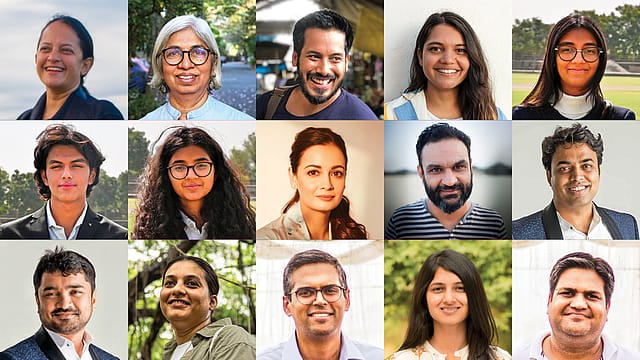
CLIMATE CHANGE IS RESHAPING every aspect of life, moving from a distant idea of a grim future to a widespread phenomenon that affects everyone on the planet. In response, conversations around sustainability and climate-positive action have soared—propelling people from different walks of life forward. Today, sustainable values span business and science, food and agriculture, education and public life. There are many ways to care for the Earth and the lives it holds—from restoring biodiversity and ecosystems to reducing waste. These ways can involve reimagining the food we eat and the clothes we wear. These efforts can impact wildlife and trees as much as people—whether urban dwellers or rural and indigenous communities. They determine how we navigate our present lives and map the future. From farms to forests, laboratories to design studios, classrooms to coastlines, here are changemakers who have found their purpose in innovating and finding solutions to an array of environmental challenges.
Krithi Karanth, Conservation scientist: Ear to the Ground

Earlier this year, Krithi K Karanth was named the 2026 Rolex National Geographic Explorer of the Year, adding another feather to a cap already adorned with accolades. The conservation scientist, who serves as CEO of Centre for Wildlife Studies (CWS) and an adjunct professor at Duke University, has built a body of work that ranges from conducting field research and designing community programmes to writing and editing academic journals as well as accessible resources in the form of books, film and other media. Karanth grew up close to forests with her conservationist father and eventually became one herself. She remains excited by the dynamic nature of her job. “Every day is different,” she says, adding that “the most meaningful moments are always in the field, whether it is visiting new locations, new locations, spending time with our teams, or having direct conversations with the people we work with.”
At CWS, Karanth and her team are scaling its conservation programmes. These include: Wild Seve, which helps families navigate compensation for wildlife-related losses across four states; Wild Shaale, an educational programme which engages more than 100,000 students and teachers; and Wild Surakshe, which works on public health and safety preparedness. Meanwhile, the Wild Carbon initiative has planted over 1.5 million trees in partnership with over 2,700 farmers, and Wild Saakshi has been combating illegal hunting and trafficking across 32 wildlife reserves. “Each of these programmes has demonstrated real impact, but equally, each has enormous room to grow,” Karanth tells Open. “The need on the ground far exceeds what we have been able to reach so far, and the potential to deepen impact, expand geographically, and bring more communities into the fold is very much there.”
Wilma Rodrigues, Social Entrepreneur: Nothing is Wasted
In 2001, not long after the introduction of the Municipal Solid Waste (Management and Handling) Rules, 2000, Wilma Rodrigues switched tracks from journalism to start Saahas Zero Waste—a Bengaluru-based non-profit that aimed to create awareness and promote action around waste management. This year marks 25 years for the non-profit as it continues to promote the cause of sustainable waste management. Going beyond awareness, Rodrigues set up Saahas Zero Waste in 2013 as a social enterprise that would actively facilitate waste management and circular solutions. “Waste is a complex issue and we need to demonstrate the solutions—we need to actually be in it in terms of the day-to-day, moving the needle to show the changes that need to take place,” Rodrigues tells Open, emphasising the need for robust business models.
“The implementation of the rules is focused on circular systems and material recovery and that can only be done when we pay attention to good operations. It means having dialogues and partnerships with different customers—whether it’s bulk waste generators or anyone else.” Saahas has facilitated waste management in educational campuses and commercial organisations, set up Materials Recovery Facilities (MRFs) and enabled recycling for plastic, textiles and e-waste among other solutions in a bid towards circular transitions. As waste management evolves, Rodrigues applauds stronger regulations and action but also seeks for more considered approach to steps like incineration which have their own adverse effects. She also calls for a greater spotlight on waste generation and collective action in response to a challenge that impacts our present as much as the future.
Thomas Zacharias, Chef and Entrepreneur: Good Taste
“EVEN WHEN I worked in restaurants, my relationship with food was driven by curiosity,” says Thomas Zacharias. “I wanted to travel, encounter unfamiliar ingredients and dishes, and bring that excitement back into the dining room.” Zacharias worked at Michelin-starred restaurants like Le Bernardin and helmed The Bombay Canteen before launching The Locavore in 2022—drawing from travels around India to explore the relationships of food and communities. “I also saw climate change, extractive production and concentrated markets threatening entire ways of life. When a crop becomes unviable or a community loses access to its landscape, livelihoods, nourishment, knowledge and autonomy disappear with it,” he says.
“That changed the question for me. It was no longer simply how to encourage people to eat local, but how food could help people understand the systems they participate in and make them fairer.” The Locavore’s multi-pronged approach includes storytelling, producer partnerships, public programmes and initiatives such as the Mumbai Koli Project, Millet Revival Project and Local Food Clubs. Another important aspect is storytelling that aims to alter behaviour. Zacharias’ own relationship with food has moved “from mastery towards greater humility” but not at the cost of creativity or ambition. “I still want food to surprise people and expand their imagination,” he says. “I am simply more conscious of whose knowledge makes that possible, who benefits from it and what responsibilities accompany the act of sharing it.”
Gabriella d’Cruz, Marine Conservationist and Entrepreneur: Coastline Cause
The coastlines of India are home to over 800 varieties of seaweed—nutrient-dense superfoods whose benefits have come into the limelight amid growing conversations around health and wellness. For Gabriella D’Cruz, seaweed can change lives for the better in more ways than one. Hailing from Goa, the marine conservationist found her calling in the oceans early—with a Masters in Biodiversity Conservation and Management from the University of Oxford, she worked on coral reef conservation projects and cetacean monitoring with World Wildlife Fund-India.
Her work earned her the BBC Global Youth Champion award around the same time she met a community of women seaweed harvesters in Tamil Nadu. Their knowledge systems and perseverance in taking forward a generational-occupation inspired the marine conservationist to dive deeper into the seaweed ecosystems and industry in India. The result of over half a decade of research has led to The Good Ocean, a firm that promotes the use and consumption of locally sourced seaweed from the Indian coastline. Sourced responsibly in partnership with fishing communities, The Good Ocean works with restaurants, food and beauty companies, exploring seaweed, besides creating its own products such as a seaweed-based cracker. D’Cruz and her team also enable knowledge-sharing, growing local expertise in farming and safeguarding native and wild seaweeds that ensure protection for coastal environments and the communities that live in such regions.
Ariana Agarwal, Avyana Mehta and Vivaan Chhawchharia, Student Innovators: Bright Sparks
THIS YEAR, INDIA got its first winners at The Earth Prize—one of the world’s largest environmental competitions and ‘ideas incubator’ for 13- to 19- year-olds which supports young innovators with mentorship and funding. Ariana Agarwal, Avyana Mehta and Vivaan Chhawchharia, 16-year-old students of Jayshree Periwal International School, Jaipur, emerged as global winners of the prize for Plas-Stick—a biodegradable magnetic tamarind powder that can extract microplastics from water. Developed in collaboration with IIT Guwahati, the idea for Plas-Stick emerged from a village visit where the trio encountered the challenges of accessing clean water sources. Designed to work without electricity or machinery, the method involves adding the powder to water to bind microplastic particles into clumps which are then extracted using a hand-held magnet. “What started as an idea between students has now been recognised among thousands of projects from around the world, which feels both surreal and deeply motivating. We hope this not only helps us scale Plas-Stick further but also encourages more young people to believe that their ideas can create meaningful environmental change,” the winners said in a statement announcing their win. Having reached 8,000 students and teachers, the innovators hope to now scale their innovation and expand it to more communities.
Dia Mirza, Actor and environmentalist: Natural Act
Nature has its own voice, says Dia Mirza who has carved a distinct space as an actor and eco-advocate in equal measures. To advocate for nature, she observes, is “about reminding ourselves that we are part of it, and that protecting the planet is ultimately about protecting one another. My role is simply to use whatever platform I have to help make that connection impossible to ignore”. Actors lead highly publicised lives and Mirza leverages this spotlight—spreading awareness on sustainable living, for daily living, organising cleanliness drives and collaborating on environmental stories.
As an UN Environment Programme (UNEP) Goodwill Ambassador for India and an Advocate for the Sustainable Development Goals (SDGs), she amplifies campaigns on climate change, pollution and wildlife protection. Slow change doesn’t dishearten her. “I find hope in those working quietly, often without recognition: forest guards protecting wildlife, young people organising in their communities, scientists, farmers, teachers and citizens,” she says. “I’ve also learnt to celebrate small victories. A restored wetland. A child who begins to care about nature. A policy that protects a forest. These moments may seem small in isolation, but together they create lasting change.”
Apurva Kothari, Entrepreneur: Sustainable Chic
BEFORE HE FOUNDED No Nasties in 2011, debuting with a line of t-shirts made from organic cotton purchased from fair-trade cooperatives, Apurva Kothari had little to no connection with fashion. Working a tech job in Australia, what moved him were the stories of farmer suicides back home and their need for steady livelihood. When he started, organic and fair-trade were niche concepts. Today, these are mainstream and buzzy and No Nasties is among India’s most well-known clothing brands that delivers on both aesthetics and pricing. “Sustainable fashion spent a decade being ugly and expensive, and that’s exactly why it stayed niche.
Today, we lead with a balance of style and sustainability,” he says. “On affordability, we compete with regular fashion pricing, not ‘ethical fashion’ pricing—guilt has never been a great business model.” The label’s designs have expanded to not only chic clothing for adults but kidswear and home textiles too. Its production cycle is an even bigger USP—Kothari and his team undertake full life-cycle analysis to determine the carbon footprint of every garment. It is offset with investments in solar, wind, bio-gas projects, and tree-planting—from Madagascar to Guatemala and Mumbai to Goa. The business is growing too with new stores, digital offerings, packaging innovations and collection. As he says, “Fifteen years in, we’re just getting started.”
Abhishek Sinha nd Deepak Parihar, Entrepreneurs: Eco Palate
THE ROLE OF large-scale meat production in environmental degradation has been a subject of much debate as the industry grapples with concerns about a massive carbon footprint, greenhouse emissions, deforestation and habitat loss, pollution and animal cruelty. Among its solutions, which include reduced consumption of high-impact meats, improved livestock management, responsible practices and waste reduction, one has gained particular traction: plant-based protein alternatives. In recent years, a wave of entrepreneurial ventures and innovations in the plant-based food segment has emerged—offering alternatives to meat. GoodDot, founded by Abhishek Sinha (CEO) and Deepak Parihar (CFO), is one of them.
Sinha, an ex-IRS officer, and Parihar, an entrepreneur, are both animal lovers who came together with their team to start the firm based on the conviction that more people would switch to plant-based food more readily if the product “not only tasted like meat but was an ethical, healthier, and environmentally sustainable alternative”. Headquartered in Udaipur, GoodDot offers packaged alternatives to meat-based delicacies. It also operates in the B2B (Business-to-Business) segment, catering to hospitality properties seeking plant-based and vegan eatables. Besides expanding into new markets beyond India, the brand has also partnered with the likes of Haldiram’s, PETA, Starbucks and Hilton Hotels.
Parveen Shaikh, Conservation biologist: The Birdwatcher
I always had a soft corner for birds,” says Parveen Shaikh. As a student at The Institute of Science, Mumbai, she often made her way to Bombay Natural History Society (BNHS) to listen to conservationists and ornithologists and ventured out birdwatching. “I really liked birdwatching but wanted to do something more with it than a hobby.” She joined BNHS in 2012 and continues to work there as a conservation scientist known for helming a conservation programme for the endangered Indian skimmer. India is home to over 90 per cent of the global population of Indian skimmers, a species of riverine birds that nest on sandbars and are recognised by their distinctive orange bills. Shaikh’s initiative began on the Chambal river with monitoring and active interventions to protect the birds whose numbers have been in decline; it led to a 27 per cent increase with the number of birds growing from 400 in 2017 to 1,000 last year.
For her work, Shaikh won the prestigious Whiteley Award this year as she continues to expand the programme to new rivers, including the Ganga and the Mahanadi. The Indian skimmer is the flagship species of this programme but there are other birds under Shaikh’s protective radar too, from the rare and endangered black-bellied tern to the river lapwing, small pratincole, great thick-knee and several others. Conservation is a difficult pursuit undertaken in challenging conditions and often lacking the resources and budgets it deserves but Shaikh never ceases to find inspiration and delight in the unique details of birds, in their feeding rituals and migratory patterns, in the mighty flow of rivers and in the dedication of citizen scientists and birdwatchers who work with her and other researchers to protect and nurture their local biodiversity.
Kaushik Kappagantulu, Saumya Sahay and Ayush Sharma, Entrepreneurs: Being Climate Smart
AS THE DEBILITATING impact of climate change on agriculture and food security becomes increasingly apparent, small farmers and producers are in acute need of innovations to sustain their harvests and livelihoods. “For years, high-tech climate-smart agriculture was considered impossible for the one- and two-acre farmers who make up most of Indian agriculture. We set out to prove otherwise,” says Kaushik Kappagantulu, co-founder and CEO of Kheyti. A decade ago, Kappagantulu and his partners—Saumya Sahay, Ayush Sharma and Sathya Raghu Mokkapati (who has now moved on to other pursuits) founded Kheyti to facilitate accessible agritech solutions.
Its Greenhouse-in-a-Box, posited as a 90 per cent cheaper alternative to market offerings, is a modular kit for a farmer to start at a sixteenth of an acre and built to grow local crops. “They double their incomes, cut crop losses from heat, rain, pests, and hail by 60%, and farm using 70-90% less water and fertiliser,” Kappagantulu adds. In 2022, Kheyti won the prestigious Earthshot Prize and, today, has reached 7,000 smallholder farmers around the country.