Dharmocracy: Conservatism With A Hindu Accent
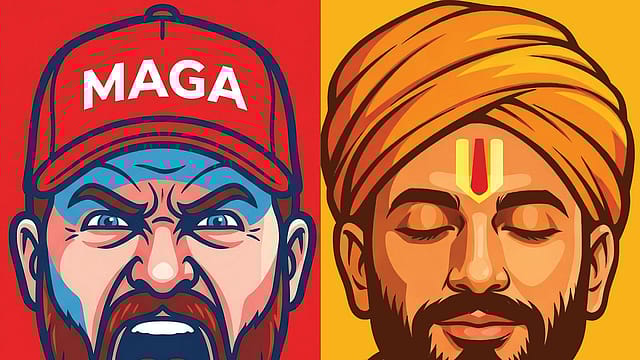
AS THE YEAR COMES TO AN END, 2025 WILL BE REMEMBERED FOR SEVERAL things like any other year. One significant event is the rise of the conservative right in the West, especially in the US and several countries in Europe. As the tumultuous year, which saw wars and conflicts continuing in Ukraine and Gaza and US President Donald Trump’s unpredictable policies causing more than enough turmoil in different parts of the world, comes to an end, mapping of the 27-member European Union (EU) reveals that some 13 heads of government represent centre-right parties like the Christian Democrats or more rightwing parties. Those include Austria, Belgium, the Czech Republic, Finland, Hungary, Ireland, Poland, the Netherlands, Sweden, Italy, and Portugal. Countries like Slovakia and Croatia too can be added to this list.
Even in countries like France and Germany, rightwing parties are making significant gains, making them the possible alternative in the next national elections. In the UK, while the traditionally rightwing Tories suffered setbacks, other rightwingers like Reform UK have gained significant traction with the electorate. In a way, national conservatism, once abhorred, has emerged as the flavour of the season in Europe.
But the biggest success story for rightwing politics is in the US. Riding over the sweeping sentiment of Make America Great Again—MAGA— Donald Trump became president for the second time in January this year. While in his first election against Hillary Clinton in 2016, Trump trailed in the popular vote by around three million, he still made it to the White House to govern until 2020. In the 2020 election, Trump trailed Joe Biden even more badly by about seven million popular votes and lost the race. But when he bounced back in 2024, Trump was able to secure not only a Congressional majority over Democrats but also a majority in the popular vote of roughly two to three million over his rival Kamala Harris. The 10 million majority that Trump managed to secure between 2020 and 2024 is largely attributed to the support he received from the MAGA champions, who included his Vice President JD Vance, the assassinated Charlie Kirk, rightwing TV icon Tucker Carlson, as well as several podcasters and many unknown far-right Christian groups.
Two decades ago, John Micklethwait, editor-in-chief of Bloomberg, wrote a book on American politics in which he described the country’s political system—its constitution, courts, culture, religion, and individual-centric values—as naturally favouring the right. “Its [the US’] institutions, culture, and voting patterns consistently favor conservative or center-right ideas, even during periods when liberal politicians win elections,” he argued in his co-authored book The Right Nation. Even a diehard liberal ideologue like Francis Fukuyama came to agree in recent years that the Americans do get influenced by certain cultural impulses. But what seems to have happened in the last election was that the mood swung a bit too far to the right, leading to the rise of new MAGA stars.

While national conservatism saw a steady rise in Europe and the US in the last few years, and more pronouncedly in 2025, its contradictions too are slowly tumbling out as we approach the end of the year. European conservatives are anything but united, with multiple parties competing for the same space—from the UK to France and Germany to others. In the US, the mothership of rightwing politics, the Republican Party, is struggling to balance between the traditional conservative politics of small state, free market, liberal church, and American nationalism and the new-age MAGA ideology of white, English and Christian nationalism.
While traditional conservatism is championed by Republican veterans, groups like Turning Point USA started by the late Kirk and a horde of podcasters led by former Fox News commentator Carlson are leading the charge on behalf of MAGA. Charlie Kirk, a young conservative author and commentator, rose as a key figure in American youth conservative activism through the organisation he started at the age of 18 in 2012 called Turning Point USA. He actively campaigned for Trump in the 2016, 2020 and 2024 elections, earning accolades from him as a “tremendous young conservative”. His critics saw him as divisive. On September 10 this year, Kirk was shot and killed at the Utah Valley University by the accused Tyler James Robinson who apparently told his fiancé that he had had “enough of his hatred”.
Kirk’s killing was originally expected to mobilise and unite the Republican ranks. But it appears that the developments are leading to the widening of the faultlines within the conservative movement in the US.
Vice President JD Vance ruffled many feathers, including probably his wife’s, when he said at an event on October 25 hosted by Turning Point USA at the University of Mississippi that he hoped his Hindu wife would one day accept the Gospel. “I honestly do wish that… because I believe in the Christian gospel and I hope eventually my wife comes to see it that way,” he said in response to a question from the audience. Usha Vance (née Chilukuri), JD Vance’s wife for more than a decade, was raised in a religious Hindu familythatmigratedtotheUSinthe1970s. She publicly stated in an interview earlier this year, “I am not a Catholic, and I am not intending to convert or anything like that.” Yet her husband insisted that while Usha was “the most amazing blessing I have in my life”, his Christian faith tells him that the Gospel is true and is good for human beings. “I hope she may one day see things as I do,” Vance, a devout Catholic, insisted.
Not unexpectedly, Vance’s statement stirred a hornet’s nest in the US. Many Republicans jumped into the fray. While a few, like the Indian-born MAGA activist Dinesh D’Souza, sought to defend Vance, arguing that what he said was the core belief of every Christian, several others saw in it a rejection of the Republican Party’s belief in religious pluralism. “Every true Christian wants to share the love of Christ—and so hoping that one’s spouse might one day convert is a normal expression of Christian belief,” D’Souza argued. He also taunted Hindus that since Hinduism believed in the existence of many gods, they should not have any objection to Usha Vance converting to Christianity.
MANY WERE CRITICAL of Vance’s and D’Souza’s comments, some highlighting the hypocrisy involved. While Usha talked on several occasions about her Hindu identity affirmatively, Vance claimed she was an “agnostic”. He also claimed that his wife accompanied him to the church on many occasions, and that they decided to raise their children in the Christian faith but stopped short of stating how he responds to her religious beliefs. On the other hand, D’Souza’s statement that “my ancestors were low-caste Hindus who were being horribly treated and found it less oppressive to become Christians” betrayed dishonesty, since he himself claimed in a book several years ago that his grandfather had told him they were Brahmins. When confronted, D’Souza argued that his grandfather’s claim was a “worthless boast” and he “actually didn’t know”.
Vance is widely seen as aspiring to step into Trump’s shoes. He may wish to use such statements to keep MAGA hardliners, who believe in making America a fortress of English-speaking white Christians, in good humour. The hardline MAGA activists believe in creating a nation based on a single religious-cultural identity. For them, immigration is not an economic or technological issue. Instead, the immigrants, legal or otherwise, including millions of Indians, are a threat to America’s cultural identity. In a dialogue with an Australian podcaster, Charlie Kirk made the MAGA position clear that for America to be America, those Indians who migrate must be Christians, suggesting that American identity is tied to religion alone, not to ethnicity or nationality.
In the early 2000s, Samuel P Huntington, American political scientist and Harvard professor, wrote a book titled Who Are We? The Challenges to America’s National Identity. Over several centuries of its existence, America failed to create its own national identity, Huntington bemoaned, warning that America was headed towards a “bilingual and bicultural society”. Rejecting the notion that America is a land of immigrants—a proverbial “melting pot”—and dismissing multiculturalism as “anti-European civilization in its essence”, he called upon all Americans to “recommit themselves to the Anglo- Protestant culture and traditions”. The MAGA activists today champion a more hardline version of Huntington’s theory.
Not all conservatives necessarily support the formulation of “one language-one religion America”. Prominent conservative commentators like Ezra Levant were critical of Vance, with Levant accusing him of “throwing his wife’s religion under the bus” for a moment of acceptance from “Groypers”—a term referring to the ultra-right activists who see themselves as working to preserve a white, Christian identity in America. Even American-born Pope Leo XIV, leader of the Catholic faith to which Vance and others belong, is known for his liberal views on the question of pluralism. “May religions not be used as weapons or walls but rather lived as bridges and prophecy! Religions are for peace, not for fanaticism,” the new Pope averred, insisting on promoting “the culture of dialogue as the path; mutual collaboration as the code of conduct; reciprocal understanding as the method and standard.”
This ideological schism is seen growing within the conservative ecosystem in the US. In the third week of December, at Turning Point USA’s annual youth conference in Phoenix, one of the biggest stages for the rightwing movement, feuding among different stakeholders came out in the open, prompting Turning Point USA’s new leader and Kirk’s widow Erika Kirk to bemoan in her opening remarks that “we have seen fractures, we have seen bridges being burned that shouldn’t be burnt”.
At the Phoenix conference, two
leading lights of the conservative podcast circuit, Ben Shapiro and Tucker Carlson openly confronted each other. Shapiro went on to attack Carlson and some others as “grifters and charlatans”, guilty of misleading their audience with falsehoods and conspiracy theories. Not hiding his anguish about Carlson hosting outspoken anti- Semite Nick Fuentes, who called Kirk’s killing an Israeli conspiracy, Shapiro called it “an act of moral imbecility” on Carlson’s part. Carlson, who spoke a little later, retorted by accusing Shapiro of seeking to “deplatform and denounce” people who disagree with him. The division within the ranks of American conservatism over the meanings of ‘America First’ and MAGA is now wide and exposed.
A couple of years ago, Democrats too faced a similar situation when radical leftist leaders like Bernie Sanders and AlexandriaOcasio- Cortez captured the centrestage of liberal politics. That led to several moderate leaders like Tulsi Gabbard, Mesha Mainor, Tricia Cotham, and Jeremy LaCombe— all members of Congress—abandoning the party and joining Republican ranks. It also alienated a good number of voters and damaged the prospects of the party in the last elections. Simmering feud within the Republican support base too may end up alienating many middle-grounders from the Republican Party. Losses Republicans suffered in some important elections in October already indicate that. The victory of Democrat Zohran Mamdani in New York’s mayoral election attracted a lot of attention. Despite Trump’s vehement opposition and the MAGA campaign against immigrants, Mamdani, an immigrant of Indian origin from South Africa, won the race with a record of more than a million votes. Also, in the gubernatorial race in two neighbouring states, while Democrats retained New Jersey, they won back Virginia from Republicans by a record margin of 15 per cent, indicating the changing mood. The results indicate that the average American voter perhaps may not support extremism of both woke and MAGA varieties. It should be a warning signal for the Republicans who will face an acid test in the mid-term elections to Congress in 2026.
A YEAR AGO, WE sought to engage with the conservative movements in the West to see if a common ground could be found on values like religion, culture, family, national identity, and sovereignty. A couple of my colleagues and I attended theNationalConservatismConference in Washington DC in July 2024. In my address, I called upon conservative friends to build a strong global movement based on the principles of pluralism, inclusivity, and respect for religious diversity.
I suggested that instead of calling ourselves National Conservatives we would prefer to describe ourselves as Cultural Nationalists. As the name suggests, we derive our national identity from the ancient culture of our land. Cultural nationalists find common ground with national conservatives in the fight against the left-liberal, woke, secular, and globalist ideology. But cultural nationalism, unlike the MAGA version of conservatism, is not exclusivist, nor against any community. It does not seek to impose any singularly religious identity on the entire population.
We share many conservative ideas of the West. But we may not fully subscribe to the conservatism-liberalism discourse, deeply rooted in the Western socio-political context. In our part of the world, conservatism comes with the baggage of colonialism and a superiority complex. The trauma of centuries of European colonisation, and the harsh treatment meted out to our religions, our cultures and our traditions, is still fresh in our minds.
We believe in freedom of religion. India is a land of many religions. At the root of Indian conservatism is the belief that all religions are valid paths to the same eternal truth. We do not abhor religious diversity; nor do we insist that everyone should follow only one ‘true’ religion; we celebrate diversity. We zealously uphold the right of every Hindu, Christian, Muslim, and Jew to practise his or her religion without fear.
Within this framework, we expressed our readiness to work with our conservative colleagues from across the US and Europe to build a strong global movement for conservatism and cultural nationalism based on the principles of pluralism, inclusivity, and respect for religious diversity— where our religions feel respected, societies feel secure, and governments feel free to pursue their national agendas. While a section of the conservatives did support the idea of a global coalition, a large number of MAGA activists frowned upon it and attacked and vilified Hindu organisations and practices, making it clear that there is not much space for such things in their scheme. Vance’s utterances about his wife’s religion, Kirk’s belief in a Christian America, and Fuentes’ commitment to building a White Christian America confirm that western conservatism is yet to come out of religious orthodoxy and cultural superiority.
In this situation, the cultural nationalist project too faces its life-time challenge. On the one hand is the increasing assertion of the country’s age-old cultural-civilisational identity through programmes like building a Ram temple in Ayodhya. On the other is the obligation to uphold core values like pluralism, respect for diversity and inclusivity. When a leadership wielding strong political will and enjoying the support of the majority is in power, the real test comes not on the assertion of identity but on adherence to values and principles. With power in their hands, the MAGA activists turned to the fundamentalist and exclusivist version of their religion. Do cultural nationalists in India ape them and convert their religion and culture into an Indian version of Semitism? Or from a position of strength, can cultural nationalism offer an Indian version of conservatism— derived from the age-old Hindu principles of ethical and cultural statecraft based on the concept of Dharma?
The distinction between the Western and Dharmic worldview is clear.
On the question of Creation, the Dharma worldview believes: Isavasyam idam sarvam (Chapter 4: The Isavasya Upanishad). The entire universe, animate and inanimate alike, is pervaded by Isvara— the divine consciousness.
On the question of ethnic, racial, linguistic and other difference in the world, it proposes: Vasudhaiva Kutumbakam. The entire world is one family.
On economics, it talks about “sustained consumption”: tena tyaktena bhunjitah. One should acquire only that much which was left for him by Isvara.
On welfare, it states: sarve bhavantu sukinah/ sarve santu niramayah. Let all be happy and free from disease.
On the environment, its proposition is: Mata bhumi putro’ ham prithvyah (Atharva Veda 12, 1, 12). This earth is my mother and I am her son.
On the question of religious diversity, it proposes: Ekam Sadvipraa bahudhaa Vadanti (Rig Veda). Truth is one; wise men interpret it in different ways.
The Dharmic worldview has attained ultimate levels of tolerance, accommodation and celebration of pluralism. On the question of diversity, it says: nana vibrati bahudha vivacasam; nana dharmanam prithivi yathaukasam; sahasra dhara dravitasya ye duham; dhruvena dhamurenk pasphuranti. “The earth is full of variety; it contains people speaking different dialects and speech, of diverse religious customs, each living according to what they think is right. The earth contains innumerable valuable things. It bears trees and plants of great diversity. We should pay homage to that Earth.”
A great opportunity awaits India to offer this alternate vision for humanity— Dharmocracy—based on its ancient civilisational value system. At the same time, it also faces the acute challenge of achieving the balance required to tackle internal Adharmic forces and the temptations of majoritarian power on one hand and having the tenacity to not lose sight of its hoary wisdom and principles on the other.
In the world of competing communalisms and conflicting understandings of what constitutes a nation and its welfare, it is not easy for people to overcome emotions. We see it in catcalls at religious processions to crude trolling on social media to heaping humiliations on national stars. A case in point is the manner in which a woman cricketer was treated by some because of her public articulation of faith.
The temerity of the leadership is tested on such occasions when tenacity triumphs over temptations of power.