Desolation Row: Blame Hindus too for Hampi’s desecration
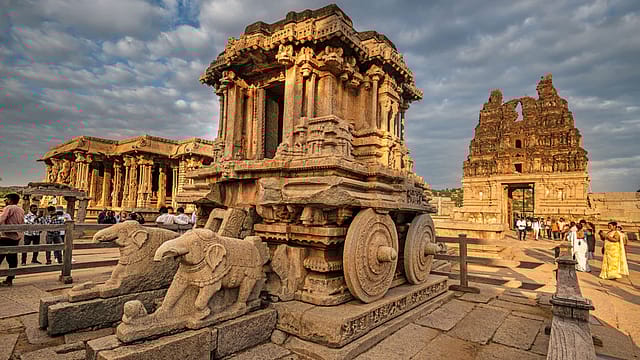
RAJARSI DEVA pratimau tapasau samsita vratau/ desam katham imam praptau bhavantau varavarninau
(Both of you appear like sagely kings and divine princes who have embraced an arduous vow and are dressed like ascetics. You have a smooth complexion. Pray, what brings you to this region?)
This is the maiden address of Hanuman to Rama and Lakshmana, and this is how he formally introduces himself:
Prapto’ham presitastena sugrivena mahatmana/ rajna vanara mukhyanam hanuman nama vanarah
(Delegated by that Mahatma named Sugreeva, the great king of monkeys, I have come to you. I am another monkey named Hanuman.)
This pivotal meeting in the Ramayana occurs in the serene vicinity of the Pampa Lake situated amidst the enchanting Kishkinda region teeming with mountain chains, caves, lakes, ponds, flowers, animals, fish, birds and butterflies. The Indian tradition holds that every millimetre of (undivided) Bharatavarsha has been sanctified by Rama’s ayana—journey or footstep. Of all the Kandas (books) in the Ramayana, only the Kishkinda Kanda is named after a specific geographical location. Thus, its primacy in India’s sacred geography and cultural inheritance needs no better proof. Kishkinda, the capital of Sugreeva’s kingdom, is also the springboard to Rameswaram and thereafter to Lanka.
Before their first encounter with Hanuman, the demon Kabandha has guided Rama and Lakshmana to the Pampa Lake. Maharshi Valmiki simply can’t get enough of extolling its splendour. The bulk of the 73rd chapter of the Aranya Kanda is devoted to describing the marvels of its environs; in its final chapter, Rama beholds the Pampa Lake, and its breathtaking tranquillity reminds him of Sita; his pining for her intensifies. He continues this lament in the first chapter of the Kishkinda Kanda and eventually becomes acquainted with Pampa’s divinity. The extent of Valmiki’s rapturous portrayal of Pampa makes it evident that he had spent months if not years in the region.
Pampa.
Hampi.
The site of an extensive Hindu empire that was predestined for glory. An empire that saved southern India from becoming the wasteland that its northern counterpart became under relentless Islamic depredations. The founders of the Vijayanagara Empire couldn’t have chosen a better location for its capital. The site was formerly a kingdom of monkeys who put their neck on the line and defeated the invincible Ravana in his own den. The ‘reality’ of this immortal epic is less important than the ideal it upholds; an ideal that continues to preserve whatever precious little is left of Sanatana culture.
History and mythology are fused in ways that are unapparent. In Sri Rama’s time, Kishkinda was steeped in fear, chaos, and confusion. He not only liberated it by killing Vali but instilled order by infusing a sense of noble purpose. The founders of the Vijayanagara Empire achieved a comparable feat by expelling the Turushkas and bringing the whole of Dakshinapatha under their unifying spectre and birthed the safest and richest city of its time. Two centuries before Thomas Roe stood in Jahangir’s opulent court, Vijayanagara had been the magnet that continually attracted Europeans to India; its contact enriched Venice, Rome, Lisbon, China, and Persia.
When Will Durant memorably wrote “history is the planks of a shipwreck” where “more of the past is lost than saved,” he universalised the phenomenon of the rise and fall of great empires.
The fateful Battle of Talikota (1565) was one such massive shipwreck of history. The Bahmani confederacy did not stop at merely killing Aḷiya Rama Raya, the commander-in-chief who led the Vijayanagara army; it physically extinguished the capital, Vijayanagara. In the Bahmani mind, this accursed city was the fount of Kaffir power; for more than two centuries, it had terrorised their psyche in indescribable ways. And their assessment was accurate. No great Hindu empire arose in South India after Vijayanagara was erased. The temblor of its devastation was more enduring. Till recently, the Hindu memory preserved the history of Vijayanagara in two Kannada words: Halu Hampi— desolate Hampi. Hindus preferred to forget the epic Talikota tragedy notwithstanding the grandeur that had preceded and led to it.
According to archaeologists and historians, the spread of the original Vijayanagara city was 236.46 square km, and the core area of the capital was about 42 square km, comprising 1,600 ruined monuments. This core area is what tourists are shown today. The data gives some perspective regarding the scale of Bahmani devastation, whose fanatical esurience was sated after nearly six months—excluding the genocide of Hindus.
If Kishkinda wasn’t endowed with such a hoary legacy, it would be nothing, not even a tourist destination. Today, it is hard to imagine that a flourishing civilisation had existed here; every trace indicating its former magnificence has been wiped out. The most tragic loss, however, is the erosion of its sanctity.
A casual conversation with locals in the vicinity of the Anjanadri Hill reveals the extent of their cultural and spiritual apathy. A majority are Kannadigas but their preferred tongue while opening a conversation with a stranger is English or Hindi. A standard reply to discreet questions is a nonchalant, “Yahan sab milta hai” (You get everything here). Liquor, ganja, synthetic drugs, etc.
Over the last two decades, the whole area has been transformed into another Goa, bursting with illegal resorts, homestays, and shacks. It shares its sorry plight with another sacred Kshetra, Gokarna, which has for long been notorious. Beginning roughly in the mid- 2000s, a new, thriving tourist triangle of sin has emerged—Goa-Gokarna-Hampi. Needless, white-skinned foreigners are the prize catch in all three places and their every need is catered to.
Nothing illustrates the defilement of sacred Kishkinda better than the depraved ‘Hippie Island’, a Xanadu of debauchery. Shut down in 2020 by a court order, this had been the greatest allure for tourists for about three decades. Locals are still furious at the monetary loss and ‘hippies’ lapse into wistful nostalgia mourning the end of its “iconic vibes” and variants thereof.
The original name of the appellation, Hippie Island, is Virupapura Gaddi, named after the Virupaksha temple in Hampi, the guardian deity of the Vijayanagara Empire. The location is home to an ancient Durga temple and scores of other Hindu shrines; the term gaddi also denotes a spiritual seat. This transformation of the sacred to the profane has been done not by hippies or invaders but by Hindus hungry for a few pieces of foreign silver.
In his 1926 Kannada monograph, Pampayatre (Pilgrimage to Pampa or Hampi), V Sitaramaiah mentions that the purpose of the pilgrimage was to discover the secret of Hampi’s holiness, to unlock the magical continuity of its spiritual primacy from the Ramayana days, to listen to the stories it told of Vijayanagara, and to learn the history of its art. This monograph, regarded as a classic, is also an ugly mirror to the erosion of sanctity in Kishkinda.
Perhaps the most painful facet of this loss is the near-total absence of monkeys in the area. Kishkinda, the capital of Sugreeva, the abode of Hanuman, today has no descendants to extol their lineage.