Delhi Sets the Stage for Mega AI Summit
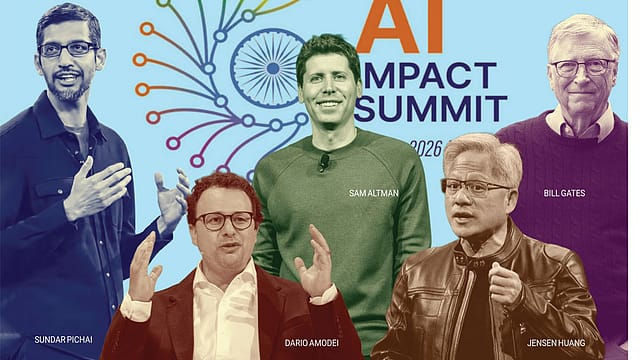
IT WAS IN 2023 that the first AI Summit was held in Bletchley Park, UK. The venue was in many ways symbolic because Bletchley Park was where, during World War II, the most brilliant mathematicians of that era got together to break the codes of the Germans. This propelled, once the war ended, the computer age, which then eventually led to Artificial Intelligence (AI). Many of the codebreakers of Bletchley Park would go on to write papers that directly envisaged the arrival of AI. The AI summit was an initiative of the then British Prime Minister Rishi Sunak, and its main focus was on the safety of the new technology. Since then, there have been two more of them, one in Seoul, South Korea, and another last year in Paris, France. There is no central body behind these summits; rather, the baton is passed on. In Paris, India was the co-chair, and it was decided that it was here that the next one would be held. The India-AI Impact Summit 2026, which takes place from February 16 to February 20 at Bharat Mandapam, New Delhi, will be a series of events in which almost all those who matter in this field will be participating, including leaders, policymakers, researchers, and business heads. The focus will be on AI's impact. It is the first one to be hosted in the Global South, a term that denotes emerging economies, primarily in Asia, Africa, Latin America and the Pacific Islands.
As many as 15 to 20 heads of government and over 50 ministers are said to be attending. There are more than 35,000 registrations. A report on the Doordarshan website added that it would also see the participation of over 40 CEOs of leading companies, plus innovators, researchers, and chief technology officers. It added, “Highlighting the scale of engagement, the summit will feature a startup showcase involving over 500 AI startups and host nearly 500 sessions alongside the main programme, making it one of the most comprehensive global convenings on artificial intelligence.” There is, for instance, the presence of Sundar Pichai, the CEO of Alphabet, who has, through Gemini, pivoted Google from being a search company to being right at the forefront of AI across images, text, and videos. Anthropic CEO Dario Amodei will be participating. The company's latest model updates this month were so good that it led to valuations of information technology stocks tanking. Sam Altman, the founder of OpenAI, which flagged off the AI era when it launched ChatGPT, will be present. Bill Gates, Microsoft founder and chair of the Gates Foundation, is attending. And there is going to be Jensen Huang, the founder and CEO of Nvidia, whose semiconductors are the hardware propelling the AI revolution, making the company the most valued in the world with a market capitalisation of over $4.5 trillion. There are also people like Mukesh Ambani, chairman of Reliance Industries, and N Chandrasekaran, the chairman of Tata Sons, among the long list of Indian business leaders participating.
The summit's primary purpose is to arrive at a consensus of sorts across issues related to AI, which can then drive its future. For that, the areas to focus on have been broadly divided into three 'sutras'—people, planet, and progress. Based on them, seven working groups, called 'chakras', have been formed, which will contain experts from different domains to discuss and arrive at actions that can further this consensus. The groups so formed are: human capital; inclusion for social empowerment; safe & trusted AI; resilience, innovation and efficiency; science; democratising AI resources; and AI for economic development & social good. The working group on science will, for instance, figure out how AI can positively impact science in a way that makes it transparent and equitable. The one on human capital will look at how people can be reskilled to adapt to AI. This is especially necessary given that AI is expected to lead to a large number of professionals becoming irrelevant. The AI Summit website notes: “Each working group theme represents a distinct yet interconnected sphere of potential engagement through which the transformative potential of AI can be harnessed to deliver tangible benefits aligned with the three foundational pillars. Together, the seven themes present comprehensive coverage that would facilitate countries, international organizations, and stakeholders to deliberate on all aspects of AI towards maximising collective benefits while still addressing shared challenges.” Depending on what these groups come out with, at the end of the summit, on February 20, there would be a 'Leaders' Declaration' that would be the consensus statement on what can be implemented going forward.
The summit will also see a mega exhibition for those in the field. The India AI Impact Expo 2026 will have thematic pavilions, each tailored to specific systems offering solutions in areas like 'climate resilience, scientific discovery, inclusive development, secure governance, workforce skilling, and more.' The website adds, 'With 300+ exhibitors from 30+ countries, the Expo serves as a meeting ground for innovators, policy thinkers, researchers, and enterprises.'
Plus, there are over 550 startups showcasing themselves. Within this ecosystem, women and youth have been given a special impetus. AI by HER was a competition of sorts for women entrepreneurs using AI. The top 30 teams will be present at the summit, and they can also pitch to investors. The initiative's objective is to create an ecosystem where such women-led startups are supported and mentored to become successful. Another initiative targets youth. YUVAi - Global Youth Challenge asked innovators between 13 and 21 to put in applications to show their AI business ideas. Those selected will get to participate in a boot camp and also interact with experts in the field. The days of the summit will also be filled with sessions and panel discussions on areas that AI touches. For instance, a session called 'AI for Road Safety' will discuss how the technology can be used for 'data-driven approaches for understanding crash patterns, predicting risks, and enabling proactive interventions.'
AI is powered by large language models (LLMs), with companies in the United States owning a majority of them. India is trying to catch up through the IndiaAI Mission. The summit is an opportunity to show what has been happening on this front. Like Sarvam AI, for instance, is developing LLMs for Indian languages. On February 11, it came out with a new brand identity. It and the other 11 startups training Indian models using the country's data will be on display at the event.
India has been a latecomer to the AI race but is now trying to catch up. Even if technologically there is still some way to go, it has the advantage of being a major consumer and hence a market that others cannot ignore. It is the reason why the who's who of the AI world is turning up in Delhi. The India-AI Impact Summit 2026 is a recognition of India's intent to be at the frontline of this race and to use its influence to shape AI's direction.