Control C for Culture
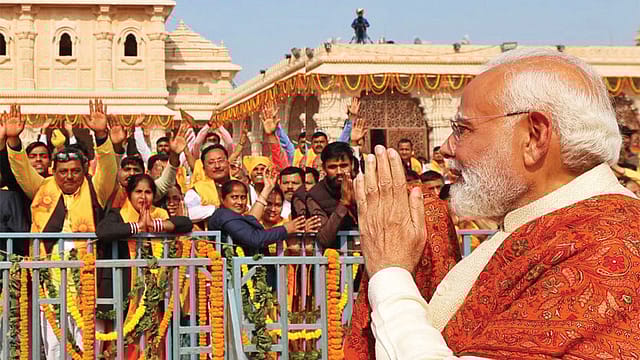
IN TWO RECENT SPEECHES, INCLUDING THE ALL IMPORTANT ADDRESS IN Ayodhya to mark the completion of the iconic Ram Janmabhoomi temple, Prime Minister Narendra Modi referred to the cultural and intellectual devastation caused by Lord Macaulay in India. Modi’s attack on what he viewed were the damaging consequences of Macaulay’s infamous Minute on Education was seen by a section of the Indian intelligentsia as needless and even misplaced. Why, it was asked, should a policy dating back to 1835 be deemed relevant 78 years after the British restored sovereignty to Indians?
Some of the bewilderment stemmed from a belief that the real target of Modi’s attack was the elevated status of the English language in India. Since Macaulay’s bid to transform the Indian personality into something Britons found more comprehensible involved the primacy of the English language, the connection was understandable. At the same time, I believe that those who imagined Modi was using an attack on Macaulay to signal his preference for cultural insularity were getting the wrong end of the stick.
Over the past two decades, Modi has accurately identified Lutyens’ Delhi as the springboard of the political attacks on him. The expression ‘Lutyens’ Delhi’, which was subsequently rebranded as the ‘Khan Market Gang’ by the prime minister in 2019, wasn’t a mere description of privileged groups in the national capital that had prospered during the long years of Congress rule. Such people, not least of which were power brokers, arms dealers and middlemen who facilitated contacts with government departments, were, of course, disoriented when it became quite clear that Modi’s victory in 2014 was much more than a mere change of government—something they had become accustomed to after it became clear that the Gandhi family’s monopoly over political control was well and truly over.
Much more markedly than the six years of the Atal Bihari Vajpayee government when the Bharatiya Janata Party (BJP) had to share power with different regional parties, the orientation of the Modi government is much more ideological. At one level, as the sharp attack on Macaulay suggests, there was a bid to differentiate the culture of the new Bharat from that which had prevailed during the first six decades after Independence—a period that was defined by the Nehruvian consensus. The importance attached to the use of Hindi as the preferred language of politics and statecraft as opposed to English was a facet of the change. English wasn’t discarded; its status was sharply downgraded. Those not entirely comfortable with Hindi were encouraged to use another Indian language.
The attacks on Macaulay’s legacy have triggered responses—usually from individuals who are known for their anti- Modi views—that are centred on asserting the importance of English in a globalised world where the dominance of the US is an inescapable reality. It has been argued, and quite rightly, that the colonial baggage associated with the forcible use of English by ‘natives’ has been steadily discarded since the process of political decolonisation was initiated after World War II. Indeed, there has been a very conscious attempt by radicals all over the world to create a post-colonial intellectual ecosystem that also incorporates the usage of English. It is a different matter altogether that the woke culture that accompanied the capture of academia by post-Marxian scholars, radical gender and race activists, and other weirdos added another colonialist dimension to the 18th and 19th-century suppression of the cultures of dominated peoples.
The issue of the English language apart, Macaulay’s project had two other elements, at least one of which was internalised by powerful sections of the Indian intelligentsia.
The first was the Christian agenda, a product of the times. The British Empire, it should always be remembered, was built on two distinct approaches—although there were areas of overlap. The first was the commercial agenda that was relentlessly pursued by the East India Company, much to the exclusion of everything else till the 1830s. The other was Britain’s so-called ‘civilising mission’ that incorporated the attempts to make Christianity the predominant religion of India. In the wake of the fierce backlash that almost led to the collapse of British rule in 1857-58, the official encouragement to Christian missionaries was severely curtailed. The natives were permitted to keep their religious practices largely intact. At the same time, the missionaries and other Christian bodies didn’t abandon their proselytisation thrust. Instead, the focus shifted to securing a body of converts drawn from the upper echelons of Hindu society who would be drawn to Christianity intellectually. Their detox from their Hindu inheritance would come from institutions imparting a Christian education.
The project was only partly successful. The formal conversion of Hindus from the upper castes turned out to be a non-starter. After some initial Christian successes in mid-19th century, particularly in Bengal, Hindu society reacted in anger and simply disowned the new converts. They were ostracised by their families and the wider society and forced to relocate to other parts of India. The missionaries were, however, more successful in converting a slice of Hindus from the lower castes and triumphant in turning entire societies of Northeast India into Christians.

Where the quiet patronage of Christianity by the British Raj yielded greater returns was in creating an intellectual climate that equated Sanatana Dharma with vile and inhuman practices, crude superstitions and plain backwardness. In the early days of the East India Company, there were administrators such as Warren Hastings who tried to understand the religious and philosophical underpinnings of native religions. In Britain, there were notables such as Edmund Burke who argued against the Company’s social disruption. However, following the Company’s adoption of Macaulay’s approach to education in India, it became less intellectually taxing to mirror the Christian disdain of idolatry and paganism.
Unlike many other sites of the colonial encounter, Indians who were educated in Christian institutions and even government-run institutions didn’t change their religion. Instead, they entered the job market and filled subordinate positions in government with the conviction that their own religious practices were somehow primitive and unworthy of being subject to rigorous intellectual scrutiny. Combined with the experience of a few centuries of Islamic rule where their subordination was a fact of life, the intellectual assault on their religious practices and social customs left them lacking in self-confidence.
Raja Ram Mohan Roy is viewed as a great social reformer and his initiatives to ensure the formal ban on widow burning (sati) has quite rightly earned him a place in modern India’s pantheon of greats. At the same time, it shouldn’t be forgotten that his establishment of a monotheistic Brahmo Samaj was a bid to somehow Christianise Hindu religious practices. A significant section of educated Hindus in Bengal saw the Bramho Samaj as a refuge of those who were lacking in cultural self-esteem.
Bankim Chandra Chatterjee was among the few Indians who combined an awareness of the intellectual traditions of Europe with an understanding of the huge repository of knowledge within Hinduism. He was dismissive of attempts by Christian missionaries to become authorities on Hindu traditions. Likewise, he was contemptuous of those Hindus who equated modernity with an uncritical acceptance of everything European, including lifestyles. It is worth quoting his savage attack on the deracinated in his Letters on Hinduism: “And what shall I say of that weakest of human beings, the half-educated anglicised and brutalised Bengali babu, who congratulates himself on his capacity to dine off a plate of beef as if this act of gluttony constituted in itself unimpeachable evidence of a perfectly cultivated intellect?”
In the case of Bankim, this wasn’t a case of shadow boxing. It is true that institutions such as the Brahmo Samaj failed to persuade Hindus to enter its fold. Although adherents of the new sect escaped the brutal rejection of Christian converts because of their faith in the Upanishads and their commitment to prayers in the vernacular—although the rituals were often derived from the church services of Anglicans—they were nevertheless detached from mainstream Hindu society.
In time, descendants of the original Brahmos were important figures in Bengal’s cultural elite. They also constituted an important part of the early leadership of the communist movement. It required the aggressive Hindu nationalism advocated by the likes of Swami Vivekananda, Aurobindo Ghose, and Bipin Chandra Pal to demolish the demonisation of Sanatana Dharma that was an offshoot of the Macaulay project. Yet, the intellectual anti-Hindu proclivities persisted well into the 20th century.
The other facet of the Macaulay agenda that scarred the personality of educated Hindus was a belief that the imperatives of modernity necessitated a national commitment to the values of the European Enlightenment. Partha Chatterjee, a ‘post-national’ social scientist, summed up this left-nationalist ideology which shaped the post-1947 Nehruvian consensus: “The intellectual history of India in the 19th and 20th centuries, Marxist historians argued, was a history of the struggle between the forces of progress and those of reaction. Progress was represented by those who stood for modernity, that is to say by those who fought against the antiquated beliefs and practices of a medieval society, who championed the cause of rationality, science and enlightenment against scripture, custom and faith.” Nehru, for example, was deeply sceptical of the Swadeshi movement that emerged in the early 20th century and regarded it as “reactionary” for its generous use of Hindu symbolism.
This is not to suggest that the forces of political liberalism that emerged after the formation of Congress in 1885 were not fully committed to the restoration of national sovereignty. The likes of Surendranath Banerjee, Gopal Krishna Gokhale, and Pherozeshah Mehta—the so-called ‘moderates’ in the battle against the Lal-Bal-Pal trio in the first decade of the 20th century—were deeply committed to self-rule. But their vision of the future was profoundly influenced by the institutions of the colonisers. This meant their liberal outlook combined constitutional government with a secular vision of modernity. Until his conversion to Muslim separatism after 1937, Muhammad Ali Jinnah too shared these beliefs.
The nominal commitment of the likes of Nehru and some socialists in Congress to centralised planning and the public sector didn’t amount to any rejection of the Anglo-Saxon liberalism which was a derivative of the Macaulay agenda. These leftist inclinations were hardly dissimilar to the puerile iconoclasm of the Young Bengal movement in the mid-19th century. In his The Continent of Circe, Nirad C Chaudhuri described the political and social assumptions of the Nehruvian ruling class: “Hinduism is dying, if it is not already dead. Our industrial revolution will kill it, and that would be right. We have proclaimed a secular state, and to try to bring into it an out-of-date religious notion is rank obscurantism. That might do for Pakistan, a backward, theocratic country, but India is progressive and is admired by the whole world for her progressive outlook and activities.”
Nirad Babu wasn’t proffering a caricature. In 1950, a controversy erupted within the Nehru government over the rebuilding of the Somnath temple in Gujarat. Prime Minister Nehru was dismayed by the active involvement of KM Munshi in the project. “I do not like your trying to restore Somnath. It is Hindu revivalism,” he told Munshi.
Munshi’s reply was very sharp. In a letter to Nehru on April 24, 1951, he wrote: “I cannot value India’s freedom if it deprives us of the Bhagavad Gita or uproots our millions from the faith with which they look upon our temples and thereby destroy the texture of our lives… [This] shrine once restored to a place of importance in our life will give to our people a purer conception of religion and a more vivid consciousness of our strength, so vital in these days of freedom and its trials.”
There are eerie similarities between the Nehru-Munshi exchanges and the debates India witnessed in the wake of the movement for building the Ram Janmabhoomi temple in Ayodhya. It is impossible to be certain if the penetration of secular-liberal beliefs had become more pronounced or weakened in the seven decades after Independence. In the early Nehru years, Walter Crocker, a very perceptive High Commissioner of Australia, had debunked senior Congress leaders and Nehru’s ministers as “provincial mediocrities, untravelled, ill-educated, narrow-minded… some were cow worshippers and devotees of ayurvedic medicine and astrology.” Discounting Crocker’s personal juxtaposition of the enlightened prime minister and a political class enveloped in darkness, what comes through quite clearly is that India’s liberal dispensation always lacked social depth. In the aftermath of the 1967 General Election where Congress in North India received a big jolt thanks to the parallel pro-Hindi and anti-cow slaughter agitations, Nirad Chaudhuri had despaired of “a social class whose outlooks, ideas, behaviour, and social role are utterly different from those of the traditional and numerically stronger part of the middle class.” The latter, he felt, “can only regard the Westernised type of Indian only as a renegade or usurper.”
The Unknown Indian could just as well have penned his essay in 2025. Modi’s India is experiencing the electoral decline of a Congress whose leadership continues to be fanatically committed to Macaulay’s fantasy world. The old order is being overwhelmed by a more vibrant version of those who feel that the restoration of national sovereignty after a thousand years also necessitates reclamation of a suppressed inheritance.