‘Cockroach’ Revolt: Testing Times
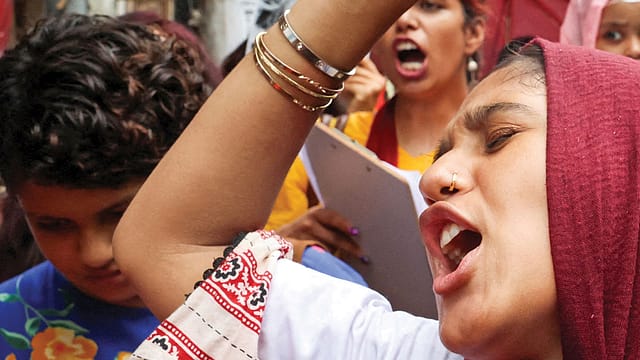
THE BIRTH OF THE Cockroach Janta Party (CJP) on social media was a farcical take on Chief Justice of India Surya Kant’s passing remarks. But the handle set up by digital creator Abhijeet Dipke ballooned to 2,00,000 followers in no time and what started as an internet ‘bubble’ began gaining serious traction. So much so that the question whether the online movement had indeed hit a nerve grew day by day. Dipke’s decision to return to India from the US and organise a protest at Delhi’s Jantar Mantar put the idea to a reality check.
The first show on June 6 was not too encouraging. There was a swarm of young protesters clearly committed to CJP’s demand that then Education Minister Dharmendra Pradhan should resign over the leak of the National Eligibility cum Entrance Test (NEET) papers, but the numbers were not impressive. The media contingent attracted by the unlikely sounding outfit made up a good part of the crowd on a hot summer’s day at the small ground between the Free Church near the Jantar Mantar monument and the South Indian food stall Kutty’s not far from Kerala House. There were posters and lusty sloganeering but the protest seemed a far cry from the sense of anticipation that had built up.
Over the next few weeks, CJP and Dipke took the protest to other cities and the reception was definitely mixed, drawing some support but not quite making waves. Faced with rebuffs and the possibility of the purported youth revolution dissipating, CJP leaders came back to Jantar Mantar on June 20 and began an indefinite sit-in at the site in defiance of police orders. Ladakh activist Sonam Wangchuk, a well-known face after his
long incarceration for his alleged role in the violence that swept the Union territory on September 24, 2025, began a fast in support of CJP’s demands on June 28, and that was when the protest began to receive wider attention and gather critical mass. This was also when Left student organisations like the All India Students’ Association (AISA), the Students’ Federation of India (SFI), and the All India Students’ Federation (AISF) sensed a serious opportunity to take on the Modi government and stepped up their involvement, with AISA activists joining the fast at Jantar Mantar.
The next twist in the plot happened in the early hours of July 18 when Wangchuk was picked up by police and moved to a hospital where he initially refused to accept drips. The move, two days before CJP’s announced march on Parliament on July 20, failed to defuse the situation. The crowd at Jantar Mantar kept swelling and while Delhi Police mobilised personnel from five districts and its reserves along with detachments from CISF and CRPF, it was apparent that a showdown was on the cards. The police and Central forces were under instructions to act with restraint but violent clashes broke out as the marchers pushed past barricades on the way to Parliament. The clashes between protesters and police took place on Parliament Street, near Rail Bhawan and at Patel Chowk. Lathi charges and tear gas were resorted to in order to deter the marchers, resulting in injuries to around 60-70 CJP marchers and more than 100 police personnel. The violence sharply escalated the confrontation and even Wangchuk’s decision to call off his fast on July 22 after reaching an agreement with government interlocutors made no difference. The protesters, back at Jantar Mantar, insisted on Pradhan’s resignation and the government was left with no option but to open a dialogue with Central ministers JP Nadda and Jitendra Singh meeting CJP representatives. While the government was keen to defuse the tension, the increasingly unruly nature of the crowd at Jantar Mantar made the CJP organisers wary about prolonging the agitation. The education minister’s resignation, a pledge to compensate families of NEET aspirants who committed suicide, and the withdrawal of FIRs were the terms of the truce announced by Jadda with CJP’s Saurav Das and Ashutosh Ranka.

More than a week after CJP’s decision to withdraw its agitation on July 25, the political tremors have far from died down. While Parliament remains disrupted, with Congress leader Rahul Gandhi accusing Home Minister Amit Shah of authorising “firing” on protestors—hotly contested by BJP—several questions continue to swirl round the corridors of power. There is no clear answer why the CJP protest, which had spluttered after its launch on June 6, was allowed to continue at Jantar Mantar for days on end from June 20 despite the lack of police permission. The decision to shift Delhi Police chief Satish Golcha just 11 months into his tenure on July 17, days before the march on Parliament, raised eyebrows. His successor Anurag Kumar barely had time to take charge before central Delhi turned into a cauldron of unrest. The same questions are being asked about Wangchuk’s prolonged fast, with political sources pointing out that the activist’s presence sharply elevated the profile of the protest. Although it was hard to anticipate the turn of events, the successful conclusion of the NEET retest on June 21 might have been an opportune moment to secure the education minister’s resignation.
The situation on July 20 was not particularly hard to anticipate as the visit of Communist Party of India (Marxist-Leninist) leader Dipankar Bhattacharya to Jantar Mantar confirmed the role of Left student organisations, particularly AISA which is aligned with the CPI-ML, in the protest. Precipitating a confrontation with police is a tried and tested part of the Left student manifesto and there are several precedents Delhi Police could have considered. Also puzzling was the ease with which CJP leaders returned to Jantar Mantar after the violence on July 20 as the site had been almost untenanted through the day. Once the march was over the protest site could have been cordoned off, said a person familiar with the situation. While a large number of students as well as young people in a variety of jobs had rallied to CJP’s call, there was a noticeable presence of anti-socials too as evidenced by thefts of CCTVs and targeting of security personnel, some of whom were cornered and beaten. The anarchic nature of the protest did not spare journalists either as they were indiscriminately labelled “pro-government” and subjected to heckling.
Despite the political elements at play and the protest becoming a lightning rod for all manner of grievances beyond anger over NEET paper leaks, BJP leaders recognised the youthful Gen Z nature of the agitation. The reels saturating social media made it clear that the government’s response would need to be carefully considered and convincing. Although BJP did not anticipate the gravity of the situation prior to the July 20 march, the party brass moved quickly to douse the fires thereafter. The decision to depute Nadda, health minister and former BJP president, as chief negotiator was a deliberate choice as he is seen to carry no “baggage” and has a background of student and youth activism. His non-confrontational nature made him an effective communicator while Jitendra Singh, MoS in the PMO, was also a “neutral” figure as far as the agitators were concerned. A reputed medical professional before he first contested on a BJP ticket in 2014, Singh has a business-like approach and an ability to convey messages effectively and unambiguously.
THE RISKS OF mishandling the situation and alienating Gen Z voters were clearly weighing on Prime Minister Narendra Modi when he posted a selfie video close to midnight on July 24 speaking directly to the youth and accepting that paper leaks are no “ordinary” matter for students and their families. In the video, shot in an informal manner, Modi assured that cases against the accused in the NEET case and several other measures had been pursued vigorously in the two-and-a-half months since the breach came to light. “Our most important responsibility was to ensure students did not lose a year. The government used all its resources to ensure 22 lakh students were able to appear for the test and the results are also out. But I am not one to be satisfied with such measures alone. Instructions have been given for fast-track courts. The Cabinet will discuss fast-track courts and tough penalties and will be brought to Parliament for consideration and passing,” he said. The video on Instagram—Gen Z’s preferred platform—crossed a record 303 million views in 24 hours. The next day, Modi posted a follow-up video thanking viewers for their response and amendments to the Public Examinations (Prevention of Unfair Means) Act were passed by Lok Sabha on July 29.
Pradhan’s resignation and the government’s acceptance of the terms set by CJP mark a rare setback for the Modi government that has negotiated difficult political bends since 2014. But its resilience has also seen retreats its critics view as capitulation but can also be seen as strategic withdrawals. The prime minister on November 19, 2021 had announced the withdrawal of three farm laws opposed primarily by farming unions from Punjab which had blocked arterial roads leading into Delhi for more than a year. Early into Modi 1.0, the prime minister recognised that land acquisition reforms—despite enjoying the support of Congress chief ministers—were being opposed on political grounds and dropped the idea, leaving it to states to tweak the rules.
The anti-Citizenship Amendment Act (CAA) agitation saw the convergence of Left and Islamist organisations and led to the sit-in at Shaheen Bagh in Delhi lasting more than 100 days before it ended on March 24, 2020. The anti-CAA protests took place across the country and riots broke out in Delhi in February 2020, timed to coincide with the visit of US President Donald Trump. The Shaheen Bagh site was finally cleared by police but it was essentially the advent of the Covid pandemic that ended the anti-CAA movement. The ability of determined and well-organised Left groups to confront the government has been a thorn in the side of BJP. The rioting that broke out in Noida and Gurugram after the implementation of the new labour codes revealed a similar playbook, with the Bigul Mazdoor Dasta—identified as a main organiser of the protests—closely aligned with CPI-ML’s political aims and, importantly, methods of street-level mobilisation.
Although the Left’s involvement and the AAP links in the CJP protest were evident, the larger messaging of the stir tapped into the impatience and discontent in this mobile and influential population. The prime minister’s regular outreach by way of ‘Pariksha pe Charcha’ and frequent references in his monthly radio talk Mann ki Baat indicate that he is keenly aware of the need to connect with the demographic and understands Gen Z concerns, its impatience and youthful scepticism of convention and norms. CJP founder Dipke and his associates are not limited to the ‘NEET leak’ case. Their social media profiles reflect an alignment with narratives on India’s “democratic backsliding” under the Modi government. The challenge for BJP and the government lies in bringing the focus back to education reforms that are being implemented. The rollout of the National Education Policy (NEP) 2020 is at a crucial stage with printing and distribution of textbooks and teacher training following the finalisation of the curriculum framework. The education ministry has been in the news for the wrong reasons due to the NEET leak and a recent order of the University Grants Commission (UGC) setting out “anti-discrimination” rules that led to an upper-caste backlash on grounds that the safeguards against “false” complaints are inadequate. Yet UGC has passed more than 40 orders that aim to facilitate students, researchers and academic institutions.
A POLITICAL FALLOUT of the agitation, the violence on July 20 and the emergence of CJP was inevitable and Congress took the lead with a sit-in outside the prime minister’s residence on July 21 which ended with physical removal. The developments came at a time when, ironically enough, the government was looking to more comfortable numbers in Parliament with a breakaway group of 20 Trinamool and six Uddhav Sena MPs adding to its strength in Lok Sabha while the comfort zone in Rajya Sabha has also improved significantly. The CJP protest presented Congress and other I.N.D.I.A. bloc parties an opportunity to stall the government’s plans to pass politically important legislation like the Foreign Contribution (Amendment) Regulation Bill, 2026, which increases scrutiny of foreign funds flowing to NGOs and religious groups. Although the government has not announced it, passage of the delimitation Bill and the amended women’s reservation Act are high priorities. As long as the CJP issue was live, it would be next-to-impossible to move Bills in Parliament or to conclude terms of support with parties such as DMK and NCP (Sharad Pawar) who are needed to reach the two-thirds majority for passing the Constitution amendment for delimitation.
Rahul Gandhi’s speech on the public examinations Bill on July 29 was intended to provoke a confrontation with the treasury benches. His tactics were not unusual, as the Congress leader has trodden this path before. This time, with Congress leaders Randeep Surjewala and Pawan Khera watching from the gallery, Rahul Gandhi upped the ante by claiming that Amit Shah had ordered “firing” on protesters on July 20. Earlier he had used a word called “unparliamentary” by Speaker Om Birla to taunt the BJP brass but his comments on Shah were vehemently opposed by the BJP benches and Parliamentary Affairs Minister Kiren Rijiju demanded Gandhi either prove his allegations or tender an apology. The angry exchanges led to an adjournment and when the House met again, it was only for the concluding reply of Jitendra Singh, the minister piloting the resolution. On July 30, Congress again led the disruptions in Parliament, demanding the home minister’s “accountability” for the July 20 events. It is evident that the party feels keeping the pot boiling will keep the government off-balance and pose a hurdle to its legislative agenda.
BJP leaders feel that though the CJP protests are a definite setback, the movement may struggle to retain relevance over time. Generating employment has figured high on the party’s agenda but there are obvious limitations as skill sets do not always match aspirations. BJP’s strategy lies in highlighting the development and reforms pursued by the Modi government and re-examining its political narrative-building that has largely served the party well to date.