Bengal Public Safety Bill 2026 Cleared, CM Adhikari Slams Bengal's 'Goonda Culture'
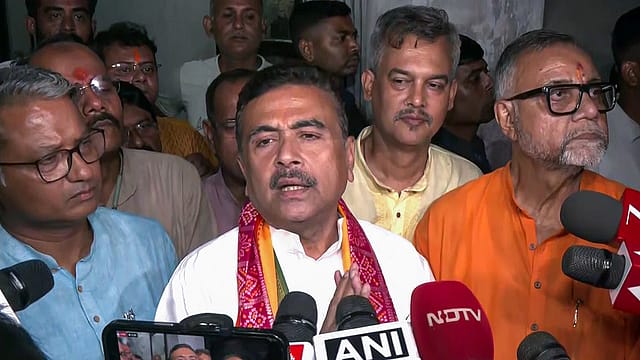
The West Bengal Assembly on Monday passed the West Bengal Public Safety and Control of Anti-Social Activities Bill, 2026, with 176 legislators voting in favour and 41 opposing it.
The legislation, which aims to strengthen the state's ability to tackle organised anti-social activities and maintain public order, has sparked debate over its preventive detention provisions and expanded enforcement powers.
During the discussion on the Bill, Chief Minister Suvendu Adhikari launched a sharp attack on both the Trinamool Congress (TMC) and CPI(M), accusing them of fostering political violence and using communities for electoral gains.
Adhikari Targets TMC, CPI(M), Defends New Law
Speaking in the Assembly, Adhikari argued that similar laws are already in force in several states and rejected concerns about potential misuse.

Look Who's Talking Regime Change
23 Oct 2026 - Vol 05 | Issue 43
"Before this is implemented, let me point out that the previous government took no action. The people of Bengal have rejected you through EVM. You have managed to form an opposition, but it is not a strong one. This bill has already been introduced in several states under different names; Maharashtra, Delhi, Uttar Pradesh, Karnataka, Madhya Pradesh, and Jharkhand have implemented it," he said.
The Chief Minister also blamed the CPI(M) for introducing violence into the state's political culture.
"We witnessed how the CPIM introduced 'goonda culture' into Bengal's politics. In 2001, they deployed 'Harmads' specifically to prevent others from gaining power through democratic means," he added.
Assuring the House that the legislation would not be misused, Adhikari said the government intended to ensure accountability for damage to public and private property.
"Since 2019, we have seen the previous government assuring a specific community of its support. We also witnessed the murders of CPI(M) voters Haragobinda Das and Chandan Das, and the ordeals their families had to endure. People engaged in the vandalism of public and government property. We will not misuse this law. We must ensure that no damage is caused to public or private property. It is the government's responsibility to enforce this law strictly; that is why it is essential. Since becoming Chief Minister, I have ensured that compensation is recovered. It is not merely about sending people to jail; we will also confiscate their movable and immovable assets," Adhikari said.
The Chief Minister further accused the TMC of treating Muslims as a vote bank and linked recent protests to incidents of violence.
"The Naoda MLA (Humayun Kabir) raised communal issues before the assembly elections, and now he has started doing so again. They provided neither jobs nor amenities to Muslims, yet incited them to take to the streets. Are the NRC and the CAA the same thing? Then why did they mobilise people for protests? They organised a rally over the Waqf issue, which led to arson. If you do not wish to abide by this law, go and protest in a state governed by the INDIA alliance," he added.
What the Bill Provides
The legislation seeks to ensure public safety, maintain law and order, and strengthen action against organised anti-social activities.
Under the Bill, authorities can act against individuals or groups whose activities create fear, panic or insecurity among the public, threaten life and property, disturb public order, or obstruct lawful trade, business and professional activities. Illegal mining, unauthorised sand extraction, and unlawful activities involving forests and wildlife have also been included within the ambit of anti-social activities.
One of the most contentious provisions is preventive detention. The Bill allows the State Government or authorised officers to issue detention orders if they believe an individual's activities could threaten public safety. District Magistrates and Police Commissioners will also be empowered to issue such orders under specified circumstances.
The legislation further provides that, notwithstanding provisions contained in the Bharatiya Nagarik Suraksha Sanhita, 2023, all offences punishable under the Act and wilful violations of lawful orders issued under it will be cognisable and non-bailable.
Persons detained under the law must be informed of the grounds for detention within a prescribed period and given an opportunity to make representations. However, authorities may withhold information if disclosure is considered against public interest.
Expanded Powers for Enforcement Agencies
The Bill also lays down measures to deal with individuals who evade detention orders. Authorities may seek court-issued proclamations, initiate action against the person's property, and direct the individual to appear before designated authorities.
Additionally, the law empowers officials to search, seize and confiscate property, documents and materials linked to anti-social activities. The State Government and authorised officers may issue directions regarding the custody, release or disposal of seized assets.
Explaining the rationale behind the legislation, the government said existing legal provisions had proved inadequate in dealing with organised anti-social elements.
In the Statement of Objects and Reasons, the government noted that certain sections were engaged in activities posing serious threats to citizens' lives and property, and that prevailing laws had been ineffective in combating such activities. It said the new framework was intended to strengthen the state's ability to curb criminal activities, disrupt criminal conspiracies and impose stringent penalties on offenders.
Separately, Adhikari reiterated that the Uniform Civil Code (UCC) would be implemented in the state on the lines of Gujarat, Uttarakhand and Assam. He said a committee headed by a retired judge had already been constituted and that details would be presented before the Assembly.
(With inputs from ANI)