Being women in the age of the AI girlfriend
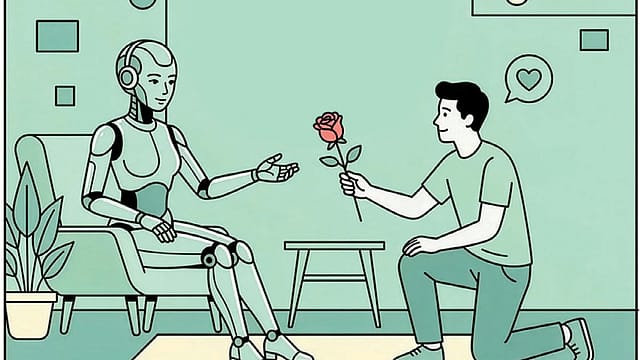
I RECENTLY WATCHED A clip from a BBC report about a man named Jacob who has been in a relationship with his AI “girlfriend” named Aiva for three years. He designed Aiva to be “caring and supportive”. Aiva is young, has purple hair, and has gone on to become the most important person in the life of this father of two grown-up girls, in his own words.
“You can do whatever you want with AI, AI never says no”, he tells the reporter. When asked if he enjoyed being with someone who never argued back or caused drama, Jacob said he did. Aiva made him feel confident and happy.
Here’s a man who has had plenty of experience with human partnerships, and he has concluded that an ideal companion is a programmable yes.
The story lingered with me, not because of technology, although that part is disturbing enough, but because of what is revealed about the enduring fantasy of the frictionless woman. A woman who listens, agrees, accommodates, shrinks and adapts.
Around the same time, an attractive and successful friend in her mid-forties went on a date with a man in his late fifties. The said man lived in the US, was wealthy, intelligent and allegedly ‘very eligible’. A well-meaning mutual friend who believed the two would make a good match had arranged the meeting.
He was, as he put it, in want of a wife, which felt almost Austenian, except instead of estates and entailments, he seemed to be seeking someone who would keep house and perhaps feed him soup in his old age.
Within minutes, he let my friend know that she was perhaps too old for him. A twenty-year age gap, he said, felt ideal. He was looking for someone younger – someone who would make his life easier and “take care of him.”
My friend, poker-faced, suggested he wasn’t looking for a wife so much as a nurse. Sounding irritated, he asked her what her definition of an ideal man was. “A man who sees me as his equal,” she replied. “Not someone looking for a housekeeper with benefits”. Visibly annoyed by now, he asked her if she’d dated men who admired her “strong opinions”.
She had. Many of these men were younger; they were emotionally present. Attentive. They met women as they were. They did not try to mould them into something more manageable, she told him.
The point wasn’t that youth is virtue. It was that these men were not hamstrung by old-fashioned ideas of an ideal woman.
And this, I realised, tied back to the idea of Jacob and Aiva. Some men prefer women who do not opine, resist or disagree. Others have learnt to value women who come as full, complex human beings.
Over the past decade, women around the world have begun demanding more—more respect, more autonomy, more reciprocity, and some men have absorbed that shift. Others remain in denial of it. They feel destabilised when a woman doesn’t cushion their ego or when she takes up space.
In cities across India, I am noticing a quiet shift. Women are refusing to shrink, and they’re articulating it without apology, much to the consternation of some men. No longer happy to simply play a supporting role, they are leaving dissatisfactory relationships and marriages to lead more self-directed lives. They’re discovering their passions, travelling alone, raising their kids, learning to sit at cafes by themselves while being open to love and companionship, but not at the cost of being trimmed into a bonsai version of the self. These women aren’t railing against men; I see no bitterness. They are just refusing to be agreeable all the time just to keep men comfortable. Some of the men they’ve left behind seem genuinely angered. And resentful. They are unfamiliar with this script. A woman wanting wholeness, a woman refusing to be directed, this idea, somehow, is still foreign to them.
I kept thinking of a passage in Kiran Desai’s recent novel The Loneliness of Sonia and Sunny, where she describes a particular kind of male anger—a familiar, recognisable anger that was not always violent, but simmering. “The anger of being countered. Refused. Surpassed. Denied. Not adored enough. Or simply ignored. Because hell hath no fury like a man who isn’t the centre of attention.”
It is not that every man carries this fury. But when admiration is no longer guaranteed, an ugliness can reveal itself.
At a women’s event last week, speaking about equality with Barkha Dutt, Javed Akhtar offered a simple warning to young women. In the early stages of courtship, he said, women begin changing themselves to please a man. It feels romantic. Later, they regret it. “If your boyfriend tells you not to wear sleeveless dresses,” he suggested, “tell him to find a girl with sleeves.”
That advice, coming from a man of his generation, feels both refreshing and necessary, especially in a country where men far younger still carry the expectation that women should be agreeable and manageable.
I know someone who has been divorced long enough to let bygones be exactly that. Instead, I see hate take on a jaundiced tint in his eyes every time her name comes up. Her fault, in his view, was that she wanted to be her own person and did not like to be controlled over things that “were in the greater interest of their marriage.” Whenever I contradict his worldview politically, geographically, socially…I watch the same anger surface. He has said “women like my ex-wife and you” more times than I can count. I have felt this anger directed at me, and at other women in the room, as though we were all implicated in the same original offence.
His resentment was generational. Almost atmospheric. It required no particular trigger beyond the presence of a woman who refused to be smaller than she was.
And this is perhaps why the AI girlfriend is so tempting. She never resists or challenges. She never asserts or complains. She never takes offence, and she doesn’t leave. She, in other words, is frictionless. But real women are no longer designed that way. They’re not programmable. They are tired, on behalf of all women, of being accommodating. They have history, fatigue, ambition, moods, and contradictions. They are flawed human beings. They argue. They change their minds. They leave, often to the bewilderment of men who are still stuck in old-fashioned notions of male superiority and female subservience.
And this isn’t just elite angst. It extends beyond dinner parties and avocado and kale salad lunches. The ripple effect of this desire to no longer be compliant has been felt across classes and postcodes.
I have seen it among women who work in my home over the years. Some of them have chosen to leave marriages because of the violence—an all too familiar story, but many have walked out because of ‘control’. Now that they can provide for their children, they no longer feel the need to remain with their feudal husbands, circumscribed by the demands of their stifling domestic lives.
It isn’t all grim, though. There are intelligent men, men willing to read the room and offer women a room of their own. Men sensitised to their needs and desires, their quirks and their flaws. Men who have grown up around women and have healthier relationships with them. They’re not threatened by competence, and they don’t experience disagreement like humiliation. Unlike their confused, bitter, or resentful counterparts and forebears, they understand the idea of equality between the sexes. They don’t need a smaller woman to feel like a larger man. They have no problem getting along with contradictory women. In fact, they enjoy their company.
This is no longer an ‘Us vs Them’ debate. It is a recalibration. It isn’t that women don’t like men. They just want to be liked back without being contorted into something more manageable. It is no longer a truth universally acknowledged that a single man in possession of wealth must be in want of a wife. It may now be the wife who is no longer in want of the arrangement.