Bastar Regained: How education has paved the way for development in the former Maoist stronghold
AT 25, LACHHMAN MANDAVI has a diminutive frame and a disarming manner to greet people. But the appearance of calm is deceptive: A handshake reveals calluses, one only an experienced gunner can acquire in Bastar. Mandavi was once a member of an Area Committee in the Abujhmarh region of Bastar and has handled firearms from simple pistols all the way to a light machine gun. These days, he is learning to become a barista and is trying hard to acquire all the social skills necessary in his new trade.
Jagdalpur is not exactly a location where one can find chic cafés brewing new ideas and coffee. But the “new” Bastar is trying to change that. At Café Pandum, a clutch of former Maoists is being trained in real life skills, something essential if they are to find their way in normal life, away from the hide-and-seek tactics they’ve learnt for the better part of their lives. The wall of Café Pandum proclaims “Brewed by Bastar Police and Team Nukkad Café.” It is an adventure of sorts, as much for the former Maoists as well as Bastar Police. But it showcases the creativity and imagination about what can be done with former Maoists who are seeking a normal life.
Mandavi’s last assignment was a guard for the Maoist commander Rupesh, alias T Vasudev Rao. “Rupesh told us that circumstances had changed and we, too, had to change,” says Mandavi. He surrendered soon after Rupesh bid farewell to arms last year. He was 11 when he joined the Maoists. His friend, Lakhmu Poyam (32) of Bastanar, who also quit the Maoists in 2025, has a similar story. Poyam joined the Maoists when he was 14. The two have spent the better part of their life waging war against India. Now, at a time of forgiveness and rejuvenation, they are trying to find their feet in a very different world.
Café Pandum is just a symbol for what is being attempted in the badlands of Bastar after decades of Maoist control and insurgency. After March 31, the deadline set by Union Home Minister Amit Shah, wheels of development have been set in motion in the entire region. Stories of success that seem small in India’s metropolitan areas, but which are stories of perseverance against all odds, are now emerging across this vast forested clutch of districts.
One area that stands out in the drive towards development in Bastar is education. For the longest time the Maoists ensured that educational activities could not take off in this far-flung and remote region of India.
This was not always so. Back in the 1980s, Jagargonda in Sukma district—once dubbed the ‘capital’ of the Maoists—was an educational centre, replete with hostels and schools. Over time, the teachers fled and the students disappeared. Today, the clutch of buildings that housed those institutions has decayed. Wild grass, dilapidated structures and memories are all that remain of a vibrant time. That is set to change. The last state budget in Chhattisgarh has earmarked money to develop education in Jagargonda again. But even before that work begins, the state government has sprung into action.

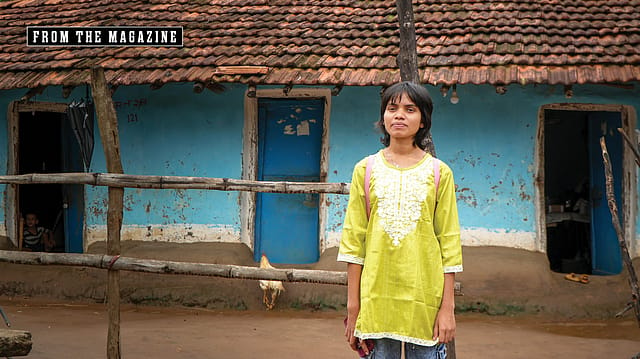
In Potali village of Dantewada district, Deepa Markam (21) has cleared the NEET-UG examination and is on her way to becoming a doctor. Deepa had appeared in the exam earlier as well but she did not make the cut for an MBBS admission and was offered a BDS seat. Undeterred, she appeared again and has made it. What makes her case unique is the place she hails from. Potali is a remote village at the edge of Dantewada district just near the border with Sukma district. Until 2023, this was pretty much the Maoist heartland. Jagargonda is a mere 25km away from Deepa’s home as the crow flies. In this part of Bastar division, even the mention of the word “development” was heresy and could get you killed in a jiffy. In a place where cries of jal, jungle, jameen (water, forest, land) once served as a catechism in lieu of education—in typical Maoist style—Deepa’s achievement is formidable.
Deepa is a product of the ‘Chhoo Lo Aasman (Touch the Sky)’ programme of the Dantewada district administration. The programme, funded by proceeds from the District Mineral Fund (DMF), brings children from villages like Potali to Dantewada and imparts them education that equips them for competitive examinations. All requirements—books, clothes, accommodation and food—are taken care of, providing these students with an environment where they are not subject to stresses in managing these requirements. The same approach informs the Gyangudi institution in Jagdalpur where students are coached for competitive examinations towards higher education after they finish school. That nascent institution is already notching up successes. In 2025-26, out of a batch of 90 students, 50 have qualified for NEET, an achievement that would give a private coaching mill a run for its money. “What is to be remembered is that we are not a for-profit organisation but government teachers who have come together to coach students who are from underprivileged backgrounds,” Alexander Cherian, the officer in charge of Gyangudi, tells Open in Jagdalpur.
The focus on education has a quality of depth to it. Merely helping students secure admissions in medical and engineering colleges is not enough. There is a much larger stratum of persons who have been left behind due to Maoism making education impossible. Resultantly, a much wider net has to be cast.
The Livelihood College on the outskirts of Dantewada is one such experiment. Every two-and-a-half months, a batch of 100 odd students arrive from Maoism-hit villages of various districts in Bastar and learn real world skills like welding, plumbing, electrician training, and more. Here, there is close coordination between Bastar Police, which selects students from these villages who want to learn these trades, and the college that hosts them. The state government, through the local administration, picks the tab for the training, food, equipment and clothing for those who attend the college.
Open met a group of such trainees from the Mirtur area of Bijapur who have come to learn these trades. Mirtur is located on the southern side of the Bailadila range. This is the range where the public sector National Mineral Development Corporation mines iron ore. While the northern face of the range has been secure for some time, the southern slopes in Bijapur were a Maoist-controlled territory for a long time. “We have no welders in our villages and as construction picks up, welding work offers us scope for earning some money,” the group says. This work will continue along with farming of land in their homes.
Most of the trainees have been involved with the Maoists in one way or another, such as cooking for them or working in other assorted ways. None were involved in armed activities. This careful segregation of active Maoist cadres from villagers who had to end up working from them due to Maoist domination of territory is necessary to ensure a smooth transition to normalcy. But there is no ‘discrimination’ as such, as the experience of former Maoists at Café Pandum and elsewhere shows.
As Open takes leave, the Mirtur group gathers to give a lal salam (Red salute) until they are told the world has changed. A simple handshake is a signal of warmth and a normal future. An effort to that end is being made in these institutions.
IN NETANAR, A small forested hamlet about 40kms from Jagdalpur, the first signs of changed security dynamics in Bastar are clearly visible. The camp of the 80th Battalion of the CRPF there is being repurposed for developmental tasks. One part of the camp has been converted into a seva dera or a services centre while another part centres a production centre where locally gathered forest produce is processed, while yet another part imparts training on basic skills that are useful for the local community.
At the seva dera, Heeramani, the local banking correspondent doubles as an Aadhaar enrolling agent. A no-frills banking service is also available. She spends three days in Netanar and for the rest of the week shuffles to neighbouring villages to provide the same services. She tells Open that roughly 20 persons come to the centre every day. “During the agricultural season, the footfall goes down. But the service is popular as everyone now wants banking services.”
In the production centre next door in the camp, Hemlata is busy husking rice in the traditional manner using a foot-operated husking mill. The rice, of a red variety, are prized for their flavour. Marketing support is now available through Bihan, the State Rural Livelihoods Mission, that has tied up with the local women-led self-help group. Apart from red rice, the famous Bastar tamarind is also being marketed now. An application for a Geographical Indication (GI) tag has been filed for these local products.
The move to convert the camp is a very recent one. “When Home Minister Amit Shah visited this place some months ago, he said we must use this infrastructure for the benefit of the community. Now that the CRPF is moving out, we have plans for various development programmes here,” says Virender Bahadur, the local official assigned for development activities in Netanar.
These changes, such as the provision of Aadhaar, banking services, rural livelihood with the cooperation of Bihan and other programmes were inconceivable even two to three years ago. Netanar is on the flanks of the “core security” zone in Bastar district and, as such, has not seen any Maoist violence since 2020. But security calculations in Bastar are not based on point-to-point basis. The road from Netanar leads to Chandametta, in the hills of Darbha Valley, a place infamous for the 2013 massacre of the state’s Congress party leadership. The entire highland belt, that borders Odisha, was infested with Maoists until very recently.
“The last known incident in Koeleng [Darbha Hills] was in late-2025 and early-2026. We had information that 15-20 Maoists were present there. All of them have surrendered in Odisha, in Sukma district [Chhattisgarh], and here in Bastar district,” Superintendent of Police for Bastar Shalabh Kumar Sinha tells Open.
The point is clear: while the security situation in the Bastar division has improved dramatically and the focus is on rehabilitation and development of erstwhile Maoist-dominated areas, the police are taking no chances. For example, the two security camps that are being repurposed for now are at Netanar and Kamanar, two locations that are in relatively less-affected areas compared to the areas that were contested for long. These were mostly in the deep recesses of Sukma, Bijapur and Narayanpur districts. But it would be misleading to claim that other districts—Kanker, Kondagaon, Bastar and Dantewada—were not affected. If anything, the Maoists had an elaborate strategy of spreading in a quilt-like fashion across the entire division. To give one example, Lakhmu Poyam, the aspiring barista, worked as an active Maoist in the Kiskodo region of Kanker district, one of the oldest Maoist-controlled areas in Bastar.
AT ONE TIME, the debate in Delhi’s rarified circles was about the development versus security binary. Anyone who has worked in areas that were dominated by the Maoists for decades on an end knows that the idea of development in these areas is very different from what is understood in the normal sense of the word. To give one example, constructing a four-laned highway in the interior areas of these districts is likely to be viewed with suspicion by Adivasis living there. This is as much a function of Maoist propaganda about jal, jungle and jameen belonging to Adivasis being snatched away as it is of the absence of government from these regions for a very long time.
The state government is aware of these complexities and is taking a careful approach to development in these districts. “We are not rushing into large development projects such as mining immediately. We want to take a pause before we venture into that area,” says Rajat Bansal, special secretary to Chief Minister Vishnu Deo Sai, who has served as a district magistrate in the area earlier. He tells Open that the effort now is to win the trust of Adivasis instead of imposing notions of development that are alien to them. “For now, development will be along their needs and not other priorities,” he adds. Ongoing projects where capital has been invested will be completed but, “what we are conscious about is that new large-scale mining will be undertaken only after careful consideration and not immediately,” he adds.
This unequivocal message is important. The ideological backers of Maoism in urban India have created a myth that as soon as the Maoists disappear, large-scale mining and despoilation of Bastar’s environment will follow rapidly. This is clearly not on the cards. The emphasis is on development on the lines of what Adivasis require. The overwhelming emphasis on education demonstrates this clearly.
Development is a complex and challenging task in Bastar, as officers accept readily. The first challenge is how to take forward this large population in a huge swathe of India as the rest of the country moves forward. The simplest solution—going by the activists who have held policymaking hostage in these areas for a long time—would be to leave matters where they stand. There is a very serious risk that if this approach is followed, Maoism or any other equally pernicious ideology will fill the inevitable vacuum. This is how events turned out the last time when Bastar and other Adivasi areas were ‘left alone’. At a practical level, the danger flows from the fact that as India posts rapid economic growth, per capita incomes will continue to increase while they will remain stagnant in these areas if this course of action is followed. The other extreme is, of course, to go for development as understood commonly: highways, dams, irrigation projects and industrialisation.
Instead of blindly following these extremes, the present Chhattisgarh government has adopted a cautious, optimised course of action. It is from this vantage that one can understand the emphasis being placed on education as the gateway towards development in Bastar. From skills being imparted to villagers of Mirtur, Burgum and other locations in the Bailadila range and the outlying parts of Dantewada at the Livelihood College to showcasing the creative possibilities in an adventure like Café Pandum, a creative exploration of sorts is on in the Bastar division. Much of this work is removed from headline-grabbing attention. What makes it interesting is how virtually no time has been lost after the self-imposed deadline of March 31 to make a developmental push of the right kind in these erstwhile Maoist badlands.
‘We Want Villages to Benefit from the Peace Dividend’
CHHATTISGARH CHIEF MINISTER VISHNU DEO SAI has good reason to be proud. The last vestiges of Maoist insurgency in the state are being eliminated under his watch. Sai is now actively pushing for development in the Bastar region where Maoist control and domination was total until recently. He spoke to a group of journalists in Raipur recently.
“We began the fight against Maoists and now that fight is concluding, we have begun our development outreach. We want villages to benefit from the peace dividend and to that end, we have started the Niyad Neelanar Yojana to promote development,” he says. Niyad Neelanar is an expression in Gondi, an old language. Its Hindi translation is aapka sundar gaon or your beautiful village. As the security camps begin to empty, what is visible is the five-kilometre radius of a security camp that used to be 10kms. In effect, the security conditions in the area have improved markedly.
Chief Minister Sai says that earlier people in interior villages, the ones far removed from roads and means of transport, were deprived of basic services like rations. “It used to take five days to get rations to these villages,” he says, adding, “We have opened ration shops in these villages and in the last two-and-half-years, 500 such villages have been provided these facilities.”
The plan now, according to Sai, is to convert security camps into seva deras or service centres where people will be provided government services that were not available in these villages until now. Seventy security camps will be converted into seva deras. For security reasons, Bastar was dotted with more than 200-odd security camps. A beginning has already been made on this front in the more secure areas around Jagdalpur in Bastar district.