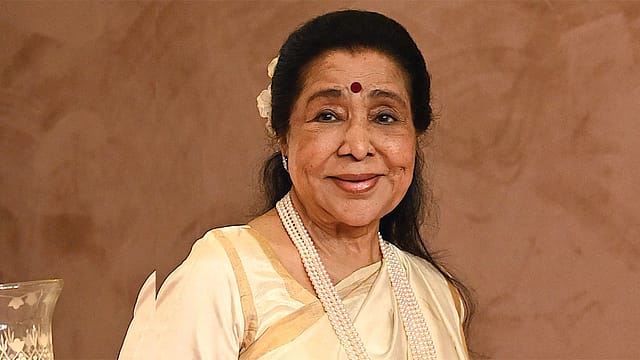
Asha Bhosle (1933-2026): The Voice of Cosmopolitan Cool
THE YEAR IS 1973. The song begins with a clinking of wine glasses by the heroine, the incomparable Zeenat Aman, dressed in a white jumpsuit. As she turns around, with the bar in the background, she is carrying a guitar and she starts to sing ‘Chura Liya Hai Tumne Jo Dil Ko’. The object of her attention is Vijay Arora, who was briefly the ultimate girl crush, dressed in a tux. The film is Nazir Hussain’s Yaadon Ki Baaraat, for many the first modern, masala multi-starrer in Hindi cinema and also one of the first Salim-Javed collaborations.
The song was one of the earliest to be remixed for a Western audience in 1994 by Bally Sagoo. Not surprisingly it was sung by one of the country’s most modern voices, Asha Bhosle. The music was by her longtime fanboy and eventual personal and professional partner, RD Burman, and the lyrics by Majrooh Sultanpuri.
OP Nayyar had made Asha the leading lady’s voice in Naya Daur in 1957, after the singer had spent several years struggling to shrug off the bad girl persona she had been stuck with. But it was Burman who gave her an unmistakable contemporaneity with ‘Piya Tu Ab To Aaja’ in Caravan (also directed by Nasir Hussain) in 1971, in a cabaret shot on Helen, in a nightclub that screamed early cosmopolitanism with its Big Ben like clock tower, flamingoes by the side and the Bombay skyline behind her.
Both Caravan and Yaadon Ki Baaraat celebrated a mobile young India, which seemed more at ease with the world and everything it had to offer. And Asha epitomised it in her voice, which literally breathed freedom and liberty, shattering the binary between the good girl and the bad girl, enabling the heroines of the 1960s and 1970s to demand love with confidence and a certain coquettishness.
In a career that began in 1943 and spanned 12,000 songs, Asha created a cosmopolitan voice that embodied the emerging Indian woman. She was the soundscape to generations that wanted to be Asha Parekh as she seduced a recalcitrant Shammi Kapoor with ‘O Mere Sona Re’, fluttering eyelashes, tight churidar, and faux innocent smile in Vijay Anand’s Teesri Manzil (1966) with music by RD Burman. She was the voice our parents pretended didn’t exist as she breathed her way through ‘Dum Maro Dum’, picturised on a chillum-smoking Janice played by Zeenat Aman in Hare Rama Hare Krishna in 1971. And she was the voice our children heard in ‘Tanha Tanha’ in 1995, picturised on another Marathi woman who symbolised earthy sensuality, Urmila Matondkar, in Rangeela.
If Lata Mangeshkar, her elder sister, symbolised prim, proper, socialist India, Asha Bhosle was the personification of an India trying to break away from the shackles of the past. It was her own past as well, of a difficult marriage with an abusive man, life as a single mother with three children, her early struggles trying to establish herself, and the loss of two children, one to a suicide and another to cancer. She didn’t ever endorse Sai Paranjpye’s 1997 film, Saaz, but the story captures an essence of her relationship with Lata in the story of Mansi and Bansi, two singing sisters who, despite their love for each other, seem forever in competition, or as the film called it, a “healthy rivalry”.
ASHA’S TRANSFORMATION into the voice of the leading lady began in BR Chopra’s 1957 movie, Naya Daur, with Nayyar making her the voice of Vyjayanthimala. Her duets with Mohammed Rafi, like ‘Maang Ke Saath Tumhara’, ‘Saathi Haath Badhana’ and ‘Uden Jab Jab Zulfein Teri’, penned by Sahir Ludhianvi got her much acclaim. Their work together ensured a distinct voice for her, and it was aided by the songs often being from the woman’s perspective. As singer Shreya Ghoshal remarked recently, this female orientation is missing from contemporary music, with most ballads being sung by men now, and the woman’s voice being slowly and steadily erased.

It was not so in the ’60s and ’70s when Asha sang her most iconic numbers, often teasing the hero, seducing him, or even sometimes misleading him. Think ‘Yeh Mera Dil Pyaar Ka Deewana’ in Don (1978), with Helen cavorting in a white gown and silver sandals as a grumpy and suspicious Amitabh Bachchan looks on, largely unmoved. Or ‘Yeh Ladka Hai Allah Kaisa Hai Deewana’ where Kajal Kiran, dressed in a fuchsia pink sharara, is trying to beguile Tariq Khan in the middle of a vast farmland in Hum Kisise Se Kum Nahin (1977). Or ‘Aaiye Meherbaan’ in Howrah Bridge (1958) as Madhubala is draped all over Ashok Kumar in a dinner jacket and bowtie, smoking a cigarette, which she stubs out before lifting him up to dance with her.
Whether it was a bad girl trying to take revenge on the hero or a good girl who wanted her hero to be more demonstrative, Asha Bhosle was the voice Hindi cinema turned to. Who else was the alchemist who could turn pain into passion, sorrow into seduction and loss into yearning? The women who stand on stage now belting out songs of love and longing without a whit of inhibition owe a lot to what she endured.
And she didn’t always need a Westernised song to express emotion. It is evident in Umrao Jaan (1981), where she sang Rekha’s lovelorn ghazals penned by Shahryar and set to music by Khayyam. Anyone who can listen to ‘Dil Cheez Kya Hai’ without a lump in her throat can only have a heart of stone. The iconic song contains multitudes—not merely Umrao Jaan’s tragic life, but also the heartbreaks of Rekha and Asha. When the film was restored and released again last year, there were few who didn’t know the words to ‘Dil Cheez Kya Hai’ or ‘In Ankhon Ki Masti’.
TO THINK THAT 20 years later, the same voice would sing the feisty ‘Radha Kaise Na Jale’ in a duet with Udit Narayan in Lagaan (2001), as a fierce Gracy Singh berated Aamir Khan’s character for paying attention to the gori. Asha was able to sing along with the times, and take inspiration from several sources, whether it was the early influence of Portuguese-Brazilian oomphy singer Carmen Miranda or even later the ganda-bandh she undertook with Ustad Alauddin Khan’s son, sarod maestro Ali Akbar Khan, through whom she learnt the repertoire of the Maihar Gharana.
Her collaborations became legendary, from singing flirtatiously with Brett Lee (‘You’re the One for Me’, 2007) to Boy George (‘Bow Down Mister’, 1991) to her elegiac contribution to the British band Gorillaz on The Shadowy Light (along with Ajay Prasanna and Amaan and Ayaan Ali Bangash) as late as this year. As she sang: “Chal mere majhi/Gehra hain paani/Mujhe jaana hai us paar/Jahaan sukh ho/Na dukh ho/Jahaan jai ho/Na haar ho (Come my boatman, the waters are deep/Take me across the river/where there is peace/not pain/Where there is victory not defeat).”
Her extraordinary voice, sometimes complete with heavy breathing and tasteful moaning, taught women sensual independence and sexual autonomy. Take the beautiful Gulzar song from ‘Ijaazat’ (1987) composed by Burman: “Mera kuch saaman tumhare paas pada hai/Saawan ke kuch bheege bheege din rakhe hain/Aur mere ik khat main lipti raat padi hai/Vo raakh bhujaa do, mera vo saamaan lauta do (There’s something that you have of me/The memory of some rain-soaked days/Wrapped in some letters/Put out that fire/Return those memories).”
Legend has it that Asha sang the song in 10 minutes in a conversational style that captivated both Gulzar and Burman, and the rest, as they say, is history with the song winning the National Award for Best Playback Singer and Best Lyrics in 1988. The tale of a doomed marriage ending in a hopeful union, directed by Gulzar, where both the women in the movie strive to strike their own paths, for better or worse, could have had only one emblematic song, and it could only have had one voice: Asha Bhosle.
As she sang in Hum Dono (1961), supposedly directed by Vijay Anand though credited to Amarjeet, “Dukh aur sukh ke raste/Bane hai sabke vaste/Jo gam se haar jaaonge/To kis tarah nibhaaonge/ Khushi mile hame ke gam/Balenge hum na apne gam (Paths of sorrow and joy, are made for everyone/If you give in to sorrow, how will you live life?/Whether I receive joy or sorrow, I will not change my ways).”
Much has been written about the movies of the 1960s and 1970s directed by Nasir Hussain and Vijay Anand and their collaboration with RD Burman, providing the spine of contemporary Bollywood. The fourth collaborator is perhaps not given as much credit, perhaps she is a woman, and perhaps because history is often the story of great men doing great things. What Asha did to give wings to their creativity by articulating a new sound and giving voice to it needs much more recognition. When the conversation around women changed from the heroine and vamp trope, she was there. When the discourse around the Bharatiya nari and Westernised woman altered, she was there. And when the binaries that straitjacketed the classical and pop dissolved, she was there again.
In almost eight decades of active singing, she was body and soul, the sensual and the spiritual, the temple bell and the disco beat.