Artificial Intelligence: Modi AIms High
AVIRAL JAIN, A YOUNG TECHNOLOGY EXPERT at OpenAI’s pavilion at the India AI Impact Summit in Delhi, is overworked, but has a sunny disposition. I watch him explain repeatedly the new features of the American generative AI company’s Sora 2 text-to-video tool to a band of cocky, self-confessed YouTubers. They don’t seem to be in a mood to leave and so, after a while, he turns to ask me, sensing that I’ve been waiting for his attention for long enough, “Can I help you, sir?” I respond with a smile, “You already did.”
The enthusiasm of various young men and women at other pavilions and stalls of corporations, small and big, across numerous halls of the summit in New Delhi’s Bharat Mandapam is contagious, notwithstanding controversies surrounding the event. These include the preposterous display of a Chinese-made robodog and a drone made overseas at the pavilion of the Noida-based Galgotias University, besides inordinate delays on day one of the six-day conclave and serpentine queues at the food court.
Rajat Bose, a young executive at Singapore-headquartered Prisma’s stall, promptly answers my questions about the functions of the company’s Gryphos computer-vision platform, which can be used for surveillance in crowded areas, besides multiple other tasks. He also tells me about their new projects in Mumbai and high-profile clients; their visual AI-based solutions look attractive.
Not far away, I run into Tata Consultancy Services (TCS) employees who are kicked about how they are using AI in the design of sarees and other apparel, helping weavers make products with the help of an AI-guided equipment. “Please speak to our weaver, sir,” one of the ladies tells me. “It is like magic,” the weaver tells me as he works on the threads in a machine that looks like one from science fiction. The TCS employee goes on to add that it is an LED system that guides the thread movement.

Equally keen are executives at other counters to speak to people about their AI services and physical products, including robots. To say that the whole place is bursting at the seams is not an exaggeration, but an experience as you wade through various pavilions, including those of SapidBlue Technologies, Lakshmikumaran & Sridharan (LKS) (which has integrated AI into legal practice), Gnani AI, Propel, Protecto (which protects against leakage of data from apps that you use), AI chipmaker Nvidia, Salesforce, Amazon, Google, Meta, Microsoft, JioSanskriti, Tata, Tech Mahindra, Sarvam, LinkedIn, Dell, and many more.
On its part, Sarvam AI, which was earlier selected by the India AI Mission to build the country’s first sovereign large language model (LLM) ecosystem, has launched two LLMs, Sarvam-30B and Sarvam-105B, at the summit with the aim of competing with ChatGPT, Gemini, Claude and others.
As India hosted this global summit aimed at untangling issues that could cloud the future of AI by focusing on three aspects— people, planet and progress—and by building on the momentum of similar multilateral meets held in recent years in Bletchley Park, Seoul, Paris and Kigali, what stood out were remarkable conversations covering the entire gamut of the AI revolution sweeping the planet. With the who’s who of the IT world in attendance along with policymakers, academics and others, the India AI Impact Summit 2026 discussed issues relevant to the current imbalances in AI power stakes and how to resolve them.
While the summit—prominently announced via hoardings across the capital carrying Prime Minister Narendra Modi’s messages about India’s AI ambitions—coincided with a flurry of new deals and announcements by generative AI firms such as Anthropic and other players, as well as supercomputing heavyweights including Nvidia, the substance of the discussions was remarkable. The focus was on how countries in the Global South could preserve technological sovereignty when they so often host companies that function merely as integrators rather than intellectual property owners, even as value accrues elsewhere to firms such as OpenAI, Google, Microsoft or Baidu, which capture subscription revenues, enterprise AI contracts, cloud rents and model-licensing fees.
India also saw big investments flow into the country during the summit, accomplishing the goal of the Modi government to use the occasion to pursue new partnerships. Billions of dollars are expected to be invested in the country over the next few years even as large investments and joint ventures were announced. For instance, Nvidia and L&T said they will build “India’s largest gigawatt-scale AI factory”. Nvidia chief Jensen Huang said in a statement, “We are laying the foundation for world-class AI infrastructure that will power India’s growth.” According to reports, L&T said it would use Nvidia’s powerful processors to provide data centre capacity of up to 30 megawatts in Chennai and 40 megawatts in Mumbai. For its part, Nvidia also said it was entering a pact with local AI infrastructure player Yotta which will pay $2 billion to deploy more than 20,000 top-end Nvidia Blackwell processors.
Ever since becoming prime minister, Modi has cultivated friendships with technology leaders worldwide, particularly those in the AI space. From Elon Musk to Mark Zuckerberg, he has courted them to invest in India, presenting it as a win-win proposition for their companies and the country. The pitch appealed to them as they sought growth beyond the saturated markets of North America and Europe. Such a strategy also promises to diversify market risk, and counter expanding Chinese tech investments in emerging economies. Modi’s outreach made sound commercial sense for AI and other technology firms looking to establish regional hubs for Asia-Pacific operations. In fact, Nvidia CEO Jensen Huang recalled in 2024 that, six years earlier at a time when AI wasn’t yet a fad, Modi had asked him to address his Cabinet on AI.
On his watch, the Indian government has actively promoted AI research through national strategies, startup funding, tax incentives and related policy support. India’s existing digital public infrastructure—from Aadhaar to UPI—combined with the country’s continued mass adoption of smartphones and large-scale use of mobile payments, e-commerce and social platforms, has made the market particularly attractive. India has also granted a 21-year tax holiday to foreign cloud providers routing global services through Indian data centres, a strategic move to establish India as a leading AI and digital infrastructure hub (See: ‘Data Is Destiny’, Open, February 2, 2026).
Interestingly, after Sam Altman-led OpenAI, which created history in the generative AI space with the launch of ChatGPT in November 2022, set up its India office in September last year, Anthropic, the San Francisco-based AI startup that makes LLMs named Claude, followed suit. During the Delhi Summit, Anthropic tied up with Infosys to develop AI agents for telecom with the aim of expanding later into other sectors, including manufacturing. In October last year, Anthropic CEO Dario Amodei had met Modi to discuss the company’s expansion to India. At that time, he had said that Claude’s use in India had risen five times since June 2025. “How India deploys AI across critical sectors like education, healthcare, and agriculture for over a billion people will be essential in shaping the future of AI,” Amodei had posted on X.
For its part, Google, the maker of the Gemini chatbot among other offerings, had already pledged investment in India to construct its largest AI data centre hub outside the US, in Visakhapatnam, Andhra Pradesh. Google also said on February 18 that it would build new subsea cables from the US to India and to other countries. These cables will connect the US, India and multiple locations across the southern hemisphere, Google CEO Sundar Pichai announced in Delhi on the sidelines of the AI Impact Summit. “Google has full-stack connectivity in India, and I have never been more excited about the future we are building together,” he said. Pichai also announced what he termed as some of the company’s most ambitious skilling plans in India, including a professional AI certification programme to help students master AI. He also said that the company is partnering with Wadhwani AI in education, while unveiling AI programmes in English and Hindi for students and early-career professionals. Pichai added that his company will secure a cloud platform for 20 million public servants across 800 districts in 18 Indian languages.
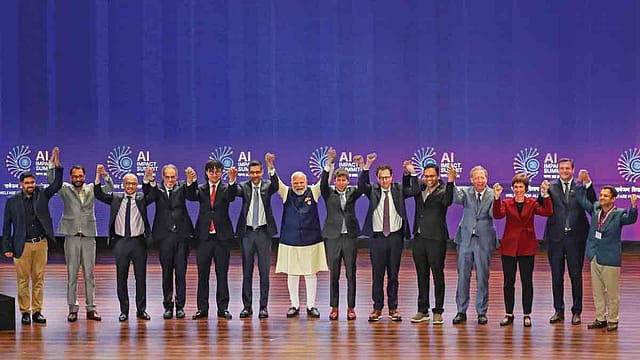
SHORTLY BEFORE THESE announcements, Modi had posted on X after meeting Pichai that it was a delight to meet the Google boss. “Talked about the work India is doing in AI and how Google can work with our talented students and professionals in this field.” Modi then proceeded with the summit where he received global leaders and representatives of global organisations. They included Spanish Prime Minister Pedro Sánchez Pérez-Castejón, Slovak President Peter Pellegrini, Kazakhstan’s Prime Minister Olzhas Bektenov, Finnish Prime Minister Petteri Orpo, Sri Lankan President Anura Kumara Dissanayake, Estonian President Alar Karis, Mauritian Prime Minister Navinchandra Ramgoolam, Bhutanese Prime Minister Tshering Tobgay, Seychelles Vice President Sebastien Pillay, Dutch Prime Minister Dick Schoof, Greek Prime Minister Kyriakos Mitsotakis, and Croatian Prime Minister Andrej Plenkovic. Among the others who had arrived in India for the summit were Brazil’s President Lula da Silva and France’s Emmanuel Macron.
Apart from Indian CEOs and foreign dignitaries such as the UN secretary-general, those from the AI space that attended the summit included Altman, Amodei, Pichai, Yann LeCun (of Advanced Machine Intelligence Labs), Brad Smith (vice chair, Microsoft), Demis Hassabis (co-founder and CEO, Google DeepMind and Nobel laureate), Alexandr Wang (Meta’s chief AI officer), Julie Sweet (CEO, Accenture), Sriram Krishnan (senior policy adviser for AI, White House) and others, including academics.
Although poor crowd management and confusion at Bharat Mandapam resulted in inconvenience for the delegates and inordinate traffic jams across the city, Modi’s AI push to attract as many investors as possible to India and use the occasion to promote trade seems to have clicked, if one goes by the announcements of investments and the turnout of top-notch CEOs of AI firms.
The conversation at the summit also highlighted the problems the Global South faces as it forges ahead with AI adoption. At one of the panel discussions, Surya Ganguli, associate professor, Applied Physics, and senior fellow, Institute for Human-Centered Artificial Intelligence, Stanford University, talked about the need to make public investments in AI. “We need something like a CERN for AI,” he said, emphasising that excessive concentration of AI power in the hands of a few countries and companies is not a good idea.
Similarly, Nairobi-based technologist Kate Kallot who is the CEO of Amini, a data infrastructure company building sovereign data and compute systems for Africa and the Global South and who had earlier worked with Nvidia, made meaningful suggestions about the need for countries outside of the Global North to veer away from AI dependence by investing in local technology development and in communities. Some others said that generative AI companies, especially OpenAI, want to do what Microsoft once did with Windows: colonise young psyches, a topic Open had covered extensively earlier (See: ‘ChatGPT Comes to the Classroom’, Open, September 1, 2025).
For her part, Sabina Dewan, founder and executive director of the JustJobs Network, averred that people, including analysts, often get carried away by buzzwords such as innovation and refuse to see the other side of the story. “There is the reality of jobless growth; negligible growth. Among the 370 million in the 15-29 age group in India, the unemployment rate is three times the total unemployment,” she said, adding that on one side there is large accumulation of wealth and on the other, people are struggling to make ends meet. “I offer that as a provocation,” she said, noting that it is not just AI that is causing job losses but a collection of reasons, including AI, climate change, pandemics, and so on. “Then there is the multiplying effect. Cascading effect,” she said. Claire Melamed, vice president for AI and Digital Cooperation at the United Nations Foundation in New York, agreed with Dewan, saying, “We have to take into account the costs of transition. Political and social histories tell us about the need to do that.”
Several other discussions were insightful and invigorating and touched upon all sides of the AI story.
Sir Demis Hassabis, CEO, Google DeepMind, said he is amazed to see the progress in the AI space, starting off in 2010 at a time when very few people were talking about it. He called AI the most transformative technology and wanted the summit to discuss how to make more opportunities while mitigating the risks. “International dialogue is imperative,” said this Nobel Prize winner in chemistry, asserting, “We are going to enter an era I would call the new Renaissance.”
Asked about his advice to young people, Hassabis said, “Lean in to become incredibly proficient in these AI tools.”
The conversations at the summit cut both ways. While a section of pundits highlighted that the AI boom in the Global South mirrored earlier patterns of India becoming a services powerhouse in IT, when the core platforms and product companies remained Western, others argued that the priority should be placed on building strategic autonomy in compute infrastructure, language models, AI governance frameworks and so on. There was palpable concern that AI could evolve into a kind of “new East India Company”—not through conquest, but through licensing regimes and infrastructural dependence. That worry did lend urgency to the summit. With participants from more than 110 countries and 30 international organisations, it was inevitably a lively affair, notwithstanding the criticism that it risked becoming a carnival rather than a council of consequence.
Dame Wendy Hall, professor of Computer Science, University of Southampton, wanted experts to not just talk about the need to narrow the gap between the Global South and the Global North in AI adoption and mitigate risks caused by AI, but also dwell on “how” to do it. Hall went on to say inclusivity is one topic that keeps her awake at night. “My biggest worry is the lack of women in AI. You get fed up with being dismissed, being patronised as a woman. A few weeks later, you see a man come up with an idea you had shared before and he gets a pat on the back,” she rued.
What was left unsaid at the summit was the widespread misuse of AI for creating non-consensual deepfake pornography targeting ordinary women and girls such as the recent controversy surrounding Elon Musk's Grok AI, which has left gender-rights activists alarmed. Other panels and speakers covered a range of subjects from healthcare, military use, climate change, AI sovereignty, future of jobs, and so on. Union Minister Ashwini Vaishaw talked about multilingual language models.
In the pre-Summit sessions held by the government and consultants, a white paper on AI’s impact and risk mitigation of five sectors was prepared and will soon be made available online for public consumption, R Chandrashekhar, former president of NASSCOM and former secretary to the Department of Information Technology and Department of Telecommunications, disclosed during the Summit. He said in the introduction to the paper, “This series of five Sectoral Round Tables brought together leading minds to craft an India specific AI roadmap. The goal: maximise equitable growth and job creation. Unlike the Western narrative of job loss fears, India can chart a different path—but only with deliberate design.” The sectors covered here are healthcare, education, agriculture, manufacturing and finance.
Experts, including senior-level AI CXOs, tend to see summits such as these with cautious optimism, reflecting the conversations held in Delhi. Bengaluru-based Sreejith Sreedharan, a technology author and Aula Fellow in AI Science, Technology and Policy, says, “AI summits generate visibility and diplomatic momentum, but they deserve more scrutiny than they typically receive. They open channels between governments, equip policymakers with technical vocabulary, and occasionally produce statements such as the Bletchley Declaration. The more relevant question, however, is who these outcomes ultimately serve.”
He goes on, “Across Paris, Seoul, and Bletchley Park, the pattern is clear: industry shapes the agenda, technology firms with commercial stakes dominate the discourse, and civil society remains peripheral. This imbalance is consequential because AI is not merely a business development; it is a social transformation. Billions are being drawn into AI-mediated systems with limited agency, while impacts on labour, cognition and democratic discourse remain insufficiently studied. Yet, summit conversations tend to orbit innovation frameworks, competitiveness and safety standards largely defined on industry’s terms.”
Sreedharan, whose latest book, Future of Work—AI Augmented, Autonomous, Decentralised, was released recently at the National University of Singapore, adds that the accountability gap is structural. “The outcome is legitimacy conferred on a technological order that has not yet demonstrated sufficient public accountability,” he argues. He also points out that the geopolitical risk becomes stark in moments of conflict. “India’s ban on Chinese apps during border tensions was necessary, but it exposed how much of everyday digital life rested on infrastructure controlled by a strategic rival. Core technology is leverage, and those who do not build it do not possess it. This dependence is structural, reinforced by India’s relatively low R&D investment, which leaves space for foreign platforms to dominate on their own terms.” His argument is that the pattern is not unique to AI or tech, but with AI, the stakes are higher.
Mumbai-based AI expert and cyber-crime investigator Ritesh Bhatia notes that India is attractive to global AI players primarily as a large market, not as a source of foundational innovation. “The biggest disadvantage of being a mere user base is that ownership of IP, platforms and standards remains outside the country…. When you are only a user, your realities are approximated, not represented. AI systems trained largely on Western data will always struggle to reflect India’s linguistic, social and economic complexity. Over time, scale without ownership weakens both economic and strategic sovereignty.”
He feels that for the Global South, AI sovereignty is about relevance and resilience, not prestige or frontier benchmarks. The focus, therefore, Bhatia says, should be on agriculture, climate resilience, public health surveillance and education personalisation, areas largely ignored by Big Tech but crucial for our societies. “Sovereignty requires ownership of local datasets, access to affordable compute, and transparent AI systems in critical public functions. A major risk is that so-called sovereign AI initiatives are captured by a few global or domestic conglomerates, reproducing existing power imbalances. Open models, shared regional infrastructure, and public research institutions are essential safeguards. If India wants a real AI future, it must stop chasing headlines and start building quiet, patient, deeply contextual AI that serves its people first and not global valuation benchmarks.”
Amid such debates and anxieties about the future—and as India’s youth worry about jobs and economic precarity—Modi exudes confidence, urging the country to harness artificial intelligence for human-centric progress. Seeking to allay fears of disruptive change, he pitches technological transformation as an opportunity rather than a threat and positions himself as a representative of the Global South. With a rapidly expanding AI startup ecosystem, the world will be watching to see whether his wager pays off.