Article 370: Keeping the Promise of August 5
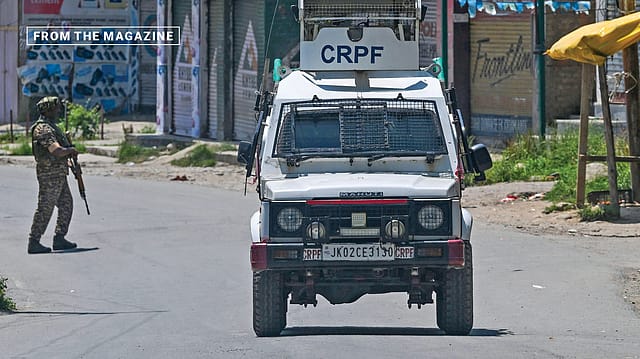
ON AUGUST 5, 2019, the BJP government made a political and constitutional wager on Jammu & Kashmir. The abrogation of Article 370 and the subsequent reorganisation of the former state into two Union territories were deemed not merely an administrative correction or an assertion of constitutional integration; they were also part of a larger promise that taking away the state’s special status would help end militancy and the instability caused by it.
Seven years later, that promise is only partially fulfilled.
To be fair, there have been genuine changes on many fronts. Militancy is not what it was during the peak years. There are no murderous mobs baying for the blood of security forces; there are no crowds treating foreign terrorists as messiahs or taking part in tens of thousands in their funeral. To put it more succinctly, there is a substantial decline in several conventional indicators of violence. The administration continues to take credit for it, maintaining that the overall security situation has improved.
But are terrorists gone? Or are they still able to hit soft targets at will? The picture here gets uncomfortable. In the summer of 2026, militants have once again demonstrated their ability to choose vulnerable targets, strike selectively and then disappear into the geography of south Kashmir. A policeman was shot dead in Anantnag in July. Head Constable Ashiq Hussain Qureshi, attached to the Special Operations Group, was on Amarnath Yatra duty when he was targeted. The killing triggered a massive security crackdown, with more than 2,000 people detained in subsequent operations. Then came Kulgam, where on July 31, two migrant workers from Chhattisgarh were shot, leading to their deaths.
But the threats did not stop here. Soon afterwards, a letter purportedly from an organisation considered to be a Lashkar front surfaced. It warned Kashmiri Pandit government employees to “change their ways” and also released the names and phone numbers of some of them. This led their departments to ask them to work from home. Similarly, several precautionary steps had to be taken to conduct the Amarnath Yatra in a way that the probability of a militant strike on pilgrims is minimised.
This is revealing. The return of the Kashmiri Pandits was supposedtobeoneoftheresonantelementsofthepost-2019project. Forget their return, even a handful of employees who are already in the Valley cannot be guaranteed safety. Such episodes of hitting soft targets have produced the same outcome. At the first hint of threat, the minority Hindus are asked to go on leave or are forced to work from home. That does not seem to be a permanent solution.
The argument that Article 370 itself caused terrorism was always difficult to establish as a simple causal proposition. Militancy in Kashmir had deep roots in Pakistan’s proxy war, the rise of armed separatism in the late 1980s, the political crisis surrounding the 1987 election and the subsequent collapse of trust. Article 370 did not create all of those conditions. Conversely, its abrogation could not, by itself, be expected to eliminate them. But the government did make a larger argument: removing the constitutional and political arrangements associated with Kashmir’s exceptional status would help create a more secure, integrated and normalised Jammu & Kashmir.
That is the promise that deserves scrutiny.
According to police sources, the man behind the recent attacks is Mohammed Lateef Bhat, a 22-year-old resident of Kulgam, who was an overground worker of Lashkar before he joined its ranks sometime last year. A police source in Kulgam revealed that Bhat is under tremendous pressure from his handlers, Sajid Jutt and Sajad Gul, to carry out attacks on soft targets. It is believed that they are angry with him because it was due to his mistake that a local Lashkar commander, Zakir Ganai, was discovered by a drone while moving through an orchard in Shopian. This led to an encounter in which Ganai was killed, while Lateef managed to escape. “It is important for Lashkar to have local militants who they want to act as conduits for foreign terrorists,” the source said.
The problem does not end in south Kashmir. The worrying development for security forces is the increasing use of a geographical bridge between south Kashmir and the Chenab valley in Jammu division. There are indications that terrorists, including dozens of foreign terrorists, have made this axis their home, making movement across the Pir Panjal mountain range. What works as advantage for these terrorists is that beyond a point, there is no security presence in the upper reaches. Special Forces and other security components often go up acting on specific inputs. But after that, the terrorists are able to roam pretty much freely. Sources in the CRPF say that now that a significant component of the force has been freed from duty in leftwing extremist areas, there might be a possibility of it being used to create Forward Area Bases (FOBs) in the upper reaches. But, right now, this is just a plan.

In the Chenab valley, recently, security forces launched yet another anti-terror operation after movement of terrorists through upper passes was reported by locals. Such presence of militants is worrying because the Chenab valley is also communally sensitive. In the last few years, due to increased militant activities, the government has again begun the training of Village Defence Guards (VDGs), whose volunteers are provided weapons and training by the Army. Security sources in Jammu say that there are several militant conduits active in the area. Prominent among them is a militant, Ghulam Haider, more popularly known as Niku, who they say facilitates the entry of foreign terrorists deep into the Jammu region (and onward to Kashmir Valley) after they infiltrate from the international border along Jammu. Niku, reveal security sources, went to Pakistan in 2006 and is in touch with his handlers there, including several militants who are originally from the Chenab valley but are now based in Pakistani cities like Rawalpindi. Currently, he is active in the Basantgarh area bordering Doda, and is accompanied by two foreign terrorists.
This new challenge brings in something more elusive, as has been indicated in several attacks in the last few years, including the one in 2025 in Pahalgam: small groups, often consisting of a handful of foreign or locally recruited militants, supported by networks of over-ground workers, moving through difficult terrain and waiting for opportunities to attack targets that require minimal preparation. It is another way of controlling the narrative; by hitting soft targets, the peculiar asymmetry of insurgency is established.
This is why the language of ‘normalcy’ can become dangerous if treated as a substitute for security. It is at this point where the post-2019 security narrative confronts its hardest contradiction. Militancy can only disappear when terrorist organisations lose the ability to recruit, move, hide, communicate, obtain weapons and identify vulnerable targets. This requires comprehensive policing, the basics of which were found lacking, especially if one took into account attacks like Pahalgam. There has also been a policy to allow the radical Islamist organisation Jamaat-e-Islami a quiet route back into public life. Its former political wing, the Justice and Development Front, contested the 2024 Assembly elections, presenting itself as the political face of the banned organisation. The danger is that the state may be mistaking political silence for ideological moderation. A Jamaat that no longer openly sides with the gun but is still capable of shaping the social and religious environment from which the next generation of militants is drawn is a dangerous idea. When such organisations regain a foothold in society, the distance between ideological radicalisation and armed militancy can become dangerously short.
This is perhaps the most uncomfortable question for the post-August 5 security strategy. The government has been exceptionally successful in squeezing the visible infrastructure of separatism. But if, in the name of political accommodation, it permits the ideological infrastructure underneath it to quietly regenerate, it may simply be pushing the problem one generation forward. A quieter Jamaat is not necessarily a less influential Jamaat; and an organisation that has learnt to operate without openly confronting the state may, in some circumstances, be more difficult to monitor than one that declares its intentions from the streets. That would be a particularly perverse outcome for a security policy whose stated purpose after August 5 was to eliminate the ecosystem of separatism and terrorism rather than merely suppress its most visible manifestations. There is a temptation, especially in political narratives, to divide Kashmir into two neat periods: before August 5, 2019, when everything was supposedly broken, and after it, when everything was supposedly fixed. The reality is less convenient. The first proposition ignores the many security successes of the pre-2019 period; the second ignores the persistence and adaptability of terrorism after 2019.
The more honest assessment is that August 5 changed the political and administrative framework of Jammu & Kashmir and coincided with a dramatic reduction in mass violence. It did not abolish the security problem. Pakistan’s ability to send trained militants across the Line of Control or the International Border has not disappeared. Local recruitment, though vastly reduced, has not ended. Over-ground networks remain.
That is a far more difficult victory to achieve, one that cannot be declared from Delhi, Srinagar or the pages of a government dossier. It has to be felt in the Valley, in the villages of south Kashmir, and increasingly in the forests and mountains of the Chenab.