Anini, Arunachal Pradesh: The Edge of Epiphany
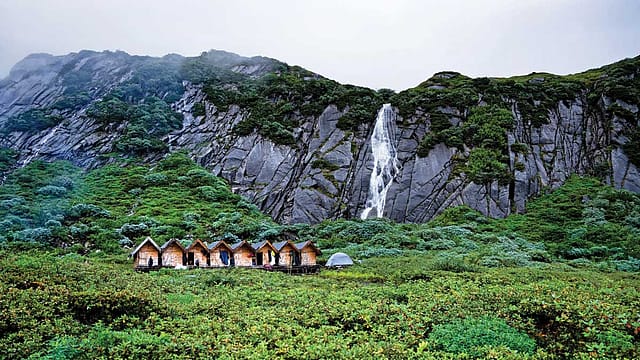
WHILE READING a biker’s blog on his journey to Anini, a small border town in Arunachal Pradesh, flashes of images from a visit over three decades ago came back—the helicopter circling dark green mountains before landing into what looked like rolling meadows, the locals looking up at the sky, another helicopter dropping supplies like rations, clothes and livestock. Cut off from the rest of the world, the people of Anini relied on the Indian Air Force (IAF) to airdrop essential commodities.
“What a life,” I remember telling someone, looking around, thinking this is paradise. It was stunning, surreal, pristine, and beyond the reach of outsiders. Temporary roads used to be made, it seems, but they gave way in the heavy rains in the precarious terrain. It was difficult to communicate with the locals, most of whom knew neither English nor Hindi. What was life like for them in the remoteness of the easternmost town on the border with China? They did not seem to miss what they never knew. Or did they? Several memories of the trip faded over time, but Anini remained etched on my mind. It was a story I had never forgotten.
Flown in from Delhi in an AN32, a military transport aircraft, to the IAF base in Chabua in Assam’s Dibrugarh district, and from there to Anini in a chopper, as IAF showcased its operations in remote places of rain-ravaged areas of the Northeast through the media, it was a world far apart from the one we had known. I had never imagined returning there. I wondered if the biker’s blog was about the same Anini. Going by the geographical indications, it looked like it was. The desire to revisit it was irresistible. There was finally a road to Anini, still treacherous in parts, but making the town accessible to anyone. It got added to my bucket list. I made it to Anini towards the end of November, along with a couple of friends, just as winter was setting in—this time, by road.
The road from Dibrugarh to Roing, in Arunachal Pradesh’s Lower Dibang Valley at the foothills of the Eastern Himalayas, is a zipping three-four hour drive on National Highways 15 and 115, first through the tea gardens of Assam and later over the 9.15km Bhupen Hazarika Setu or the Dhola Sadiya Bridge over the Lohit river, a major tributary of the Brahmaputra. Before entering Arunachal Pradesh, a state bordering China, the inner line permits are checked. From the hills of Roing, far away in the plains, the Lohit river glistens in an amber hue in the twilight. The distance from Roing to Anini is just around 235km, but keeping in mind that it could take up to 12 hours depending on road conditions, it called for a night’s halt at Roing, the gateway to the Mishmi hills named after the indigenous community inhabiting the region. At a homestay, built on stilts, in the traditional architectural style, using bamboo, wood and thatch, the cooks serve a blend of Bengali and Northeastern cuisine of chicken, pork, aubergine and lentils.
The next morning, the initial drive is smooth. The vegetation—bamboo, ferns, rhododendron, orange, and evergreen trees—starts getting thicker, the forest darker, the air aromatic, the habitation sparser. It is nature at its zenith, silent, but for the lilting sound of a waterfall. At the Mayodia Pass, (Mayu, the name of the mountain, and dia meaning peak in Idu-Mishmi language) at 2,655 metres, snow-covered in winter, a couple of tourists stop to take pictures. People and settlements are conspicuous by their absence till Hunli, a small town in Dibang Valley, which is among the districts with the least population density in the state that records the lowest population density in the country at 17 people per square kilometre, as per the 2011 census. At the quaint Hunli market, where the shops cater to tourists, the driver fills the tank from fuel in a jerry can sold in a shop. A young woman, running a tea shop, sells a flavourful sweet, somewhat like a cupcake. The road has given the locals, who speak a smattering of Hindi and English, a means of livelihood other than their traditional occupations of weaving bamboo baskets and textile, agriculture, rearing the native Mithun (a bovine species which is neither a cow nor buffalo unique to the region) and hunting. An old Mishmi man with a weather-beaten face is carrying an “Erutah”, a machete-type sword, used to cut the undergrowth and bamboo, around which their life revolves, but it is more than anything else a symbol of their identity. He flaunts it proudly, showing the carving on its handle, saying it must be a hundred years old.
Further down, crossing rivers, gorges, waterfalls, with mithuns on the roadside the only telltale signs of habitation hidden somewhere in the wooded mountains, it gets more mesmerising. But, the road gets unpredictable. The driver Mukul, who is from Assam, takes the half-built parts with composure. There are moments when you wish you were flying over the hazardous, time consuming stretches, where the road construction, which had started in 2016, is still being completed. On the back of a rundown Sumo Victa, without a number plate, is written “no airbags—we die like real men.” By the time we reach Anini, which is at a height of 1,968 meters, it is dark, and cold.

Asking directions of a resort at a wine shop, we go looking for it. Its large gates open into a space with several huts, built around a sprawling lawn, all in the traditional architecture of bamboo and wood. It is buzzing with music, warm lights, plates of food being carried to a large open hut where locals are celebrating a child’s birthday. Hungry and tired, we head to the restaurant and pore over the menu, hoping to order some local dishes. The “Aandoye”, an Idu-Mishmi preparation, described as red beans locally procured from villages of Dibang Valley made with local herbs and a spoonful of bamboo shoot, has run out because of the birthday party. That leaves “Asumbhi”, made with broken rice/corn/wheat with a meat of any choice cooked with local herbs, turned into a thick gravy, which, according to the manager, Imiya Tacho, a young Mishmi woman, is the most popular local dish at the resort. The food, served by the staff of mostly young local women who speak Hindi and English, is delicately cooked, low on spice and oil. Besides, there are, as generally in restaurants anywhere in the country, the regular Chinese and Mughlai fare, to which is added pork curry and pork fry with bamboo shoot.
In the morning, on a walk, I spot a narrow road, leading to an Army camp, that says only four-wheel drive. I look down at the helipad, the town, the roads, wondering where I may have landed on my earlier visit. This is no longer the Anini of thirty years ago. Life seems to have come a long way from the dependence on choppers. The hills are still picturesque. It is still serene. But it is no longer still.
According to Chimmi Linggi, who runs the Mishmi Hills resort, when Chief Minister Pema Khandu came to Anini with his team, they hurriedly opened the resort, one of the first to be built in the town around three years ago. Linggi, a hotel management graduate from Chennai who belongs to Roing and came to Anini after marriage around eight years ago, says there were no hotels or even homestays then, and when tourists came they had to stay in people’s homes. “For the people of Anini, there was no life outside their home. We opened the restaurant and started inviting relatives and friends. Gradually, that monotonous life started changing. The footfall increased. Tourists started coming for Anini’s natural beauty and our culture,” she says. There are now a couple of resorts, several restaurants and countless homestays in Anini, the headquarters of the Upper Dibang Valley, which is becoming a tourist attraction with its bewitching landscape, adventure and Idu-Mishmi culture.
Away from the pollution in Delhi, it is rejuvenating to breathe in the fresh air characterised as “excellent” on a cool, sunny day. In the small, clean market, past noon, some shops are yet to open. Inside one, selling local handicrafts— bags, clothes and ida— a young woman shows a traditional sling bag woven in colourful wool. Her son, around six, is busy playing games on a cell phone, oblivious to the customers. There are several other shops like this one, mostly run by young women, who have Mongoloid features—high cheekbones and straight black hair—selling similar artefacts, besides western clothes like feather down and puffer jackets, which the locals are seen wearing. The traditional swords cost anywhere starting `6,000.
THE AROMA FROM a bakery wafts in the air, tempting us to step in. Some of the confectionary is already sold out even before lunchtime. We pick up mutton and chicken puffs and go back for more. Down the road is a wine shop, where you could get single malt whiskeys and scotch like blue label and green label, which Ula Rondo, a woman in her late twenties, has been running since 2015. After finishing Class 10, Rondo got married and had nothing to do. She applied for a licence. “Tourists started coming around four years ago. There are also a lot more houses now,” says Rondo, as she packs a bottle of whiskey for a local customer.
After completing schooling, some go to college in Tezu, which is about a seven-hour drive, the headquarters of Lohit district and the state’s fifth-largest town. The locals mostly commute in Sumos now. Before a proper road connected Anini, the way was cleared by migrant labourers for dumpers, in which people travelled, covering the distance from Anini to Roing in two days. Rezina Mihu, a local entrepreneur and chairman of the Mishmi Hill Resorts, recalls that till 2002 there was just a narrow track for the movement of what was called “goods trucks”, in which they travelled. If there was a landslide somewhere on the way, people would get stranded for days, staying in homes in villages along the route. “The Idu-Mishmi tribes have relatives all over the region and they are hospitable enough to offer shelter,” he says.
Before that, life was even tougher for locals to move out or outsiders to get there, an inaccessibility that makes it more alluring to a traveller. “My grandfather and father have told me how they used to travel on foot and it took seven days to reach Roing. When I was small, we used to come to Anini, 16km from our village Etayae, and carry the essentials dropped by helicopters. Life was not easy then. I was sure Anini could become a tourist destination some day, but without a road it was not possible,” says Mihu, who comes from a farmers’ family, which used to cultivate paddy and millets.
Now, a lot of farmers have turned to kiwi and orange trees. The road from Roing to Anini was sanctioned in 2009, and Mihu, along with some others, wrote to then Defence Minister AK Antony to expedite the project. It, however, took another seven years for its construction to start. As always in such places, you wonder—what made people settle in a place so distant, so secluded?
According to Pradeep Kumar Behera, a senior journalist contributing to the Arunachal Observer, the Idu-Mishmi tribes are said to have migrated from ancient Tibet in the 1st millennium BCE, speak a dialect of the Tibeto-Burman language, are known for a typical hairstyle and take pride in preserving deep-rooted aesthetic values. Traditionally nature worshippers, the community’s mythological belief is that humans and tigers share the same mother, the latter being the elder sibling. “On their journeys by foot they would eat roots, which are edible, or hunt. They dry fish and meat, which is a staple for them… The road has brought a sea change,” he says.
Behera recalls that around 15 years ago, the superintendent of police (SP) of Dibang Valley told him that there were a total of just 15 police officers in the entire region, because there were hardly any thefts and the crime rate was low as there were no outsiders.
With just three days to spend in Anini, we decide to absorb the place. Curious to know about the China border, we ask around and are told that it is nearly 100km away. Mihu says tour operators like him can now take tourists till a point around 10km ahead of the border, with proper permits from the state government. “After policies changed in recent years, Bruni village, where there’s an Indo-Tibetan Border Police (ITBP) camp, was called the first village instead of the last village. When there’s footfall you make it clear that it’s our territory. How can you claim it if no one goes there? We call it Tibet border. For generations we have been going there for hunting. Now, we have stopped hunting, and are into sustainable tourism,” he says.
The hunt for another restaurant offering local cuisine leads us to Totchro resort’s Koko restaurant, run by a woman who is also the main chef. The tables are occupied by youngsters having rice beer and pork. Besides local delicacies, the restaurant offers Korean dishes like kimchi. It was nearly 3PM and the rice beer is already over, but most of the dishes are available.
For Anini, the road has unfolded a new world, within and outside. “The inflow of tourists to Anini has gone up by 30 to 40 per cent after Covid. Nearly 99 per cent of them travel by road, because the chopper service often gets cancelled,” says Roing-based Raj Roy, who runs Northeast Advisor, organising tours to the region.
On the way back we buy 100 oranges or “Komala”, as the locals call it, a mandarin species, small but juicy, sweet and savoury. Behera says there was a time when you could get ten oranges for `1, and since 2018, Arunachal Pradesh has started exporting oranges from the Lower Dibang Valley to Dubai and Qatar.
This time we are familiar with the road. The beauty of the hills, the waterfalls, the Mayodia Pass, covered in mist, leaving a sliver of opening through which the sun shines, the turquoise rivers, the thick forests are almost hypnotic, making the uncertainties of the road seem trivial. Driving down to Roing, I wonder if I will make yet another visit to Anini. Who knows?