André Beteille (1934-2026): A Scholar’s Scholar
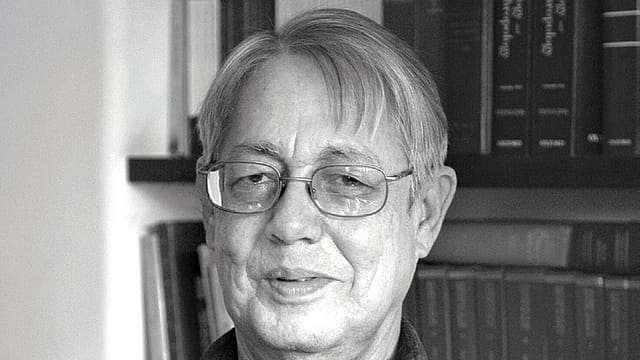
It is impossible to dwell on André Beteille (1934 - 2026) without first mentioning his seminal work, which, in academic circles, is known as CCP, short for Caste, Class, and Power: Changing Patterns of Stratification in a Tanjore Village (1965). His work helped us understand the social changes in post-independent India. His study of the tripartite physical structure of a village called Sripuram convinced him that caste would largely remain confined to marriages and political priorities but not necessarily dominate power structures and economic positions.
Now, there are some quotable quotes from him that we grew up with—they include the following:
“Caste and class resemble each other in some respects and differ in others.”
“Mobility in the caste system is a much slower and more gradual process than in the class system.”
Be warned, Beteille was a scholar’s scholar although he did occasionally write such simple statements that debaters could bring up. A theorist, he had professed that the social and cultural identity of caste Hindus would become weaker while their class identity would become stronger, a tempting argument that however had a fair share of critics.
Beteille, born to a French father and Indian mother, was an accomplished scholar associated with some of the world’s best universities as well as top-notch institutions in India, including the University of Oxford, Cambridge University, Chicago University, the London School of Economics, Delhi School of Economics, Ashoka University, and so on. An alumnus of the University of Calcutta and the University of Delhi, he had also worked at the Indian Statistical Institute and later served as chancellor of North Eastern Hill University, Shillong.

India's Action Hero
27 Mar 2026 - Vol 04 | Issue 64
Riding the Dhurandhar Wave
In fact, Beteille was projected by Alan Macfarlane, a British anthropologist and historian, as one of the intellectual heirs of the great Alexis de Tocqueville. “In some ways, Beteille can be seen as one of the heirs of Tocqueville, as someone who has applied Tocqueville’s earlier insights and broadened and updated his analysis.”
That was high praise indeed.
Beteille held controversial ideas about India’s reservation system thanks to his strong conviction that public institutions must be governed by “merit”, and not by caste-based quotas. He didn’t buy into arguments by a section of academics that the quota system helps in fighting efforts to reinforce upper-class domination in such entities. Beteille maintained that in modern India, caste identity alone was no longer central to wielding power. “How far can such claims [of distributive justice] be accommodated without damage to the interior lives of these institutions [universities, hospitals, laboratories, banks, etc]?” he wrote in an essay. He was sharply attacked by critics such as Gopal Guru who argued against his premise that reservation was an antithesis to merit. Some such critical essays were equally scholarly and cogent.
Beteille, a recipient of the Padma Bhushan, had chronicled his upbringing in colonial India in his memoir Sunlight on the Garden: A Story of Childhood and Youth. Historian Nayanjot Lahiri says the first chapter titled “My Two Grandmothers” blew her mind. “In parts, the simplicity and beauty of the prose of that chapter reminds me of Murakami’s novels!” She adds, “I also completely empathise with Beteille’s unease with ‘Left’ historians, which comes out so clearly in his later chapters. In fact, the way they packed history departments as also the ICHR during the time when Nurul Hassan was Indira Gandhi’s education minister was appalling and provided the blueprint, which was faithfully followed by the NDA government.”
Whether you agree with him or not, Beteille, who was deeply influenced by Marx and in his last days had opposed the caste census, redefined our understanding of class and caste in India