A Soft Contact. A Pause. A Final Click
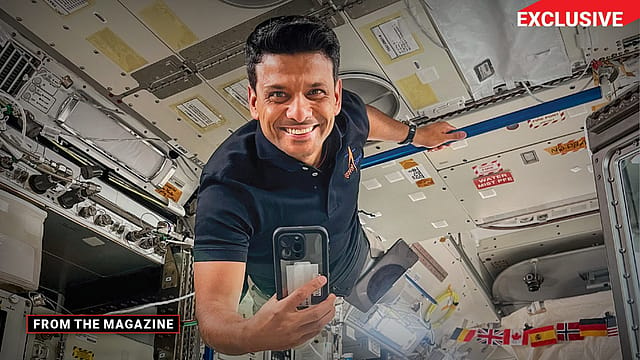
YOUR FIRST SIGHT of the International Space Station arrives as a disappointment.
I say this not to diminish it, but because the honest account of that first visual acquisition is one of disorientation rather than awe. You are looking at your screens, monitoring the approach parameters, and then someone says there, and you look up, and you find it. A point of light. Bright, yes, and steady against the absolute black in a way that distinguishes it from stars, but unmistakably small. Fragile, even. A mechanical insect suspended in the darkness, self-illuminated, seemingly held in place by nothing more than optimism.
It is, at that moment, genuinely difficult to reconcile that distant speck with what you know it to be—a structure the size of a football field, 105 metres from end to end, massing approximately 4,20,000 kg, assembled piece by piece over thirteen years in one of the most complex construction projects ever undertaken by our species. A laboratory, a home, a symbol of what becomes possible when nations decide that the frontier matters more than their differences. From several kilometres away, it looks like something you could cover with your thumb.
And then, slowly, distance surrenders.
Details emerge from the brightness. The geometry asserts itself, the long central truss, the symmetrical spread of the solar array wings catching sunlight and reflecting it back with the particular brilliance of surfaces designed for exactly that purpose. The individual modules become distinguishable, each one representing a different nation’s contribution, docked together with an intimacy that belies the political distance between some of their respective governments. The scale arrives not as a single revelation but as a gradual accumulation of evidence, each detail adding to the last until the structure ahead of you stops being a point of light and becomes, unmistakably, a place. A place people live. A place you are about to live.
By the time you are close enough to see it properly, it fills a significant portion of your window. The transformation from speck to a home in space is one of the more quietly astonishing things I have ever witnessed.
The approach itself is governed by a system of checkpoints that begins several kilometres out, a choreography of velocity and position so precisely designed that improvisation is not merely discouraged but structurally impossible. Think of it as a highway, eight lanes wide at the outermost checkpoint, generous with its tolerances, forgiving in its margins. Speed within plus or minus fifty kilometres per hour. Lateral deviation within comfortable bounds. Plenty of room to establish, correct, refine.
But as the distance closes, the highway narrows. Eight lanes become six. Six become four. Four become two. Two become one. And with each reduction, the margins tighten with the mathematical certainty of a system that understands the physics of what is about to happen and has decided, correctly, to leave nothing to chance. By the time you are in the final approach corridor, your velocity margins have shrunk from kilometres per hour to metres per second—and then, in the terminal phase, to centimetres per second. The same unit used to describe the movement of a careful hand reaching toward something it does not want to break.
Your eyes never leave the screens. Not because the view outside is not extraordinary, it is, but because the parameters on those displays are the only honest account of what is actually happening. Position. Velocity. Closing rate. Attitude. Each number a thread in a web that must remain intact for the approach to succeed. You watch them the way a surgeon watches a monitor during a procedure, not passively, not admiringly, but with the active, searching attention of someone who needs to know the moment any number begins behaving differently than it should.
There is an additional complexity worth understanding because it reveals something counterintuitive and wonderful about orbital mechanics. Not all docking ports are created equal. The ISS has multiple docking ports, and their relative difficulty is governed entirely by altitude; specifically by the fact that, in orbit, altitude and speed are inseparably linked. A spacecraft sitting slightly higher than the station moves slightly slower than the station. A spacecraft sitting slightly lower moves slightly faster. This is not a design choice. It is Newton’s law of gravitation, operating with its customary indifference to convenience.

The forward docking port sits roughly in the station’s plane of travel, which allows for a more straightforward approach with manageable thruster corrections. The zenith port, the one our Dragon was heading towards, which faces directly away from Earth, sits at the top of the station. Approaching it requires the vehicle to maintain a position slightly above the station’s altitude, which, by the iron logic of orbital mechanics, means it is naturally inclined to drift backward relative to the station. Counteracting this tendency requires continuous thruster firing, which consumes propellant at a rate that mission planners track with the focused attention of people who understand that propellant, in space, is not a resource you can easily replenish. Zenith port docking is harder, more expensive in fuel, and more demanding of the system in every measurable way.
In the final metres, everything becomes very quiet.
Not literally, the systems are running, the fans are humming, the occasional thruster fires with a sound that travels through the structure as a dull, felt-as-much-as-heard thud. But the quality of attention in the cabin changes. Conversation, which had been sparse anyway, stops entirely. There is only the approach, and the screens, and the station filling the window with a scale that is now, finally, impossible to underestimate.
The docking mechanism, a system of guide petals and capture latches that brings two independently flying spacecraft into physical contact and locks them together, is engineered to tolerances measured in millimetres. The Crew Dragon’s forward docking adapter and the station’s corresponding port must meet within a cone of alignment so precise that any significant deviation will result in a failed capture and a need to back away, regroup and attempt again. There is no forcing it. There is no pushing harder. There is only precision, and patience, and the long, careful discipline of an approach flown exactly as it was trained.
And then it happens.
A soft contact.
A pause.
A final click.
In that moment, two objects that had been racing endlessly around Earth become one.
But docking is not arrival. Not yet.
After capture, the work intensifies. Pressure checks. Seal verifications. System confirmations. Both crews, inside Dragon and aboard the station, move with practised urgency, each side racing the other, half in jest, half in pride, to complete their checklists first. Space may be vast, but professionalism leaves no room for complacency.
We began changing out of our space suits, the familiar motions grounding us after hours of floating anticipation. I was midway through pulling on my flight suit when I heard it.
A knock.
For a moment, my mind refused to accept the sound. A knock belongs to doors, to hallways, to Earth. It does not belong 400 km above the planet, travelling at orbital speed. I must have looked genuinely confused because our commander laughed and explained that the ISS crew had completed their checks before us.
They were ready to welcome us.
Our Dragon was docked to the zenith port, positioned on the top of the station. This meant that entry would not be straightforward. To see where you are going, you must enter headfirst. Legs-first would leave you blind, vulnerable to drifting into cables, equipment or handrails. But head-first entry brings its own challenge. Orientation becomes a suggestion rather than a rule.
Up and down quietly lose their authority.
As we prepared to float inside, there was another complication. Entry required an immediate, coordinated manoeuvre, turning upside down and rotating 180 degrees to face the cameras 4waiting inside the station. It had to be done smoothly, confidently, and ideally, gracefully.
I was not confident about that last part.
Inside Dragon, movement is forgiving. The space is small, and there is always something within reach to steady yourself. A handhold, a panel, a seat edge, something to stop unwanted motion. The station is different. It is expansive. It allows freedom in a way that can be unsettling. Drift too far from a surface, and you are suspended, unable to stop or redirect yourself without help.
With all this in mind, I pushed forward.
The moment I crossed the threshold my body began to rotate in ways I had not commanded. Directions blurred. Orientation dissolved. What I intended to be a simple turn became a slow, awkward ballet of limbs and momentum. For a brief second, I was no longer certain which way I was facing.
Fortunately, welcoming hands reached out.
The ISS crew guided me gently, correcting my motion, steadying my drift and suddenly the chaos resolved into clarity. The cameras were there. The smiles were real. And the station surrounded me, alive with the quiet hum of systems that had been working continuously for decades.
And just like that, I was inside.
Inside humanity’s greatest collaborative achievement.
(This is an edited excerpt from The Second Orbit: Belief of A Man… Dream of 1.4 Billion Hearts (Vintage, 342 pages, ₹599) by Shubhanshu Shukla)