A Jantar Mantar Pause
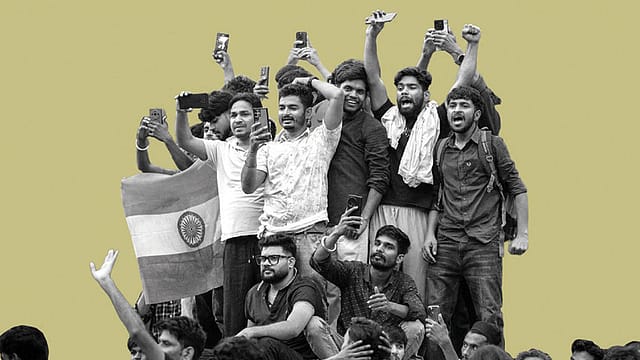
THE POLITICAL THINKER Anton Jäger calls it ‘hyperpolitics’, and when it fires up resentment and resistance, party positions, even with their desperate courting of morality, collapse in the public square. The surge of generational energy that elevated Delhi’s Jantar Mantar, a site of hopeless last slogans as well as protest tourism, to the company of those metropolitan spaces associated with springs both ephemeral and enduring, has clarified again how the crowd in these hyper-political times can defeat the Establishment.
Mobilisation is vindication: To be young and idealistic is to remain angry. We have been here before. When barricades were breached in Paris in the late Sixties, when tanks rolled over impossible dreams in Tiananmen Square in 1989, and most recently, when Gaza ignited a solidarity movement on campuses and streets in the West, to be young was to dare. Freedom was not necessarily what they achieved. They were not revolutionaries with a leader who guided them as the last arbiter of conscience. Crowds don’t have the shape of ideology; what they have is an epicentre of cause—and the poetry of slogans.
It was the insensitive metaphorical attempt of a judge that started the rage in India. It began as a hurt—and a humiliation. The ridiculed wore the metaphor as a badge of honour, as if it was time to rephrase Wordsworth: Bliss was it in that dusk to be alive,/ But to be a cockroach was very heaven. As if to turn the hurt into a joke was an assertion. Jokes are weapons when deployed by the imagination. A great admirer of Rabelais, Milan Kundera cited ‘agelasts’, the neologism by the 16th-century French satirist for those who cannot laugh, as a category of the powerful pitted against the truth in humour. Against being human.
They played with the metaphor to their advantage and called themselves the Cockroach Janta Party. The nomenclature was more than a rejoinder to the agelasts. They were, with such comic daring, holding a mirror to their own anger at being subjected to insensitivity and institutional callousness. The initial whimper allowed the agelasts to risk a smirk. The spearhead holding a copy of Ambedkar at first sight didn’t look the revolutionary part. He would not become one anyway. He sent a message to the young and the idealistic: the joke can hurt the Establishment too when it is armed by anger.
The mobilisation of anger is very much in tune with hyperpolitics. As Jäger writes in his book on this new expression of power: “Hyperpolitics confronts us with a new mode of interaction between public and private. It is dynamic, intense, and polarising, yet also ideologically diffuse, visibly modelled on the fluidity of the online world.” Jantar Mantar too, even if we take Jäger’s words out of their American context, even if the spectacle of rage was less than BLM or the cause of Gaza in magnitude, was polarising (puppet-idealist vs the nationalist) and ideologically incoherent. And the messaging was unedited. The online world was the new Samizdat. The cautious mainstream media, in the eyes of the protesters, were very Pravda.
Diffusion may have shortened the lifespan of the movement and made it seasonal. For Movements with a capital M, cohesion is mandatory. What matters is not spontaneity but the enforced order. Jantar Mantar gained force from the spontaneity of a shared romance. First they were ignored, which was an error of moral judgement. It is okay to ignore cause junkies in search of a camera, and it is necessary to go after hooligans seeking thrills, but the overwhelming nature of the protest had the rawness and immediacy of a generation let down by a calcified system. Being apolitical and amateur was a show of power. In the hyper-political universe, it is all about instant struggle, not about enduring the struggle.
They have won because the system failed itself. It doesn’t always take the death of a George Floyd for rage to take over the streets. When the system finally saw what exactly was unfolding in the capital, it was too late. The delay in reading the mood when the politicisation of a generation was out there as an open text was a sign of misplaced confidence. The absence of empathy, a necessary trait of power in a democracy, was directly proportional to the multiplying rage. The movement may fall victim to its own diffusion. Hyperpolitics, as Jäger argues, is short-term. A storm in search of the next coast, leaving behind a wreckage of reputations. National rebuilding is a long-term project—with a softer cultural touch.