2025 In Review: Travel: Where India Went
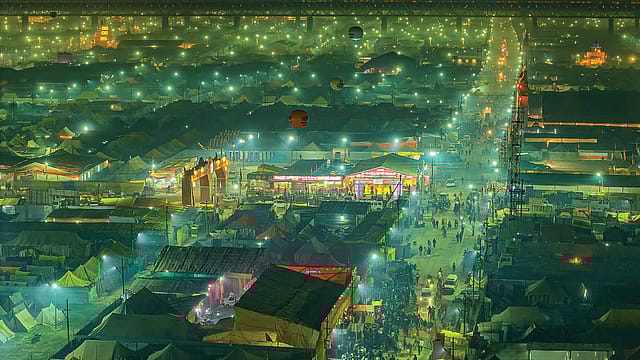
IN 2025, THE MOST SEARCHED JOURNEY IN INDIA WAS not towards a horizon but into a crowd so dense that it bends arithmetic. The year’s most sought-after destination was not a coast, a mountain, or a foreign capital. It was an appointment with a river already known by heart. The Maha Kumbh Mela rose to the top of the nation’s travel queries on the force of timing and faith alone. In a year otherwise scattered across island fantasies, visa-free promises and Instagram-approved leisure, India’s most intense curiosity fastened itself to water and ritual, to the pull of the crowd.
What this suggests is not a collective relapse into piety so much as an altered definition of experience. The Kumbh is no longer attended merely as a religious duty; it is an immersive experience, a place where anonymity becomes a form of participation. The pilgrimage, made easier now by temporary cities, transport grids, sanitation ecosystems and drone-coordinated crowd flows, has crossed over from renunciation into spectacle, without surrendering its gravitational seriousness. Modern India has not replaced ritual. It has infrastructuralised it.
Cultural motive is no longer a marginal preference in Indian travel. It has become its central engine. A Skyscanner report in 2025 indicates that more than four-fifths of Indian travellers now choose destinations primarily for cultural experience, preferring heritage, tradition, ritual and living history rather than scenery alone. The tilt is strongest among the young: roughly 84 per cent of millennials and 80 per cent of Gen Z report that culture, not convenience nor luxury, drives their travel decisions. This explains why a mass pilgrimage can outperform island resorts in search data. And why, between 2017 and 2025, domestic tourist footfall in Uttar Pradesh surged by 361 per cent, making it the top domestic destination in India. That boom has been powered almost entirely by three spiritual centres—Ayodhya, Varanasi and Prayagraj—which together account for the overwhelming majority of this revived domestic travel wave.
And yet, directly beneath this pull of rivers and ash and cold water at dawn, the nation spends the rest of its curiosity elsewhere. The Philippines follows at second place, a scatter of islands that promise distance without cost-shock. Georgia comes third, a country that only recently entered the Indian imagination, now desired for its monasteries, mountains, wine and European geometry. Mauritius is fourth. Kashmir is fifth. Vietnam’s Phu Quoc is sixth. Phuket is seventh. The Maldives is eighth. Somnath is ninth. Puducherry is tenth. The list diagrams a society learning to swing, almost without friction, between meaning and escape.

There is no longer one Indian travel dream. There are several, operating in parallel, without hierarchy. One seeks scale— Kumbh, Somnath, the dissolving of the individual into ritual mass. Another seeks the privacy of water-villas suspended over manta ray-infested lagoons. A third seeks out Georgia for a version of Europe that can be admired at arm’s length—beautiful, and largely free of civilisational weight. A fourth seeks the re-domestication of beauty in Kashmir, where landscape is now being relearned as leisure rather than symbol. In the first half of 2025 alone, Jammu & Kashmir welcomed over 90 lakh domestic tourists and around 20,000 foreign visitors, a signal that the rebound in travel has not merely held but continues to grow.
By 2024, outbound travel by Indians had crossed a historic peak of about 38–39 million overseas departures, the highest-ever recorded. Government data shows that Indians preferred to fly out to the UAE, followed by Saudi Arabia, the US, Thailand, Singapore, the UK, Canada, Qatar, Kuwait and Oman, with these 10 destinations together constituting over 70 per cent of all Indian international travel. The pattern reveals that despite the rise of new aspirational leisure geographies, India’s outbound traffic remains anchored in the Gulf, Southeast Asia and Anglophone economies—shaped by circuits of work, pilgrimage, diaspora, trade and short-haul affordability more than by long-haul tourism fantasy. In 2025, however, we saw searches for destinations such as Phu Quoc and Phuket hit all-time highs.
The geography of desire has shifted east and sideways, away from the old Atlantic axis of aspiration. The Maldives remains immune to budget gravity, but its continued presence near the top of searches suggests that pure ornament still exerts power in a crowded republic of value. The rise of places like Georgia and Vietnam reflects not extravagance but arithmetic. These are fantasies made possible not by excess but by access—relaxed visa regimes, cheaper flights, and entry points now light enough for first-generation international travellers to step through.
As visa regulations loosen across Southeast Asia and the Pacific, Indian outbound travel patterns have visibly shifted. Data from the hotel-search platform Agoda shows that after Malaysia extended visa-free entry for Indian passport holders in 2023, searches from India for stays there jumped by 47 per cent. The remote Pacific island-nation of Palau, newly added to India’s visa-free corridor, saw searches climb 49 per cent, and after the visa-free announcement for Indian nationals in mid-2025, the Philippines recorded a 26–28 per cent year-on-year rise in interest. Even nations with more modest growth, such as Sri Lanka, saw overall increases. Together, these shifts mark an inversion in how travel decisions are made: imagination now follows access, not the other way around.
OUTBOUND TOURISM FROM India is no longer a metro monopoly. Travellers from tier-2 cities, such as Lucknow, Indore, Coimbatore and Bhubaneswar are now the fastest-growing cohort abroad, with non-metro bookings jumping nearly 40 per cent year-on-year versus about 17 per cent growth from metro markets. Rising disposable incomes, expanding direct-flight connectivity from regional airports, and digital visa and booking platforms have made international travel viable beyond traditional urban hubs. Applications for Schengen, Singapore and Thailand visas from Tier-2 cities have risen sharply over the past three years, in some cases, outpacing metro volumes. Demand is also tilting toward experience rather than mere arrival—from overwater villas in the Maldives to vineyard tours in Italy and immersive trips through Vietnam or Turkey.
Atlys, a digital visa-processing platform that handles applications for Indian travellers across dozens of countries, offers a precise snapshot of who is now driving India’s outward movement. More than half of all visa applications it processed ahead of the September-October festive travel season came from millennials, and nearly three-quarters of these were for solo travel—a marked departure from the family-centred overseas holidays that once defined Indian travel abroad. Demand clustered around short-haul, high-access destinations such as the UAE, Thailand, Vietnam, Indonesia, Malaysia and Sri Lanka, with Germany standing out among Schengen applicants for its cultural pull. The pattern points to a generational reconfiguration of mobility: travel abroad is shifting from a family project to a personally calibrated, repeatable act of consumption. The young traveller is now shaped less by tour operators than by platforms, booking independently, moving more often, and optimising for access as much as experience.
What 2025’s search patterns make unmistakably clear is that travel is no longer chiefly about escape from the self; it is about distributing the self across different aspects of life. One can be, within the same calendar year, both pilgrim and flâneur, ascetic and consumer, crowd-seeker and solitude-buyer. The nation is no longer choosing between the inward and the outward, the ancestral and the aspirational. It is learning to inhabit both.