2025 In Review: Social Media: A Touch of Doom Scrolling
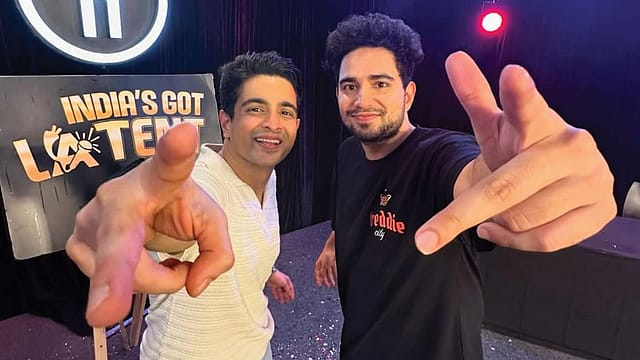
IT IS NOT HARD to see why some dislike Ranveer Allahbadia, aka Beer Biceps. He can come across as overly curated online, and his preening personality and relentless positivity can give the vibe of an influencer who wants to maximise his follower count. To be not just a teacher’s pet, but the subject of back-benchers’ adoration too.
These qualities aside, hatred is a byproduct of digital fame. Every individual who has built some clout online, will always have corners of the internet that detest him. And Allahbadia, with his millions of followers across platforms, is undeniably huge in the desi world of influencers.
And yet, for a moment in 2025, the corners of Allahbadia detesters converged and expanded across the web, and even spilled into the real world.
The consensus was that he had breached some notion of decency. Indelicacy can be a difficult subject to quantify in India, where everyone is quick to claim offence, but when he made that comment, on a YouTube show, India’s Got Latent, which was already becoming notorious for its irreverent and ‘no-holds-barred’ insult comedy, everyone seemed to agree that a certain line had been crossed from the risqué and the provocative into the deeply offensive.

Youth Issue 2026
24 Apr 2026 - Vol 04 | Issue 68
50 Portraits of Icons and Achievers
The comment had been posed in the form of a question, which itself turned out to be one that had been copied from another comic in an Australian comedy show, and all hell broke loose. It zipped through the digital landscape and landed in our living rooms in the form of prime-time TV debates, the very same engine of Allahbadia’s success—the social media network and its principal cast of influencers—coming together now to outrage against him. The proceedings fed into some primaeval anxiety about the breakdown of moral values among the young today, and soon, Allahbadia, along with the host of the show, Samay Raina, another popular comic on social media, were being hounded with multiple police cases. The show was cancelled, all episodes were pulled out of YouTube, and the conversation quickly moved to the perceived descent of the young into degeneracy today and the need to put curbs on online free speech, with everyone from the head of your resident’s welfare association, chief ministers of different states, to the highest court of the land feeling the need to comment on it.
The case of Allahbadia and India’s Got Latent is a good guide into the way the world of desi social media influence got shaped this year. India’s creator economy may be booming like never before. (A May report by Boston Consulting Group, for instance, estimates there are around 2 to 2.5 million monetised content creators influencing more than $350-400 billion in consumer spending, which in turn is expected to rise to over $1 trillion in creator-influenced consumption by the end of this decade). But there was also a certain souring of a dream. If anything, 2025 marked the year when social media became a bit less fun, and a certain wariness about its influencers crept in. This stretched from the moral panic Allahbadia and India’s Got Latent let loose upon us, to fears, in the wake of the Pahalgam attacks, about influencers being groomed into Pakistani assets. In between, influencers realised what activists and journalists have long known—that there are limits to free speech in India—and many learnt new ways to gain more clout, from having fugitive billionaires do tell-all podcasts to cursing their way to influencer stardom.

The controversy surrounding badly-behaved influencers had only just begun to die down, and some of them were just about beginning to emerge from their self-imposed exiles, when another influencer broke into our front pages. This one, a YouTuber from Haryana named Jyoti Malhotra, who mostly made travel content, was arrested, along with a string of other individuals across several states, for allegedly spying and sharing sensitive information with Pakistan. This came only days after the successful completion of Operation Sindoor. Malhotra had travelled to Pakistan, allegedly with the help of someone from the Pakistani embassy, at least twice, where she had reportedly interacted with Pakistani officials. There were whispers of her being in a relationship with a Pakistani embassy official who is said to have been an ISI operative, and even of other influencers being on the radar of Indian authorities. Was this woman posting innocuous travel content in the upbeat and chirpy tones of influencers really being groomed as an ISI asset? Was the video she put up right after the Pahalgam attack, where she blamed Indian security agencies for the lapse in vigilance, part of a disinformation strategy to erode public trust in the government and its security agencies?
It is hard to tell, since these are mostly still accusations, and the court is yet to pass a verdict. Malhotra herself remains in custody, with a Hisar court recently having turned down her appeal for bail. But this news of a spy ring, one with an influencer in the mix, right in the midst of tensions with Pakistan, was too delicious a story to pass up. And even as it dominated our news cycles, it added yet another wrinkle to our relationship with our influencers. We had only just realised we needed to shield our children from the crudeness of some influencers. Must we now worry about disinformation campaigns too?
Amid all this there were movements within the online sphere that erupted briefly into the larger consciousness outside. The Indian cricketer Yuzvendra Chahal who had separated from his influencer wife Dhanashree Verma exited from court one March day, having just secured a divorce, wearing a T-shirt that read “Be your own sugar daddy”. It was a statement made for the internet, presumably hoping to turn it, which was by then already agog with discussions along these lines, against his now ex-wife. The two have since moved on from their marriage, but that t-shirt has continued to haunt them. And then there is the case of Orry (or Orhan Awatramani) who transformed the national curiosity that had been building over who he was into arguably the first desi influencer who is truly famous for just being famous. From innocuous phrases made into t-shirt slogans (“I am a liver”) to being a fixture at every party worth attending, his poses with Bollywood and corporate royalty engineered to become viral memes, this was the year Orry transformed his carefully curated act into a viral sensation. But this too has come with its own dark cloud. He may have made light of the recent summons by the police in a drug case by creating a video on how no dress code was provided, but his name has surfaced in a large drug trafficking case, where it is alleged he, along with some other celebrities, attended raves organised for them in India and abroad.
Amidst all this, this was also the year when the podcast form really came of age, and here, it was Raj Shamani who scored a coup. Having already interviewed Lalit Modi not too long ago, he managed to get another fugitive billionaire, Vijay Mallya, to sit down for his first, long interview—running over four hours—that got record viewership. The podcast did have its detractors, some of whom felt Shamani did not push enough against Mallya’s claims and allowed him to whitewash his image. But the interview no doubt went a long way in helping Shamani emerge as India’s top podcaster on Spotify this year, beating several other contemporaries.
There were many other moments of viral fame and infamy throughout the year. But none compared to the controversy the India’s Got Latent episode generated. This was also the first cancellation of its kind of influencers, so an uncertainty lingered over the playbook from hereon. At some point, the news cycle would move on and those who outrage would tire and move on to new targets. What then was to be made of the cancelled influencers? Were they to stay cancelled forever or just for a bit? And if they were to be rehabilitated at some point, how long was this cancellation limbo supposed to last?
Allahbadia issued an apology and disappeared for some time. He returned about a month-and-a-half later, in an episode billed as a ‘rebirth’, where sitting with a wise-looking Buddhist monk, the two went through subjects like personal struggles, regrets and self-improvement, with the monk at one point wrapping him in a forgiving embrace. Other participants in that episode, like Apoorva Mukhija, who as ‘The Rebel Kid’ had herself attracted a lot of popularity over time partly because of how frequently she swears, disappeared for a bit, and returned later to detail the kind of online harassment they themselves had been subjected to. Samay Raina’s path to rehabilitation was a bit more complicated, given that he was also raked over the coals in the Supreme Court for another episode from the show, where he was accused of ridiculing people with disabilities and rare genetic disorders, and for which he had to eventually issue an apology. Raina, too, disappeared for a bit. He has since returned. But unlike the others, he continues to sometimes mine the controversy for material. A few days ago, when the turmoil caused by Indigo flight cancellations was at its peak, Raina put up a video of him seated on an Indigo flight, when a former contestant of India’s Got Latent, Monal Kohli, passes by. Raina has a sudden flashback, where he recalls Kohli talking about how wherever he went, whether it was his nursery school or workplace, those establishments eventually shut down. Seated on the aircraft, Kohli then smacks his head in frustrated realisation that what might have befallen his show may now be coming for the airline too.
This year has been equal parts good and tough for influencers. Some mercifully are still seeing the humour in it.