2025 In Review: Politics: The Art of Winning
AS PARLIAMENT’S Winter Session began with the Opposition whipping up a storm over the Special Intensive Revision (SIR) of electoral rolls, a Bharatiya Janata Party (BJP) MP, while raising a state-related issue amidst the din in Lok Sabha, remarked that the Bihar electoral outcome was testimony that people have rejected the Opposition, and yet the losers have not learnt their lesson. The MP was resonating several of his colleagues in the treasury benches. For BJP, this is payback time.
Just over a year ago, the party was at the receiving end of such taunts from the Opposition, after the May-June Lok Sabha elections threw up a fractured verdict, forcing BJP to depend on the support of allies like N Chandrababu Naidu’s Telugu Desam Party (TDP) and Nitish Kumar’s Janata Dal (United) to form a coalition government, for the first time since Narendra Modi became prime minister in 2014. The Opposition rubbed it in, inside and outside Parliament, that BJP, which had raised the slogan of ‘400 paar’, fell short of even the majority mark of 272, and lost seats like Ayodhya, Allahabad, Chitrakoot, Nashik, Rameshwaram and Tirupati. It was a red rag before a bull. BJP returned to the drawing board, poring over details, reinforcing booth-level groundwork while rolling out welfare schemes, fiercer in its will to leave no stone unturned in planning its electoral strategy in every state. The Lok Sabha jolt had nudged the party and its ideological mentor, the Rashtriya Swayamsevak Sangh (RSS), to swing into action, coordinating their efforts at the grass root level for galvanising voters, carving out larger caste coalitions, and consolidating the Hindu vote. It took less than six months for the tide to start turning back.
BJP pursued what it was best at—fortifying its organisational mastery. In October 2024, the party won 48 of the 90 seats in the Haryana Assembly election, fighting anti-incumbency of Manohar Lal Khattar’s 10-year tenure, taking pollsters by surprise. In the Lok Sabha polls, just four months earlier, Congress had won five of the 10 seats, raising its tally from zero in 2019, with a vote swing of 18.74 per cent. In the Assembly polls, however, it got just 37 seats, shattering its hopes of winning Haryana. BJP lost the Jammu & Kashmir election to the National Conference (NC) but cornered 29 seats in the Jammu region, becoming the second largest party with a vote share of 25.64 per cent against NC’s 23.43 per cent across the state. Congress’ tally dropped from 12 to six.

India's Action Hero
27 Mar 2026 - Vol 04 | Issue 64
Riding the Dhurandhar Wave
A month later, BJP swept Maharashtra, one of the big states where it had faced significant losses in the Lok Sabha election. The ruling Mahayuti or National Democratic Alliance (NDA) returned to power, winning 235 of the 288 seats, with BJP itself securing 132. The party had won just nine of the 48 seats in the Lok Sabha polls. Congress, which had increased its tally in the summer General Election in 2024 to 13 from one of the 48 seats in 2019, failed to retain this trend in the November Assembly election, winning just 16 seats, a drop of 28 seats from the previous state polls. In both Haryana and Maharashtra, the government had launched women-oriented schemes ahead of the state polls, targeting a constituency which formed nearly half the population and was increasing its footfall at polling booths. Women’s turnout in the Maharashtra Assembly polls increased from 59.26 per cent in 2019 to 65.22 per cent in 2024. In Jharkhand, where elections were held at the same time, the ruling Jharkhand Mukti Morcha (JMM)-led alliance cashed in on the direct benefit transfer (DBT) scheme for poor women. BJP’s calculations in the state, where the tribal population is 26.21 per cent, went awry with the Bangladeshi ghuspatiya (infiltrators) plank failing to cut ice. Chief Minister Hemant Soren focused on tribal sentiment, pushing for the demand of the nature-worshipping indigenous people for a Sarna code to protect their identity.

By the end of winter, in February 2025, BJP had struck again, winning Delhi after a gap of 27 years, with a tally of 47 of the 70 Assembly seats, leveraging anti-incumbency against the 10-year rule of Arvind Kejriwal’s Aam Aadmi Party (AAP). Modi, who led BJP’s Delhi campaign, punned on AAP, calling it “AAPda (disaster)”, a term that caught people’s imagination, and rhymed Kejriwal with “farziwal (fraud)”, accusing him of being corrupt. In the run-up to the election, BJP announced freebies, to take on AAP at its own game, reached out to the middle class in the Union Budget, pledged to bring down pollution and clean the Yamuna over the next five years. It wooed women, promising financial assistance to the underprivileged, to wean away the vote bank from AAP which had captured around 60 per cent of the women’s vote share in the 2020 Assembly election. Women’s turnout in Delhi this year was 60.92 per cent, surpassing that of men, which stood at 60.21 per cent. Of the 70 seats, 41 witnessed an increase in turnout of women voters. BJP, which had taken caste and social factors into cognisance while selecting its chief ministers, in Delhi chose debutant legislator Rekha Gupta who became the first woman chief minister from the party on Modi’s watch.
OVER THE LAST two years, all political parties have factored in schemes for women in their election strategies, seeing them as game changers, as it became clear that the constituency, which negates caste lines, has started playing a larger role at the hustings. JD(U) leader and Bihar Chief Minister Nitish Kumar had started cultivating the constituency way back in 2005, in his first stint at the helm, granting 50 per cent reservation to women in Panchayati Raj institutions, extending it later to urban local bodies. Over the years, he launched schemes for schoolgirls, announced prohibition and improved the law and order situation in the state, all of which retained his popularity among women voters. By the time the Bihar elections were announced in October this year, BJP already had its strategy in place, unwavering in its decision to project Nitish Kumar as NDA’s face, despite murmurs about his health. In January 2024, the BJP leadership had managed to bring around the chief minister, who was then at the forefront of forming the I.N.D.I.A. bloc, to switch sides and join NDA.
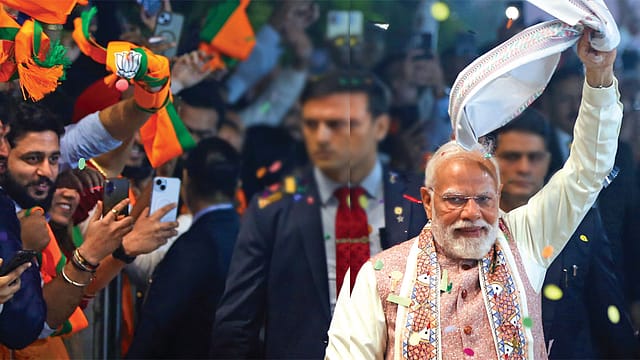
At his rallies in Bihar, Modi, waving the gamchha, a traditional cotton cloth, took on the Rashtriya Janata Dal (RJD), reminding people of “jungle raj”, a term referring to the law and order situation under Lalu Prasad and later his wife Rabri Devi. If it was AAPda in Delhi in his onslaught against the Kejriwal government, in Bihar, Modi used the term “katta sarkar” to target RJD. Katta, a country-made weapon, became a catchphrase for BJP to take on the Mahagathbandhan led by Lalu’s son Tejashwi Yadav.
Nitish Kumar, seen as a messiah of change in the state, secured his hold over constituencies he has nurtured— Extremely Backward Classes (EBCs), an amalgam of 112 castes together comprising 36 per cent of the state’s population; Mahadalits; and women. To further consolidate the women supporters, the state government in September transferred `10,000 into bank accounts of 75 lakh women in Bihar, as seed money to members of women’s self-help groups (SHGs). After the initial grant, the women are eligible for an additional support of `2 lakh, depending on the success of their businesses. Launching the scheme, the prime minister had described Nitish Kumar and himself as two brothers of Bihar’s women. The voter turnout of women has been surpassing that of men since 2010 when Nitish Kumar returned for a second term as chief minister. In this election, women’s turnout in the elections was the highest so far in the state at nearly 72 per cent, 9 per cent more than that of men.
Ahead of the polls, the BJP leadership, as part of its strategy to widen the caste net, got on board both Chirag Paswan’s Lok Janshakti Party (Ram Vilas), and Upendra Kushwaha‘s Rashtriya Lok Morcha (RLM) to ensure that the alliance did not lose the Dalit and Kushwaha votes to the Opposition. For BJP, which fought an equal number of seats as JD(U), the Bihar victory gave a slight edge over JD(U) with a strike rate of 88 per cent, 4 per cent more than that of its ally. NDA wrested 202 of the 243 seats in the Bihar Assembly, reducing the Mahagathbandhan to 35, of which Congress won just six.
The year 2025 saw BJP’s winning spell reeling back, diminishing the Opposition in Assembly elections. In his victory speech at BJP headquarters in Delhi, Modi again mentioned “Katta sarkar”, saying it will never return. He then shifted his attention to Trinamool Congress (TMC) leader and West Bengal Chief Minister Mamata Banerjee, saying BJP will put an end to “jungle raj” in the state. Modi said the Bihar win had galvanised the party cadre in West Bengal, Kerala, Tamil Nadu, Assam, and Puducherry, all of which are heading for elections next year.
The Lok Sabha election letdown, which forced BJP to depend on allies, had set off speculation that the Modi government would no longer have unhindered supremacy over policy and passage of legislation. It was predicted that Modi, new to the dynamics of coalition politics as BJP had never fallen short of a majority even when he was Gujarat chief minister, will have to factor in the sentiments of allies like TDP and JD(U) who would be concerned about their secular credentials. The government, however, stuck to its ideological agenda. It managed to avert political resistance from within NDA in passage of the Waqf (Amendment) Bill, bringing changes in administration of Waqf properties which are charitable or religious donations made by Muslims for the community. The Opposition alleged that the amendment marginalised Muslims and usurped their property rights. The issue is likely to figure in the run-up to elections in West Bengal, where Banerjee, after being accused of a u-turn with her government ordering digitisation of Waqf properties, is trying to allay the fears of Muslims, saying she will not allow anyone to touch any religious place.
For BJP, West Bengal, where Banerjee has held the reins for three terms, is its next big political test. Jubilant from Bihar, party MPs in Parliament are already training their guns at TMC, saying West Bengal is “next”.
BJP faces tougher electoral challenges in 2026. Barring Assam, it has not been in power in any of the states where elections are to be held over the next year. As a year of conquests comes to an end, the party is already in election mode for the next battleground.