Jim Sarbh: Watch Him Out
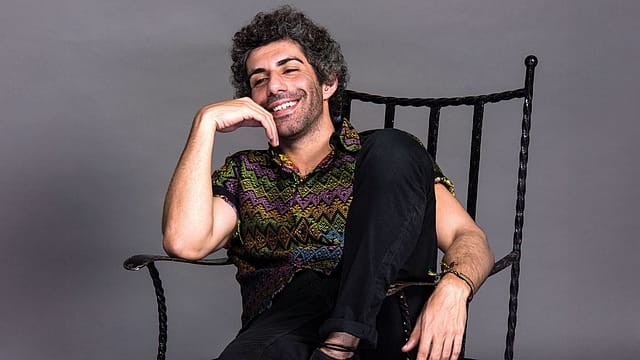
THEY SELL WATCHES, we will sell dreams to every Indian,” Xerxes Desai says to his board, while they are on a smoke-break, to convince them to invest in Titan. His body leaning forward, his eyes sparkling behind his glasses, his bald pate glistening, Jim Sarbh is every bit Desai in Amazon MX Player’s critically acclaimed Made in India: The Titan Story. Committed, optimistic, mercurial, idealistic.
The series chronicles the making of Titan watches in the India of ‘License Raj’, going up against the government monopoly of HMT (GMT in the show), by tying up with the Tamil Nadu Industrial Development Corporation as a Tata Group subsidiary. Titan MD Desai’s pitch to his boss, JRD Tata (played by the towering Naseeruddin Shah) was simple: “Titan is not merely for those whose time is good but also those who want to change their time.”
Playing unconventional characters is not unusual for Sarbh, 38. In 10 years of Hindi cinema, he has stacked up a series of memorable roles, beginning with his debut in Ram Madhvani’s Neerja in 2016, as the hijacker Khalil. Madhvani cast him after auditions and thought he had a presence that was unique. He says: “I’ve had the privilege (I’d like to call it that ) to see Jim first hand getting into character and weaving his spontaneity, his being in the moment, his interiority, and his understanding of the scene. His chameleon-like screen presence along with his public persona is very rare and precious.”
His work has spanned cinema and OTT, from the lascivious Malik Kafur, Alauddin Khilji’s general in Sanjay Leela Bhansali’s Padmaavat (2018) to the adulterous Adil Khanna in Zoya Akhtar’s Prime Video series Made in Heaven (2019); from the earnest journalist Amin Faizi in Gangubai Kathiawadi (2022) to the brilliant Homi Bhabha in SonyLIV’s Rocket Boys (2022-23). His ode to Khilji, ‘Binte Dil’, is as much a joy to watch as is Adil eviscerating his wife Tara (Sobhita Dhulipala) in Made in Heaven: “At the end of the day,” he says viciously, “class does show up. You can’t buy it, it can’t be taught, and clearly you can’t marry into it.”
Of his 10 years in the film industry, Sarbh says: “I look back in joy and appreciation. Some other emotions as well. Any 10-year period has ups and downs, but overall, yes. I have met many wonderful people along the way, I have found ways to counter disillusionment when it rears its inevitable head, and I am still working on learning how to be less bothered by media narratives. I have worked with directors I truly admired, including debut directors who I learned to admire. I have worked with some of the best actors in the industry and got to learn from them; not just from their acting, but how they operate on set. The ease. The comfort. There’s still a long way to go.”
Coming up, to add to his pantheon of Parsi greats is artist, curator and mentor Karl Khandalavala, in Mira Nair’s forthcoming film on Hungarian-Indian artist Amrita Sher Gil. It should give him a chance to reconnect with his interest in art given his uncle runs the well-known auction house, Pundole’s.
Sarbh’s mother is a retired physiotherapist, and his father is a former master mariner. The family moved briefly to Australia when Sarbh was three but returned when he was eight. His privilege is not so much wealth as intellectual and emotional intelligence.
Sarbh can slip into any skin, even one as diabolical as the French-Vietnamese ‘Bikini Killer’ Charles Sobhraj (called Carl Bhojraj) in the Netflix film Inspector Zende (2025). But he is particularly perfect as a Parsi maverick. As he cooks akuri over a gas stove, while listening to Hemant Kumar’s ‘Hai apna dil toh awara’, wearing an apron over his traditional sadra, he couldn’t be more Parsi in Made in India. But he doesn’t play him as a lazy shorthand, rather imbuing him with a depth of belief and a certain quirkiness.

How important is it to him as a Parsi to depict his community authentically without making it a caricature? Pretty important, he says, with his trademark humour. “How am I doing?”
In his greatest role so far as the Cambridge-educated Homi Bhabha who chose to return to India to learn about his heritage in Rocket Boys, Sarbh mirrored his journey. Educated at Emory University in Atlanta, Georgia, he worked in theatre for a year before returning home. Since returning to India in 2012, Sarbh has played a galaxy of characters on stage, before breaking into Hindi cinema.
So how does he approach his characters, especially the real ones? “Not from the lens of history and greatness, but in terms of what they need to do in the particular story the producers, writers, and director are trying to achieve. So, in essence, fictionally,” he says. “If there is source material, I watch interviews, and recordings, and see if there is anything to steal from their speech patterns and mannerisms. If their writings are available, I read them, to try to understand how the person’s mind works. If these aren’t available, I try to read how other people have described the person. Then I try to bring whatever I have learned to the particular story the director is trying to tell. I try to keep the character true and surprising and alive.”
Ashwath Bhatt, who plays a Tamil bureaucrat in Made in India with aplomb, says it is great fun to work with Sarbh. “We improvised a lot. If you feed him something, he plays with it in a free-flowing Laban way,” he says. He enjoys his craft which is great, adds Bhatt, because “sometimes you are mocked in this industry for being specific about things. You’re considered an odd person. So it’s a real joy to find someone who thinks like you, who wants to have fun in the scene but also keep the focus.”
Xerxes Desai was a leader. So was Sarbh in Made in India. I asked whether being the main lead changes the dynamics on set? “You’re the captain of the ship in a way apart from the director. Everything trickles down from the top,” he adds. “Our producers Sunil Bohra and Prabhleen Kaur, and Anand Jain and Amogh Dusad from Amazon MXPlayer, were so excited about this story, it was contagious. The team they assembled, starting with Karan Vyas the writer, Robbie Grewal the director, Aditya Kapur the cinematographer, the entire crew, and all the actors, were equally excited about the story. We knew there was something there.”
IT WAS VERY easy to try to foster the very same ethics and values that they were trying to represent in the show. A hard-working set, a fun set, a set that encouraged respectful dialogue, a set that was full of intelligent, earnest people. Sarbh’s favourite time was in Hosur, partly because they shot at the Titan factory, but also because the actors stayed together and would meet every evening for dinner. They bonded beautifully. “I think you can feel it in the show. We were a team,” he adds.
Sarbh is pickier about theatre work now. He hasn’t done a play in a while. Last year he began rehearsals for a production of King Lear, but unfortunately the show did not see the light of day. He hopes to act in an exciting play soon and values rehearsal and blocking a lot more because of theatre. “I only really feel I can understand a character in a film when I can put him on his feet. We don’t always get the kind of rehearsal time I would love in film prep, and so I have to find the time to rehearse myself,” he says
He is also giving back, turning producer and backing the beautiful Baksho Bondi, directed by Tanushree Das and Saumyananda Sahi, and Sabar Bonda by Rohan Kanawade. “It is one of the ways to stave off disillusionment. Getting involved yourself, and backing work you believe in. I love the director duo of Somo (Saumyananda) and Tanushree, and read a very early draft of their script of Baksho Bondi,” Sarbh says. “I admired them already, as cinematographer and editor, respectively. My friend, the very talented composer and now bona fide producer Naren Chandavarkar, introduced me to the script, and helped foster a very collaborative ecosystem for the project. Baksho Bondi has 21 producers. Lovely people. Mitigates risk. Allows us to support work that may not appeal to more classic producerial avenues.”
Sabar Bonda is different, he adds, the unifying factor being Chandavarkar. “He showed me an almost completed film, and I loved it. Rohan Kanawade is a very talented fellow, and I can’t wait to see what he will do next.”
He is also branching out into other languages, from Sekhar Kammula’s 2025 Telugu film, Kuberaa, to Atlee Kumar’s forthcoming action film ‘Raaka’, starring Allu Arjun. Having chosen such an uncertain profession, he remains buoyant, experimenting with ads (the very popular CRED series) and music videos (such as Prateek Kuhad’s ‘Cold/Mess’). What else helps? Friends. Family. Sports. Sunsets.
So far, so good. How does he see his career unfolding from now on? “Like an origami paper boat. Creased, perhaps, but lots of space to colour in.”