Vande Mataram, Two Actors and an Old Question: Why Kangana Ranaut and Sharmila Tagore Are Debating a 150-Year-Old Song
Sometimes a national debate begins with a politician.
Sometimes it begins with a court case.
And sometimes it begins with two actors talking about a song that is older than both of them.
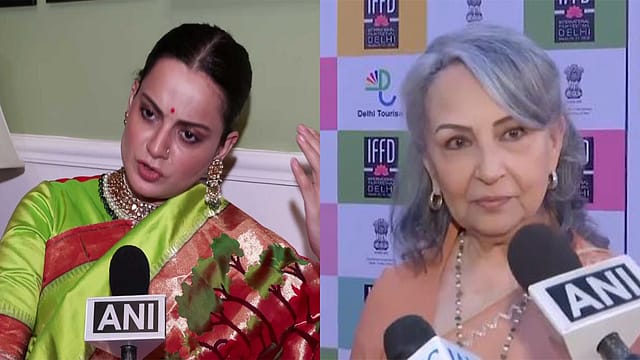
This week, veteran actor Sharmila Tagore and actor-politician Kangana Ranaut found themselves on opposite sides of a conversation about Vande Mataram, India's National Song. Tagore questioned whether some of its later stanzas are difficult for followers of monotheistic faiths to embrace. Kangana responded by arguing that poetry should not be read through a narrowly religious lens and urged people to move beyond what she described as a "Hindu-Muslim mindset."
The exchange quickly became news.
But the more interesting story is that neither actor is really arguing about a song.
They are stepping into a debate that has been running for nearly a century.
What Did Sharmila Tagore Actually Say About Vande Mataram?
Speaking to IANS, Sharmila Tagore said she had no objection to the first two stanzas of Vande Mataram, which are the portions most Indians hear at public events.
The Identity Project
11 Sep 2026 - Vol 05 | Issue 37
Amit Shah leads the mission for a national demographic correction
Her concern centred on some of the later verses, which invoke Hindu goddesses such as Durga. Tagore argued that for people whose faith revolves around the worship of a single God, reciting such lines can be difficult. Her comments echoed an argument that has surfaced repeatedly in discussions around the song.
It was not a new controversy.
In fact, it was one of the reasons India eventually settled on the first two stanzas as the most widely accepted version.
How Did Kangana Ranaut Respond?
Kangana was not convinced.
Sharing Tagore's remarks on Instagram, she said she was surprised that an artist would adopt what she called such a "limiting" view of poetry. She argued that works of art often use symbolism and metaphor, and that Vande Mataram should be understood as part of India's freedom struggle rather than as a literal religious text.
Kangana also invoked Swami Vivekananda's famous language about "muscles of iron" and "nerves of steel", arguing that nobody interprets such phrases literally. In her view, the references in Vande Mataram should similarly be understood as poetic expressions of strength and devotion to the motherland rather than acts of religious worship.
Her broader message was simple: national symbols should unite rather than be viewed through communal categories.
Why Does Vande Mataram Keep Returning to Public Debate?
Because Vande Mataram occupies a unique place in Indian history.
Written by Bankim Chandra Chattopadhyay in the 1870s and later included in his novel Anandamath, the song became one of the most powerful rallying cries of India's freedom movement. Freedom fighters sang it. Protesters marched to it. British authorities viewed it with suspicion because of its association with anti-colonial nationalism.
Yet the song also carried a complication.
While the opening stanzas celebrate the beauty of the motherland, later verses invoke Hindu deities including Durga. Those references led to objections from sections of the Muslim community long before Independence.
In other words, the argument predates social media by nearly a century.
Why Are Only the First Two Stanzas Commonly Sung?
This is where the history becomes fascinating.
In 1937, the Congress leadership confronted the same question that is being debated today: could Vande Mataram serve as a national song in a religiously diverse country?
Rabindranath Tagore, Jawaharlal Nehru and other leaders examined the issue. Tagore argued that while the complete poem could be interpreted in ways that troubled some communities, the first two stanzas had developed an identity of their own and contained nothing objectionable. Congress eventually resolved that only the first two stanzas should be sung at public gatherings.
That decision shaped the modern understanding of Vande Mataram.
When India became independent, the song was accorded equal honour with the National Anthem, but it was largely the first two stanzas that entered public life.
Is This Debate Really About a Song?
Not entirely.
It is about how a diverse nation interprets shared symbols.
For some, Vande Mataram is inseparable from the freedom struggle and represents patriotism above all else.
For others, questions about religious imagery remain important.
That tension has existed since before Independence. It survived Partition, constitutional debates and multiple political eras. And now, thanks to a conversation between Sharmila Tagore and Kangana Ranaut, it is back in the spotlight once again.
The remarkable thing is not that India is still debating Vande Mataram.
The remarkable thing is that a song written more than 150 years ago can still provoke questions about identity, faith, art and nationhood.
Few pieces of poetry have had that kind of staying power.
(With inputs from yMedia and agencies)