The Long Reinvention of the Indian Wedding
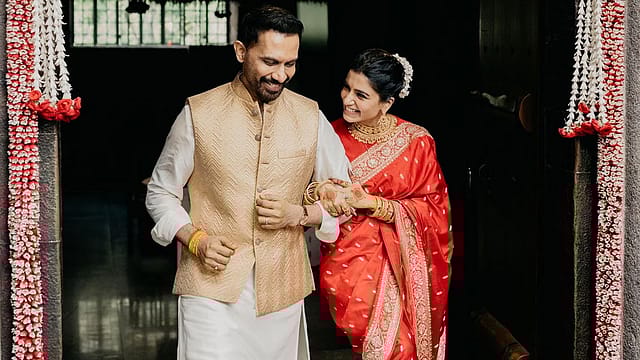
When actor Samantha Ruth Prabhu recently married filmmaker Raj Nidimoru at the Isha Yoga Centre near Coimbatore under a ritual known as Bhuta Shuddhi Vivaha, the event was framed as spiritual, unconventional and deeply personal. The celebrity wedding was, in fact, tapping into a much older Indian tradition: the restless reinvention of how marriage itself is imagined, authorised and performed. Traditional Indian weddings unfold as a theatre of sacred jokes and symbolic trials, where gravity and farce, destiny and domestic bargaining, coexist in the same ceremonial breath. From the groom’s mock renunciation in Tamil Nadu’s comic Kashi Yatra, halted mid-escape by the promise of marriage, to the bride balancing pots in Odisha, the shoe-stealing games of north India, and the turmeric-soaked initiations of the south, each ritual folds flirtation into fate, turning matrimony into a public negotiation between myth, memory and the everyday business of family. Yet alongside these inherited performances, rationalists and reformers across India have, over time, been redesigning the ceremony itself—removing priests, rewriting vows, changing languages, or discarding ritual altogether.
The ritual Samantha chose is framed as a yogic process, a refinement of the five elements—earth, water, fire, air and space—so that the marriage begins, as the ashram literature puts it, at an “elemental level” rather than merely an emotional or legal one. She did not merely choose a partner; she selected a theory of marriage—one that sits neither fully inside temple Hinduism nor within the austerity of the registrar’s office—and in doing so placed herself within a centuries-long Indian argument about who owns the ritual of marriage, and what, ultimately, it is meant to sanctify: lineage, property and caste, or consent, companionship and personal meaning.That argument predates celebrity, wellness culture and spiritual branding by several lifetimes. In early-20th-century Tamil Nadu, Periyar’s Self-Respect Movement declared open season on what it saw as the most efficient technology of caste reproduction: the Brahmin-mediated Hindu wedding. Fireless, priestless and conducted in Tamil, these marriages replaced Vedic mantras with spoken declarations of equality, stripped away dowry and horoscope, and treated women not as ritual cargo but as co-authors of the union. When the DMK government legalised these ceremonies in 1968 by amending the Hindu Marriage Act, the rebellion crossed from ideology into statute. Even the thaali, that most loaded object of conjugality in the south, was rendered optional in law. A ritual that once claimed cosmic inevitability was reduced to mutual declaration and documentation.If Periyar attacked priesthood and hierarchy with the blunt force of reason, Ilankumaranar, the Tamil scholar who spent a lifetime in the company of Sangam texts, attempted something more delicate and in its way more destabilising: he drilled past the priestly layer into a deeper antiquity and returned with another marriage. Drawing from Sangam texts like the Akananuru, he argued that Tamil society had possessed its own grammar of marriage long before Sanskrit entered the house. In the roughly 5,000 weddings he solemnised under the Aadhi Tamil Murai, the sacred was not abolished but linguistically reclaimed. No homa fire imported from another cosmology, no priest as ritual gatekeeper. Community replaced priesthood. In a civilisation where Sanskrit had long functioned as a technology of distance, Ilankumaranar made mutual understanding itself a political act.Across the Western Ghats, Kuvempu was performing a different operation on the same institution. Disturbed by a wedding culture saturated with astrology, dowry and economic coercion, he articulated what came to be called Mantra Mangalya: a ceremony in which the core sacrament was not cosmic appeasement but ethical speech. His son Purnachandra Tejaswi’s wedding in 1966 under this format became the proof of concept. There were no horoscopes to be matched, no planetary permissions sought, no ritual debts incurred. The vows, spoken in Kannada, were about reciprocity, equality and freedom from fatalism. For Kuvempu, astrology was not merely superstition but a quiet instrument of unfreedom, a way of outsourcing moral responsibility to the stars. Where Ilankumaranar turned language into sacrament, Kuvempu turned speech into citizenship, rewriting the grammar of kinship so that it could inhabit a democratic future without cosmic alibis.Running parallel to these southern experiments was the Arya Samaj’s northern austerity, a reformist compromise between rebellion and orthodoxy. Dayanand Saraswati did not dismantle Veda; he purified it of what he considered ritual accretions. Fire remained, mantras remained, but idol worship, elaborate priestly monopolies and ceremonial excess were pared away. In practical terms, this turned Arya Samaj mandirs across India into low-cost moral corridors for couples pushing against caste and economic barriers. For over a century they functioned as semi-formal escape hatches for those seeking legitimacy without surrendering autonomy—runaway lovers, inter-caste partners, the aspirational poor. At the other pole of ritual economy lies the Special Marriage Act, the most iconoclastic architecture of all because it dispenses with sacred language altogether. Born of colonial-era experiments in civil marriage, it insists that marriage is neither sacrament nor destiny but contract. For those placed at the wrong intersections of caste, community and desire, this legal provision has become much-needed shelter.This century-long democratic turbulence inside Indian civilisation converges on a shared diagnosis: that marriage had become a machine for reproducing inequality. Each reformer attacked a different joint in the same structure. Periyar dismantled caste authority and priestly mediation. Ilankumaranar reclaimed linguistic sovereignty. Kuvempu disarmed astrology and economic theatre. Arya Samaj made ritual portable and inexpensive. The Special Marriage Act replaced sacrament with law. Each, in different idioms, asked the same unsettling question: is marriage a metaphysical act, a social contract, a cultural performance, or simply an administrative fact?This is the conversation into which Samantha’s Bhuta Shuddhi Vivaha now enters. It performs a distinctly 21st-century manoeuvre, speaking the language of wellness culture and tantric antiquity at once, offering a sacrality that is elective rather than inherited, curated rather than commanded. What earlier reform movements sought to liberate from superstition, caste and economic coercion, the present moment seeks to customise. The market now supplies spirituality the way it supplies furniture—bespoke and branded.From the candle-lit monotheistic vows of the Brahmo Samaj in 19th-century Bengal, among the first modern Indian attempts to recast marriage as a moral contract between equals, to the austere, Gandhian-inspired weddings that replaced spectacle with spinning wheels, public vows and ethical self-discipline, and now to the curated consecrations of Sri Sri– and Isha-style ceremonies that promise inner alignment, India’s reformist imagination has returned again and again to the same question: whether marriage must echo the structures of the present, or dare to sketch a life beyond them.
Bengal Thriller 2026: The Plot Thickens
17 Apr 2026 - Vol 04 | Issue 67
Mamata Banerjee faces her toughest battle