The Ballad of the Baba
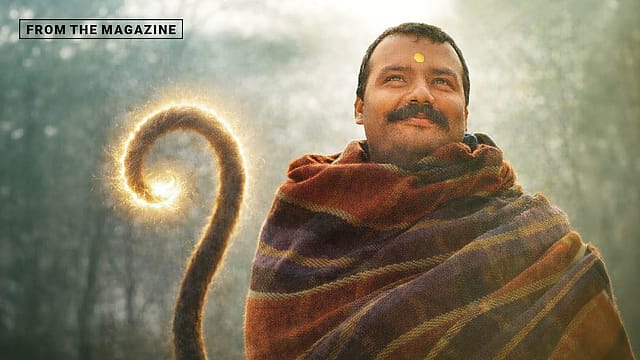
Ragini Sona recalls meeting Neem Karoli Baba as a child when she was in Nainital. She was in the midst of discussing a project with Vishal Chaturvedi and a major star when a scheduling delay led him to suggest a film on the guru in July last year. Chaturvedi was on a trip to Nainital in 2006 when a wrong turn took him to Kainchi Dham where Baba had lived. The producer and director, who first met online during Covid on the Clubhouse app, in a room where they would chant the Hanuman Chalisa from 8AM to 3PM, thought the commonality was a sign from above. They decided to make Hanuman Ansh, a film on his life.
It was a journey which would be a test of their faith in Baba and trust in each other. Ragini transferred Rs 25 lakh into Chaturvedi’s personal account. They assembled a small team and left for Chitrakoot in Uttar Pradesh for a 22-day shoot. But the miracles didn’t stop. The lead actor got diarrhoea on day one and found it impossible to continue. That’s when Chaturvedi took the assistant director, Shobhinaw Satyaa, aside for six hours. Satyaa returned, transformed into Baba, took over the part, and made it his own. On the sets, they had some rules: no abuse, no loud voices, no meat and no drink.

Zeroing In on ECI
09 Oct 2026 - Vol 05 | Issue 41
Constitutional legitimacy versus political opportunism
A year later, the film, made on a budget of Rs 2.8 crore, has made Rs 250 crore, and counting. When the first tranche of money was spent, Ragini asked a friend Namrata G Singh to contribute another sum, and then another friend, the father of Anupriya Nagar, for another Rs 25 lakh for the editing. The film was completed on schedule, because it had to. “We didn’t have any more money,” says Ragini, who had taken the blessings of Baba’s daughter, Girija Devi, who lives in Agra. “And you know what,” says Ragini excitedly, “she connected me with my father, and remembered his name. I had goosebumps.”
Ragini has worked in the Mumbai film industry since 2004, her best known production being Chocolate (2005), directed by Vivek Agnihotri, best known for The Kashmir Files (2022). Agnihotri and Chaturvedi collaborated on a short format, digital talk show called the 10MinDebate, of which they did 82 episodes during Covid. The series featured concise, 10-minute analytical discussions focused on hot-button socio-political issues, media narratives, and current events from an Indo-centric approach.
Agnihotri, who saw the film before its release, says the story appeals to those who are looking for gurus, and the more authentic, the better. Ragini considers both of them her protégés and is not concerned as much with the box-office numbers, as with the number of people who have watched the film. It is a number that keeps increasing. That too, for Ragini, is nothing short of magic. When we released the film with 300 prints on August 7, it was as if it had been put out in a void. Despite their best efforts, the film seemed a nonstarter. That is when she is convinced that Baba intervened again. “We were down to 30 prints, but something told me we had to continue. Cinepolis decided not to pull the film from theatres, Vishal went on an India tour, starting with Gujarat, Jaipur, Lucknow and Agra. Suddenly, the film gained audiences through word-of-mouth.”

Everywhere they went, they found love and appreciation, with Cinepolis reserving the number nine seat for the divine presence of Baba. “The people took up the film,” says Ragini. The film tells his story through a series of adventures, of a young boy named Lakshman Narayan who leaves his Akbarpur home at 13 as a seeker, meditating his way through much of northern India, through Rajasthan and Gujarat. Sometimes he stops to eat at a poor woman’s home, demanding kadi chawal, which miraculously extends to cover all his disciples. Another time, when he is thrown out of a first-class carriage by an Englishman, the train refuses to move until the officious Englishman apologises. Yet another time, he appears as a guide to a believer in Hanuman so he can cross a forest and ensure his brother receives important court papers in time.
The movie ends with Baba walking out on his devotees because he is evicted from his little temple. But in such a manner as to leave enough room for a sequel, which Ragini has announced. The post credits scene details another such magical incident. A langur appears out of nowhere during their shoot, and stays for the duration, convincing them it was Baba’s divine appearance. His philosophy profoundly affected a 19-year-old Steve Jobs who came to India in 1974 seeking Baba who had died a year earlier.
Vamsee Juluri, professor of media studies at the University of San Francisco, who has seen the film, attests to its simplicity and authenticity that has moved millions. As he says: “From the poignant scene of the young hero as a child trying to figure out how to go to god because that’s where his mother has gone, the movie felt like, well, not a movie at all but a reality-roller-coaster-ride, a surging, intense journey in truth; or tattva, or bhaava, or representation and rasa, if you will. Each scene, and for the most part, each frame within those scenes, felt like being in a serene, calm light, full of joy and love and nature.”
Add to that the music, which is uplifting, including passages from Krishna Das, the noted kirtan singer and Baba’s disciple who lent his songs to the movie once he knew of the makers’ intent. “Somehow I felt that the young Neem Karoli Baba was also a young Hanuman, a deity we feel familiar with both as a powerful God in himself and also as our ‘role model’, so to speak, in service, devotion and selflessness to Ram,” adds Juluri, pointing to the round-up of his Hanuman temples around the world during the end credits. He calls it the beginning of the end of the Anthropocene era, where humans have become the single most influential species on the planet.
It could also be that hope and miracles are inversely proportional to each other. When times are dark, people turn to magic. It happened in 1975 with the success of Jai Santoshi Maa, too, when unrest was at its height and black marketing was rampant. Made on a budget of Rs 25 lakh, it crossed Rs 5 crore at the box office then.
The messages Hanuman Ansh carries are emblematic of the Bhakti tradition, where a devotee just surrenders to God, with many small but powerful lessons on agency, responsibility, fairness, generosity, and of course, faith. “It tells us just who we are, what our purpose is, and how somehow both these questions are inevitably answered in a mood of friendship and kindness and love,” adds Juluri.
And it marries myth and memory. It is perhaps how Ramayana was written in ancient times, as a series of incidents, added to by every future generation, embellished perhaps but also memorialised.