Sheeba Chadha: Staying in Character
IN A LONDON MITHAI shop, Tahira (Sheeba Chadha) is meeting her son’s agent for the first time. “Even when he was little, he would say ‘I want a licence to kill,’” she says to her. Tahira turns to her son Shah Latif (Riz Ahmed) to add, “you didn’t tell me your agent was a black lady,” loud enough for the agent to hear.
This scene is from Bait, a new Prime Video series created by Riz Ahmed. It is about a South Asian actor who auditions to play James Bond, the ultimate white male fantasy. It has been well received by critics, but that’s not the only reason Chadha is making waves in the UK and the US. Ahmed has been intensely prolific this year and in his version of Hamlet, Chadha plays Gertrude, his loving but duplicitous mother.
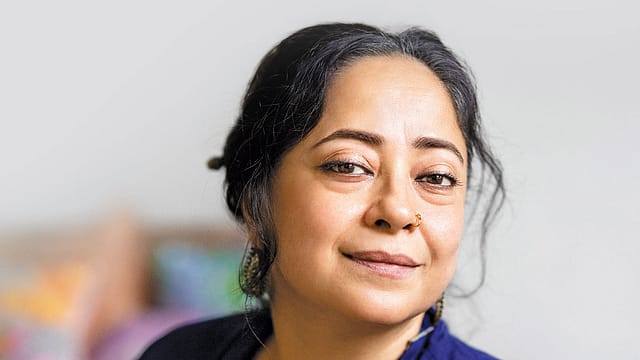
At 54, Chadha is the busiest she has ever been. She is breaking the shackles of the character actor whose brilliance is usually meant to enhance the star, not shine in solitary splendour. Born in Saharanpur and raised in Delhi, Chadha has been acting since she was in her final years at Carmel Convent, a missionary school in Delhi known for producing high-achieving women. Proficiency in dramatics got her admission in Hansraj College, the alma mater of legends such as superstar Shah Rukh Khan and filmmaker Anurag Kashyap, who was her senior by a year.
A move to Mumbai saw her getting small parts in big movies, beginning with Mani Ratnam’s Dil Se (1998) and Sanjay Leela Bhansali’s Hum Dil De Chuke Sanam a year later. Chadha spent many years on the periphery of the film industry, even doing daily soaps to pay the rent. And then less than a decade ago, the tide turned.
“Stories started changing around eight or nine years ago for actors like me,” she says. When I ask what she means by “actors like me”, she retorts, “What do you think? It’s character actors, their age, and how they are positioned”.
Positioning can literally mean the geography of the scene, where the camera is squarely on the central characters and the others are in the background. But Chadha is the kind of actor who can steal a scene even by being a wallflower. See the hesitation in her body vanishing the minute she sees her son weeping helplessly, a marginalised man in need of comfort in Badhaai Do (2022). No words are exchanged, only tears and a warm embrace. Or, in the second season of Bandish Bandits where you can almost see her mentally drawing a Lakshman Rekha around herself as she, the gifted daughter-in-law of a conservative household, finds a responsive spark in Atul Kulkarni’s character as they sing together.
CRIPTS ARE BECOMING more non-formulaic, Chadha says. “There is more breathing space for performances, for nuances, for moments and for psyche to be developed.” She adds, “Thank God for roles like [the mother in] Badhaai Do. As actors the work we do is the work we are offered. We have no way of knowing how the film has shaped. You can read a very good script but it goes through so many stages of creation that you have no control over it.”
Indeed character actors on many sets are treated little better than extras, their time and effort disrespected and disregarded. Not surprisingly Chadha has developed an armour of detachment when speaking about her work, especially her early years in an industry that was even more cruel than it is now. It is not fame that drives her but the quality of work. Her best life, on her day off, is pottering around the house and then watching theatre in the evening. A single mother, she has just turned into an empty nester, with her daughter Noor having left for college, so she is still getting used to the idea of having time to herself.

This has also meant more work coming her way. When we speak on the phone she is on her way to the sets of a series she is shooting for Netflix. There is a Tips movie she is shooting as well. “And then there are ads and a couple of cameos. It is all by the grace of God,” she adds.
Personal questions elicit little information (“Everything is in the public domain,” she says) but ask about her work and she is more forthcoming, especially of work she has enjoyed, such as in Bandish Bandits. Music was at the centre of it, she says joyfully. She can’t sing but she can appreciate it. “From a young age I was not interested in pop and rock. I listened to classical music, but I can’t hold a single sur. And I would lip sync with abandon when filming. I feel bad for the director Anand [Tiwari],” she laughs. “The screenplay was well researched, investigated and the music was not merely for the purists but made palatable for everyone. The team is one of my all-time favourites. And the series is the kind one can watch with one’s family,” she adds.
Her role on Bait happened when talent scout Tess Joseph was casting for Hamlet, the Shakespeare play interpreted by Ahmed in a South Asian setting. Hamlet was shot in December 2023. In six months she was back with Ahmed on the sets of Bait, living in London for three months, shooting episodically. “By then Riz and I had a working relationship,” she says, of her co star and Bait showrunner. “It was such a talented ensemble cast with only one motto: to make the series good,” she adds. Her character Tahira is foul mouthed, jealous of her snooty neighbour and adores her son.
Chadha has had her admirers in and out of the industry for years. Rahul Dholakia had cast her in Parzania (2005), as Akhtari in the 2012 series Laakhon Mein Ek and then later as Shah Rukh Khan’s mother in Raees (2017). Dholakia recalls her audition. “I remember it was 2003 from California and I was casting for Parzania. I was with my writer David Donihue and associate producer Ken Greenblatt. We were at the office of executive producer Munna Rizvi. Rakesh Chaturvedi was the casting director. He had brought in Sheeba. We did the scene where the saffron brigade comes to attack Cyrus’ house in the film and she is hiding in the kitchen. They spot her and she folds her hands, asking for mercy. The attacker has to throw the saffrom gamcha on her, his hate melting in the face of such suffering. I yelled at her in the role of the attacker. Her eyes changed, her body language transformed and the expression was so powerful and moving that I realised how brilliant she was. Everyone clapped at the end of the audition. Then when she performed the scene almost on the last day at Kamalistan, we were all wowed.”
HE CAN BE loud, she can be subtle, her eyes can say everything and also nothing if she wishes. She can snap her body to attention and also let it become soft. If she is the posh South Delhi mother judging Ayushmann Khurrana for his “jaahil” (wild) side in Badhaai Ho (2018), she is also the aunt trying to persuade him to marry an extra large woman so she can help the household financially in Dum Laga Ke Haisha (2015). If she is Kajol’s steely boss in The Trial (2023), not giving her an inch simply because she is a woman, she is also the unapologetic sex worker in Talaash: The Answer Lies Within (2012).
Filmmaker Abhay Punjabi became a fan of Chadha after watching Badhaai Do. “While we were scripting the film Pukam Pukai, there was a character of a politician who had to be a little silly. It had to be her. The first time I narrated the story, it was on Zoom. It is a children’s film and I wasn’t sure she would be interested. But she was giggling through the narration. When she came onboard we realised her quirks are exactly what we imagined and although we were super intimidated when we were on set it was very easy to work with her,” Punjabi says. When the film came out, he was surprised how excited she was about its future. “She is always on her toes to help us. It is going to festivals now and a lot of it is because of her. She gives this little independent film as much importance as Bait and Hamlet,” he adds.
As Chadha chases excellence, pouring her life’s experiences into her work, she brings joy to those who love art and artists. To paraphrase her character Sangeeta’s comment in Badhaai Ho, if Bollywood is a circus, we will always want to buy tickets for her.