'Raakh', starring Sonali Bendre and Ali Fazal, returns to the double murder that shook Delhi in the Seventies
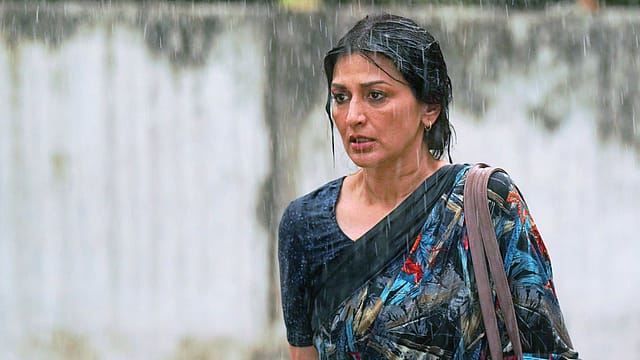
IT IS 1978. Delhi skies at night were clear enough to shine with stars. There is a family lying on a mat on the roof, when it was still not real estate to be monetised by rapacious builders into an additional floor. That is Ashok and Mona Arora, with their children Suman and Sahil. They are looking out for Halley’s Comet, something their mother tells Suman and Sahil they can talk about to their grandchildren long after they’ve gone.
It doesn’t happen. Suman and Sahil are killed soon despite fighting bravely against two men who embody evil.
It is a scene from Raakh, a heart-wrenching new Prime Video series loosely based on the horrific Sanjay and Geeta Chopra murders by Billa and Ranga that changed Delhi forever. This is not the first time Mumbai cinema has dramatised the murders. The murders were the subject of two episodes of Sony TV’s popular true crime show, Crime Patrol, as well as of the Netflix series Black Warrant, based on events in the Tihar Jail in the early ’80s. It was also the subject of a fine book, Fallen City, by Sudeep Chakravarti, which says: “Billa-Ranga, stumbling, bungling, and vicious, remain as symbols of criminality several decades into an uneasy afterlife. That is the nature of evil. It remains long after hope lives and dies.”
Raakh is remarkable in that it travels into the heart of darkness with the series, filming their crimes in gruesome detail, and showing the cruelty of their domestic lives, but it also offers hope in the fictional characters of Sub-Inspector Jayaprakash Jatav (a brilliantly contained Ali Fazal) and in the crime journalist Nisar Rizvi (a sparkling Anshul Chauhan). Both are composites of real life characters. Nisar, in particular, is a mix of journalists Usha Rai, who continues to be a friend of the parents, Madan Mohan and Roma Chopra, and the late Prabha Dutt. As Nisar says to Jatav, a young man exposed to BR Ambedkar’s philosophy from an early age: “Perhaps this is just a hope that in the days to come, the city of Delhi will recover its lost humanity, that our trust in one another will be restored.”
Along with the utterly meaningless acts of savagery, the eight-episode series directed by Prosit Roy shows us the possibility of courage and kindness. The fictional children, younger than Sanjay and Geeta, are full of life—squabbling as teenagers do but also dreamy as they are. The parents are protective, but also full of aspiration for them. Theirs is, and was, the story of every middle-class household, now forever reduced to shorthand for viciousness.
Those who witnessed the barbarity of the Nirbhaya rape in 2012 will not be surprised to know there were protests in 1978 too, from students of Modern School where the sporty Sanjay studied, and from Jesus and Mary College where Geeta was a promising student, as well as other schools and colleges. Prime Minister Morarji Desai was forced by public pressure to meet the grieving Chopras, the police was under immense pressure to solve the case, and the media was asking tough questions every day. Every wish that the feral nature of the Sanjay and Geeta Chopra murders would not be revisited was erased.

August 26, 1978, left many permanent marks on the Capital, some good, some awful. Sunil Gupta, legal advisor, Tihar Jail, where Billa and Ranga were kept till they were hanged till death on January 31, 1982, says for many years the Vande Mataram Marg, along the Central Ridge where the children hitched a ride from Billa and Ranga and were abducted, was called Billa-Ranga Road. “They were the equivalent of Gabbar Singh, the fictional villain from Sholay, which was a huge hit in 1975. The killings struck terror in the hearts of middle-class parents,” he says.
It changed the nature of the Ridge itself, which was regarded as wilderness till then. In fact, the bodies of Sanjay and Geeta were discovered by a goatherd on his rounds. No one trespassed upon the Ridge, except for poor women and men who collected wood from the area for cooking and heating, cajoling or bribing the occasional chowkidar to look the other way. As sociologist Amita Baviskar wrote in Economic and Political Weekly in 2018 on the changing geography of greens in Delhi: “On the Northern Ridge, the domestication of the wilderness took the form of clearing the dense understorey of shrubs and creepers such as bansa, heens, gondni, jangli karaunda, bilan gada and kankera and replacing it with grass. Ornamental plants and shrubs were planted in neat beds. Gravelled walking paths were cut through the forest. A small pond was spanned by a bridge, reeds planted along its banks, and benches placed so that visitors could enjoy the pretty scene. A badminton court was created in a depression near the Flagstaff Tower built by the British in 1828. The ruins of Pir Ghaib, a 14th-century Tughlaq hunting lodge, and Chauburja, a mausoleum from the same period, were spruced up. The Ridge was now accessible and inviting to middle-class citizens.”
But the wildness in the hearts of Delhiites was not so easily tamed as the city grew from an estimated four million in 1978 to more than 24 million now. Raakh shows how the city became the repository of the hurt and the hopeful. It creates a backstory for Babu (a diabolical Akash Makhija) and Rajjo (a docile but equally violent Ramandeep Yadav), underlining how they came to be so depraved. Babu is shown as a difficult child who is stigmatised for his increasingly violent behaviour while growing up in Mumbai. After being sent to a correction home, when he returns as a teenager he is particularly vile to his mother and her baby from her second husband. Rajjo’s family comprises his sister who lives in Sonipat with her abusive husband and her desperate daughter. The scenes, interspersed with images of their previous crimes, are as shocking as what they perpetrate, indicating how society can destroy the humanity in us. At one point Rajjo is called tilchatta (cockroach) and suddenly that brings us right into 2026.
ONE OF THE last scenes Babu and Rajjo have together is in front of the Taj Mahal in Agra, where they are finally caught. It is the last time together as outlaws, and also as two social rejects who had no one except each other. Then too, they are planning ahead, or at least the smarter of the two, Babu, is dreaming of starting a business in far away Kanyakumari. Rajjo, looking at the dome of the monument says, almost wistfully: “What all can one do if one has money?”
In Fallen City, Chakravarti traces an arc of darkness for Delhi from the Emergency to the anti-Sikh riots of 1984. There is a conversation between Ali Fazal’s Sub Inspector and Anshul Chauhan’s journalist where the former tells her that he remembers Delhi when nilgai, deer, and peacocks roamed freely. “Now it has been replaced by the animals in human beings,” he says.
The Delhi High Court judgment of November 16, 1979, in the State vs Jasbir Singh (Billa) and Kuljeet Singh (Ranga) wrote: “Whether we look at the crime or at the criminals the conclusion is irresistible that with the elimination of the appellants the society would be much better off and its safety will no longer be endangered. Indeed, to award any other sentence except death sentence will amount to complete failure of justice. We are in complete agreement with the special reasons given by the trial judge for awarding the death sentence.”
What makes Raakh stand out is that, like Netflix’s Trial by Fire (2023), which focused on the anguish of parents Neelam and Shekhar Krishnamoorthy who lost their young children in the Uphaar fire of 1997, the series lingers on the happy family the Aroras/Chopras once were. As the last episode airs, we are left with an alternative ending where the two teenagers don’t hitch a ride, despite the rain, and race each other to Akashvani Bhavan (called National Radio here) in time for Suman/Geeta’s performance in Yuvavani, a popular radio programme of the time. As she sings, her parents back home sink back in leisure to listen to her, her mother mending a school shirt and her father enjoying a drink. The song is instructive: “If I slip away from your sight/Ask your own heart/I am right here/I am right here.”
It is that voice that must never be smothered by the roar of crime, no matter how inhuman.