People’s Superstar
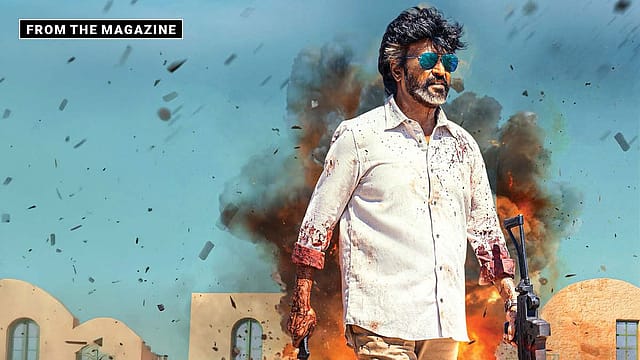
In a scene that will go down as one of the coolest moments in modern Indian cinema, Rajinikanth’s character in Jailer 2, Muthuvel ‘Tiger’ Pandian stares at the bad guy but is in reality addressing us—the audience—with a fat, unlit cigar in his hand. In Tamil he says, in true Rajini style, a smirk spreading over his face: “For 50 years many people in many different ways have tried very hard to finish me.” Then as he sniffs the cigar and the siren-like Jailer theme kicks in, Rajini chuckles and adds: “Yet...”
This is when the Malayalam superstar Mohanlal, standing to his right, tosses him a lighter even as Rajini flips the cigar into his mouth and lights it. Spontaneously and without fail, this is also when auditoriums in Chennai (and perhaps around India) immediately combusted. On the first day of the movie’s release, the theatre in south Chennai was a hooting mess after Rajini’s punchline before turning into a standing ovation.
It is an inside joke alluding to Rajini’s real life, and how he has remained the biggest superstar in south India despite facing incredible hurdles—ranging from rivals within the fraternity to political adversaries. It is also a doff of the hat to his own longevity: how for a little over half a century, a Rajini release has had far wider impact on society at large apart from simply making money for its makers, which Jailer 2 has already earned plenty of. After only the opening weekend, the film had already clocked Rs. 420 crore worldwide and hurtling towards the mythical four-digit mark.
The social phenomenon has, on occasion, spilled so far beyond the cinema that it has altered the working day. When Kabali released in 2016, companies in Chennai and Bengaluru declared a holiday for employees, some even offering free tickets to avoid a mass outbreak of sick leave. One Bengaluru firm called it a “Kabali bonus”, likening the occasion to Diwali. They even took to the skies: AirAsia painted an aircraft with Rajinikanth’s image and flew fans from Kuala Lumpur to Chennai for the firstday-first-show screening. Seven years later, ahead of the first Jailer movie in 2023, offices in both cities gained a day off and distributed tickets.
But what exactly are people celebrating when they celebrate Rajinikanth? The films, certainly. The mannerisms, the dialogue delivery, the improbable physics of a cigarette and/or a chewing gum tossed into the air and caught between his lips. Yet the devotion surrounding him, even today, at the age of 76, suggests that something else is at work.
In Cinema and the Urban Poor in South India (1993), anthropologist Sara Dickey examined Rajinikanth’s fan clubs in Madurai alongside other superstars, his contemporary Kamal Haasan, and Tamil cinema’s very first matinee idol, MG Ramachandran. She found that fans’ descriptions of their heroes repeatedly associated them with the poor while distinguishing them from the wealthy. Rajinikanth’s own journey from bus conductor to superstar was central to this identification. His fans saw a man who had suffered, lived like an ordinary person and continued to do so even after having risen. Has any other acting icon anywhere in the world cared less about his off-screen image, wholly at ease in his wrinkles and bald head?
So much so that while promoting Jailer 2, Rajini was asked how he has remained so humble despite his unprecedented fame and success by filmmaker Nelson Dilipkumar. He replied: “That’s because I don’t identify as a star, I identify as a bus conductor. I mean I like acting, it’s fine, but the job I really loved was being a bus conductor in Bangalore.”
The significance of this identification extended beyond the screen. Fan clubs organised celebrations and social service activities, offering their members a sense of purpose and standing in their neighbourhoods. As Dickey documented, devotion could translate into practical action: helping the poor, organising medical camps and contributing to community needs. The star was not merely someone to admire, he was a figure around whom people could organise their own lives.
Filmmaker Rinku Kalsy and researcher Joyojeet Pal explored this relationship in their 2015 documentary For the Love of a Man. In an interview with the Indian Express, Kalsy observed that many fans came from low-income backgrounds and that belonging to a fan club gave them “a sense of identity and a social standing”. Pal compared the clubs to community festival committees, whose members pool resources and take responsibility for public events. Rajini’s face might dominate a poster, but the people who put it up also found a way to make themselves visible.
Media anthropologist Roos Gerritsen, in Intimate Visualities and the Politics of Fandom in India (2019), examined how Rajinikanth’s images circulate through public spaces and private homes. The posters, murals and billboards are not simply decorations. They connect personal attachments to a shared public identity, while placing the star within the political and cultural landscape of Tamil Nadu.
The appeal has something to do with the body, too. Rajinikanth did not arrive as the conventional Indian film hero: tall, muscular and fair-skinned. In an interview with the Indian Express in 2018, filmmaker SP Muthuraman said Rajinikanth had “broken many stereotypes of a hero”. Rajini developed his own style rather than imitating anyone else. His difference became his signature.
That signature has proved remarkably durable. His screen persona has evolved, but the essential ingredients remain recognisable. He can be the swaggering action hero, the affectionate father or the ageing man who discovers that the world has moved on without him. His fans can celebrate the spectacle while also recognising the person beneath it.
Perhaps that is why his longevity cannot be explained by box-office numbers alone. Last year, Rajini thanked his fans as the “gods who keep me alive”. The language of divinity is hardly incidental in a culture where cinema, devotion and public celebration have long overlapped. But the relationship works both ways. The fans elevate Rajini, and he gives them a figure through whom they can express aspiration, belonging and collective pride.
Fifty-one years after K Balachander’s Apoorva Raagangal introduced him on screen, Rajinikanth is still pulling off the most improbable trick in Indian popular culture: making an entire auditorium believe that, somehow, the joke is on everyone who thought his time was up. The rivals have come and gone, the political fortunes have risen and fallen, the body has aged, but the swagger remains intact. When Tiger Pandian takes that cigar between his lips and gloriously puffs away, the eruption in the theatre is about more than a fictional character refusing to die. It is the audience answering back, completing a punchline that has been half a century in the making.