Patriot Act: Mahesh Narayanan’s digital thriller starring Mommootty and Mohanlal has the resonance of the times
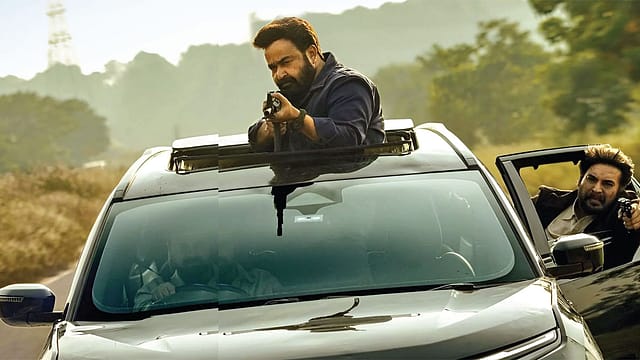
THE MINISTER HAS declared you’re a Great Indian, says Prakash Belawadi’s supine officer to Daniel James (Mammootty), a former scientist with the Department of Research and Welfare. “Am I a Great Indian Patriot or Traitor?” asks Daniel. The scene echoes an earlier one in the new Malayalam film, Patriot, where a fisherman asks Daniel if he is a police officer or a terrorist. His answer: “Patriot”.
Daniel is responsible for having introduced Periscope, a surveillance system that is now being weaponised, not merely by the government but also by its favourite corporates. Daniel runs a vlog, calling himself Dissenter, exposing the misuse of the technology. He is aided in his exposé by an old friend, a soldier who lost his leg in an insurgency, Rahim Naik, played by Mohanlal, and another colleague, Michael Devassy, played by Kunchacko Boban, who is looking for redemption.
It is a tense political thriller, though much of the chatter around it has been hijacked by the casting coup—the reunion of two giants of cinema, lovingly called Mammooka and Lalettan, in their 56th film together. In five days alone, Patriot has clocked `68 crore worldwide, suggesting an appetite both for the two superstars and a plot that marries the controversy over the Israeli software Pegasus with concerns about the emerging military-industrial-political complex. Its scale and scope is ambitious, spanning India and London. And its commentary is about the times we live in, the era of Saudi dissident Jamal Khashoggi and Kim Jong Un’s half-brother Kim Jong Nam.
“What happens when a photo is taken? What happens to the data if it falls into the wrong hands? And is turned against those it is meant to serve,” asks Mahesh Narayanan, explaining the genesis of Patriot, which he started developing in 2023. For Narayanan, it was a throwback to the era of political cinema in Malayalam, symbolised by the partnership of director IV Sasi and writer T Damodaran. He cites their Vartha (1986) as an inspiration for Patriot, where Mammootty plays an upright journalist and Mohanlal a hired thug. “I also wanted to capture the resistance in Costa- Gavras’ movies such as Z and Missing,” says Narayanan. While Z (1969) presents a thinly fictionalised account of the events surrounding the assassination of democratic Greek politician Grigoris Lambrakis in 1963, Missing (1982) was based on the disappearance of American journalist Charles Horman, in the aftermath of the US-backed Chilean coup of 1973, which deposed the democratically elected President Salvador Allende.
You can also trace his enthusiasms to George Orwell’s all-seeing Big Brother in 1984 and the hierarchy in society in Animal Farm, classic texts that continue to inspire the 43-year-old editor-turned-filmmaker. Only the Big Brother is the tech bro played with hyperactive brilliance by Fahadh Faasil and Periscope is being misused just as the revolution in Animal Farm was betrayed.
Patriot has the hum of The Fugitive (1993), the Harrison Ford-starrer classic thriller, or even Alfred Hitchcock’s North by Northwest (1959) starring Cary Grant. One can sense the same rhythm in Patriot as Daniel goes on the run, tracked by his former boss’s colleague, JPS, played with delicious venom by filmmaker Rajiv Menon, who was persuaded by Narayanan to act in the film after a spectacular turn as chief secretary in Vetrimaaran’s Viduthalai: Part 2. “I’ve done 100 ads with Mahesh as editor. When he asked me to act in this film, I told him he is taking a very big risk. But I was intrigued by the scene [spoiler alert] where Fahadh Faasil [who plays his son] talks me into shooting myself. I have always been fascinated by fratricide,” he says.

Menon also mentions the scale of the movie. For the scene where his character confronts the chief minister, played with her usual gravitas by Revathy, he says it was shot at Birla House in Delhi with 400 junior artists. “And each of the extras was provided with a pair of socks because it was winter,” he adds. The cockpit scenes were shot in a Sri Lankan air base, with the actual jet in the hangar. There’s nothing in the film Narayanan hasn’t shot himself, standing by the monitor next to the director of photography. That is his style.
Says SR Praveen, author of the new book, Ticket to Kerala: The Story of Malayalam Cinema: “When Mahesh Narayanan, who has been known for strong plot-driven dramas, gets the two superstars at his disposal, he doesn’t waver much from his usual path. He approaches it just like he did with his previous films, sticking to the core story on surveillance. The stars become tools to take this political story to the masses instead of the film becoming a vehicle for star worshipping.”
Narayanan says he was fortunate that Mammootty and Mohanlal trusted him enough to work with him. “Both are submissive, though they do ask sensible questions,” says Narayanan. He says Mammootty approaches his character like an architect, wants to shape everything, while Mohanlal is more spontaneous. “And regardless of what the fandom thinks, they are very good friends. There is an almost 10-year-gap between the two, and Mohanlal, 65, says Narayanan, considers Mammootty, 74, to be an older brother.”
Patriot is as much a drama about a whistleblower as it is homage to their old style stardom. As Faasil says in one of his impassioned speeches about the two characters, “They have faith, not followers.” The film underlines it repeatedly, whether it is Mammootty and Mohanlal using old style communication techniques like blinking or Morse Code or engaging in hand-to-hand combat. Narayanan says proudly: “There is no ropework in sight.”
THERE IS ALSO great joy in seeing how Mammootty, the fugitive, evades the global surveillance system, using old fashioned intelligence to outwit evil aided by technology, as he crosses borders, domestic and international, skipping highways, tolls and rental cars. There is equal joy in seeing two masters playing old friends onscreen and helping each other, for as Mohanlal’s character says—to help without being asked, isn’t that a soldier’s code? There is immense pleasure in seeing two men still at the top of their game after decades of making movies, still hungry for action and still committed to working non-stop, a template they have set for generations of younger actors.
Malayalam cinema has always had politically-charged narratives, from the 1970s onwards, often overtly and sometimes metaphorically, says Praveen. “Although compared to some of the films of the past, Patriot’s references to issues surrounding Pegasus might seem a tame affair, it still is quite a brave attempt in the current context when most films choose the pro-establishment route rather than raising pertinent questions as Mahesh Narayanan does here,” adds Praveen.
After completing his graduation from University College, Thiruvananthapuram, Narayanan joined MGR Government Film and Television Training Institute in Chennai after which he started working as an advertisement editor. His films have always had a political undertone. His debut feature film, Take Off (2017), was based on the ordeal of Indian nurses in Tikrit, Iraq, in 2014. In 2020, he made C U Soon using a phone, shooting it in Faasil’s flat. He followed this with Malik a year later, also with Faasil, based on the Beemapally riots of 2009. His most recent film, Ariyippu, in 2022, was also on the dangers of too much technology, in this case the workplace.
Divya Prabha worked with Narayanan on Ariyippu and was an intimacy coordinator on Patriot. “I had already experienced working with an intimacy coordinator as an actor during All We Imagine as Light. Through that experience, I realised how much of a difference it makes especially in terms of comfort, clarity, and trust. So when Mahesh, who is a friend and someone I’ve collaborated with before, called me and asked if I could work as an intimacy coordinator on Patriot, it was quite an unexpected call. But I felt I could approach it from my own experience as an actor.”
It is no surprise that Narayanan repeats his actors, who seem to love working with him. As Revathy says, “Mahesh is fabulous to work with. He is very pleasant on the set and knows exactly what he wants.”
Narayanan is mindful of how quickly society is changing, “Cinema is evolving everyday and a script can get dated in six months,” he says. As someone who has spent much of his directorial life chronicling the interplay of politics, technology, culture and society, he is figuring out what he does next. It is a distinct storytelling voice, much needed at a time when political films are becoming difficult to make unless they toe the establishment agenda. If Dhurandhar gave us a hero as an all sacrificing patriot, Patriot gives us the hero as the questioning citizen who refuses to be intimidated by power, whether it dresses up in a crisp khadi kurta or in a sharp, wrinkle-free suit.